Commercial Snow Removal Service Logs: What Property Managers Should Record
A commercial snow removal service log should record where an access concern was observed, when it was observed, what effect it had and what follow-up remains unresolved. Keep those observations separate from work the provider reports completing. That distinction makes the log useful when someone else needs to understand the issue or continue the conversation.
Use the log as a factual handoff record during and after a snow-service event, not as a substitute for the agreed service scope. The blank structure below is an optional property-management tool, not a description of ACME’s reporting system or a contractual requirement.
Separate observations from confirmed service information
A condition observed after a service visit does not, by itself, establish what happened during that visit. Likewise, a provider’s completion message may concern a particular task or area rather than the entire property. Label each entry by its source and preserve any limits in the information.
- Manager observation: Record what you personally saw, the observation time and the exact location. If someone else reported it, identify that source instead.
- Provider-reported work: Record the task and location the provider identified, who supplied the information and when the update was received. Keep a reference to the original message or record.
- Awaiting confirmation: State what remains unknown, such as whether a particular location was included in the reported work or whether further action has been agreed.
Note An incomplete log is not proof that work did or did not occur. Recordkeeping also does not establish that a property is safe, determine responsibility or resolve liability.
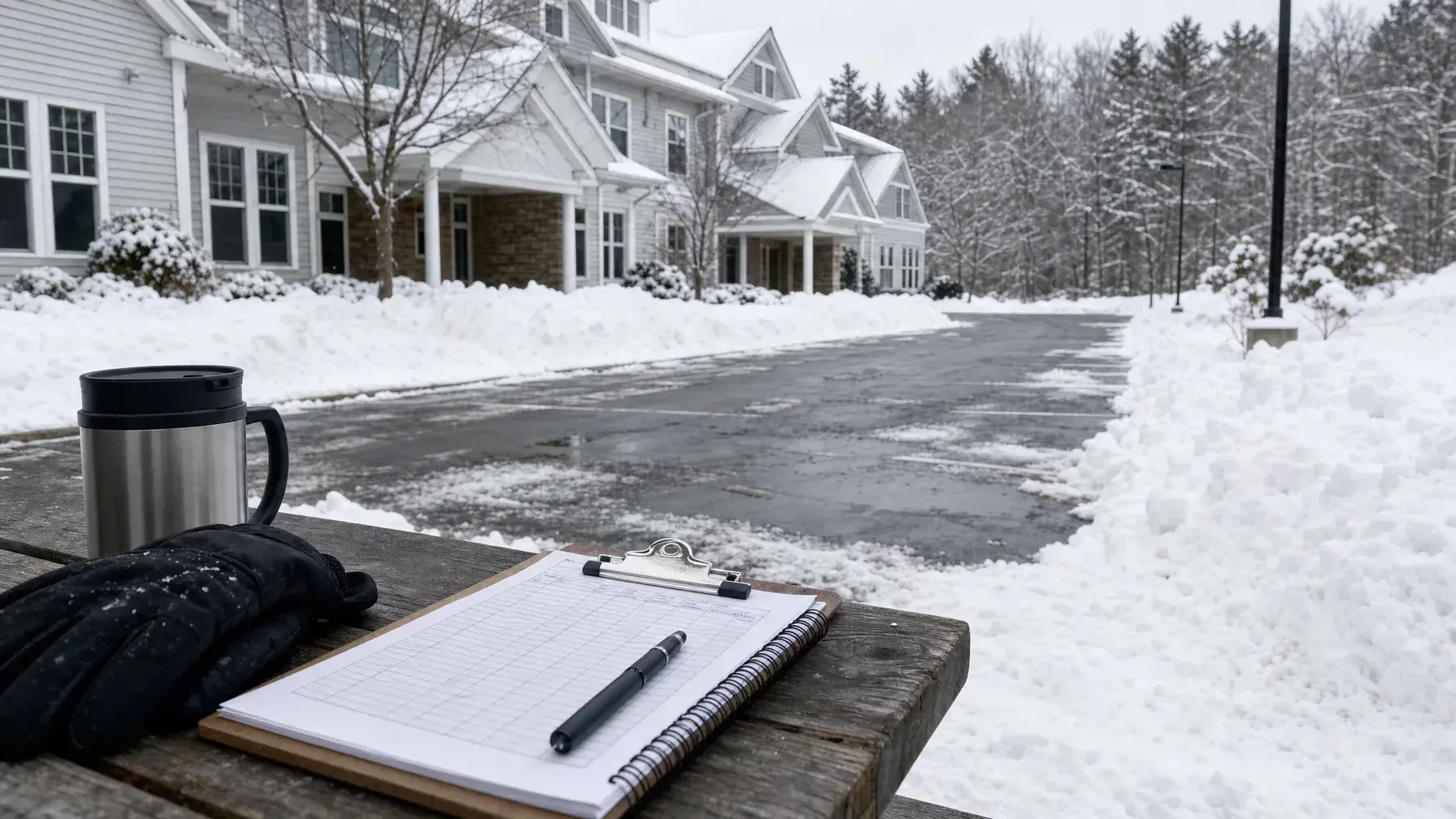
Reusable commercial snow-service event log
Copy these fields into a document or spreadsheet. Keep distinct concerns in separate entries so an answer about a parking area does not accidentally close an unresolved entrance issue. Use consistent location labels across notes, photos and provider messages.
- Property and event reference: Enter the property name and address, along with the event label used in your records.
- Entry author and information source: Enter the author’s name and role. Identify whether this is a direct observation or name the person who reported the concern.
- Observation time: Record when the condition was seen and when it was reported or entered, if different.
- Exact location: Identify the building, entrance, parking section or route and a nearby fixed landmark.
- Observed condition: Describe plainly what the identified observer saw, without inferring cause, responsibility or prior service activity.
- Access impact: Identify the affected route or activity and describe the observed limitation or reported operational concern.
- Available photos: Record file references, capture times if known and the location shown. Note if photos are not available or could not be obtained safely.
- Provider-reported work: Record the task and location reported, the source and time of the update, and the original message reference. Mark information awaiting confirmation where needed.
- Contact notified: Record the recipient’s name and role, contact method, time sent and any acknowledgment received.
- Requested clarification or action: State the specific question or request and any property-side access information needed.
- Reply and agreed next step: Record what was confirmed, who will act and any timing actually agreed. Note when timing is not confirmed.
- Follow-up status: Mark the entry as open, awaiting clarification, awaiting action or closed. Identify the person tracking it and record the latest update and basis for closure.
Describe the access concern without diagnosing its cause
Build the description around location, condition and operational impact. A location should let the recipient find the concern without guessing. The condition should describe what was visible. The impact should explain which route or activity was affected, while distinguishing an observed obstruction from a concern that still needs checking.
Avoid turning an observation into a conclusion about service quality, cause or responsibility. If you did not witness the work, do not state that an area was skipped. If you cannot identify a surface condition confidently, describe its appearance and request clarification rather than diagnosing it.
Keep the observation time separate from a reported service time. If conditions are observed again later, add a new update rather than replacing the earlier note. This preserves the sequence without implying that the condition stayed unchanged between observations.
Do not enter an affected route or approach operating equipment just to complete the log. If photos cannot be obtained safely, record that limitation and communicate the concern without them.
When photos are available, include enough surrounding context to identify the location and connect each file to its entry. Distinguish the capture time from the time the image was received. Treat a photo as a view of a particular place and moment, not proof of the condition elsewhere or of what work occurred earlier.
Track the request through acknowledgment and follow-up
Send the relevant entry through the contact route agreed for the property. Ask a specific question tied to the location and concern. Record whether the recipient acknowledged the message, answered the question or agreed to an action. Those are different stages, and acknowledgment alone should not close the item.
- If the reply is incomplete, preserve the confirmed information and identify the remaining question.
- If action is agreed, record the responsible contact and the terms actually confirmed. Do not turn a request into a promised visit.
- If the provider reports completion, retain that update separately from any later property-side observation.
- When closing the entry, state the basis for closure and any limitation. Closing a follow-up item is not a declaration that the entire property is safe.
Do not delay urgent communication to finish a form. Use the property’s established urgent-contact procedure when the concern requires it, then add the communication details to the record.
Review recurring locations without assuming the remedy
If the same location appears in multiple event records, bring the entries and corresponding provider replies to a discussion. Ask what needs clarification about access, location labels or the agreed work. The log can make that discussion more specific, but recurrence alone does not establish the cause or mean a contract change is required.
Keep related planning tasks separate from event follow-up:
- Use the pre-season site-walk checklist to prepare property layout and access details.
- Refer to the snow-removal proposal comparison guide when evaluating proposed scope and responsibilities.
- Use the tenant communication plan for occupant notices rather than treating the internal service log as a tenant update.
ACME offers commercial snow plowing and winter lot management. For information about that service, visit the commercial snow removal page. Keep your event log focused on what was observed, what was confirmed and what still needs an answer.