How to Remove Road Salt From Concrete After a New Hampshire Winter
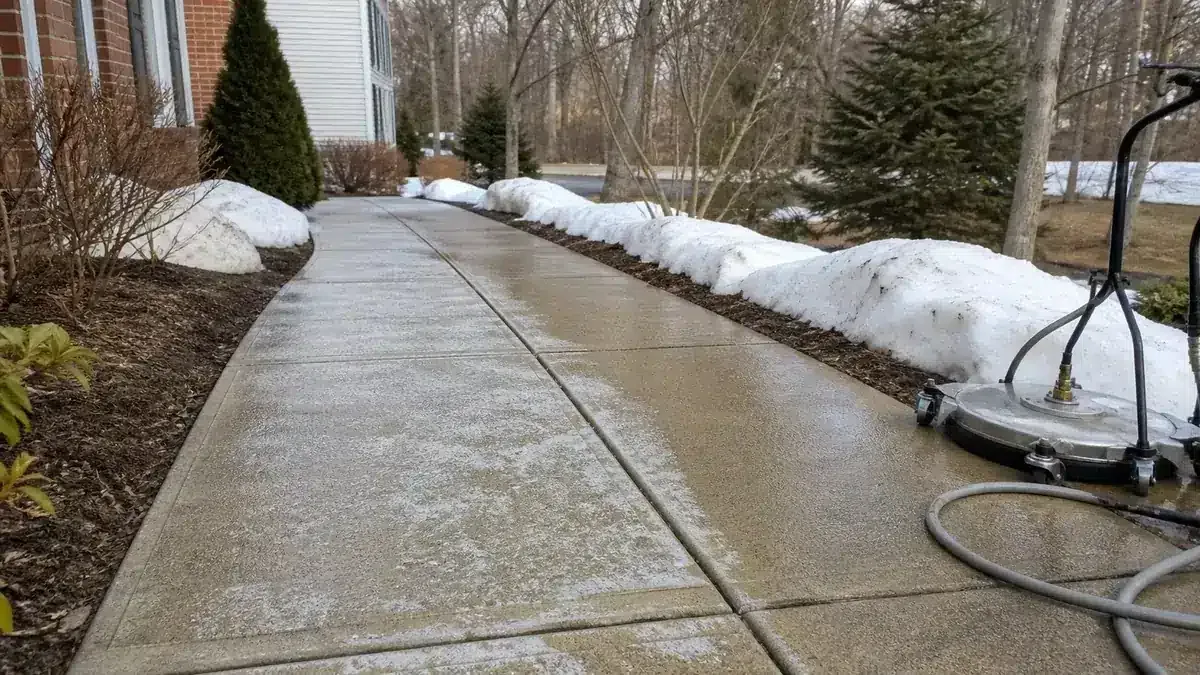
If you are deciding how to remove road salt from concrete, start with a dry surface and a diagnosis—not maximum pressure. Sweep away loose crystals, test a small section, control where the wash water goes, and let the slab dry before judging the result. A white film that disappears is a cleaning problem; flaking, scaling, or cracks are repair signals.
That distinction matters after a Merrimack winter. Deicers can leave a removable residue, but the Federal Highway Administration also reports links between chemical deicers and concrete pavement distress. Cleaning can remove contamination; it cannot reverse material loss. See the FHWA publication summary on deicers and concrete deterioration.
First, decide whether you see residue or damage
Inspect the concrete when it is fully dry. Wet concrete can hide the contrast that tells you whether the surface is actually clean.
| What you see | Likely issue | Best next step |
|---|---|---|
| Loose white crystals along joints or edges | Dry salt residue | Sweep or vacuum before introducing water. |
| A flat white haze that lightens during a small rinse test | Surface residue | Clean in controlled sections, then reassess after drying. |
| White material that returns from within damp masonry | Possible mineral movement, not simply tracked-in salt | Pause and identify the moisture source before repeated washing. |
| Pitting, flakes, exposed aggregate, cracks, or a soft surface | Concrete deterioration | Document the condition and seek a concrete-repair opinion before aggressive cleaning. |
Do not diagnose by color alone. Winter salt, natural mineral deposits, old sealer, and physical surface loss can all look pale from several feet away. A small, low-impact test is more useful than immediately treating the entire walk or pad.
A practical road-salt cleanup sequence
1. Choose a workable weather and drainage window
Wait until the concrete is thawed and the surrounding drains, snowbanks, and low areas can be evaluated. Avoid starting when rinse water could freeze on a walkway or refreeze overnight. Before wet work, identify where water will travel and what lies downhill.
2. Remove dry material first
Use a stiff outdoor broom or a suitable vacuum to collect loose salt and winter grit. This keeps you from dissolving and spreading material that could have been removed dry. Pay attention to control joints, the base of steps, garage thresholds, and curb edges.
3. Photograph and test a small area
Take a dry reference photo, then rinse a discreet section with clean water and modest agitation. Include both the stained area and an adjacent reference area. If the test exposes scaling, changes a coating, or sends water somewhere you cannot control, stop before enlarging the work zone.
4. Work from the clean boundary toward collection
Divide larger flatwork into manageable sections. Keep the cleaning pattern even rather than lingering on one pale mark. Move suspended residue toward a planned collection point instead of chasing it across the slab or into landscaping.
Wash water deserves a plan. EPA guidance for businesses says to block storm drains before pressure washing buildings or equipment and collect the wash water; it also warns against washing automotive fluids and grease from lots into storm drains. Review the exact EPA pollution-prevention guidance for outdoor cleaning and follow applicable local requirements for your property.
5. Rinse the section completely
A half-rinsed section can simply move dissolved salt to its edge. Use controlled passes and recover or direct water according to the site plan. Protect door thresholds, plant beds, painted surfaces, metal fixtures, and adjacent materials from overspray.
6. Let the slab dry before deciding
Compare the dry test section with the reference photo. If the haze is gone and the surface remains sound, continue the same controlled process. If white material returns, the appearance stays uneven, or the surface sheds material, more pressure is not the answer.
What not to do
- Do not start by holding a concentrated jet close to the concrete.
- Do not treat every white deposit as road salt.
- Do not clean a coated or sealed surface without identifying the finish and testing compatibility.
- Do not wash oily parking residue, winter grit, or unknown contaminants into a storm drain.
- Do not keep repeating wet passes on concrete that is flaking or soft.
When professional assessment is the better next step
Bring in help when the area is large, traffic cannot be safely separated, drainage is complicated, a sealer or coating is present, or the concrete shows deterioration. A useful assessment should separate cleaning scope from repair scope and account for adjacent materials and water recovery.
For broader technique and damage-avoidance context, read ACME’s guide to avoiding common concrete power-washing mistakes. If the affected surface is a patio, path, or entry walk in Southern New Hampshire, review the walkway and patio cleaning service to see whether the surface and access conditions fit a professional cleaning scope.
The goal is not to make wet concrete look briefly darker. It is to remove recoverable residue, protect a sound surface, and recognize when winter has left a condition that cleaning alone cannot solve.