If you are deciding how to remove road salt from concrete, start with a dry surface and a diagnosis—not maximum pressure. Sweep away loose crystals, test a small section, control where the wash water goes, and let the slab dry before judging the result. A white film that disappears is a cleaning problem; flaking, scaling, or cracks are repair signals.
That distinction matters after a Merrimack winter. Deicers can leave a removable residue, but the Federal Highway Administration also reports links between chemical deicers and concrete pavement distress. Cleaning can remove contamination; it cannot reverse material loss. See the FHWA publication summary on deicers and concrete deterioration.
First, decide whether you see residue or damage
Inspect the concrete when it is fully dry. Wet concrete can hide the contrast that tells you whether the surface is actually clean.
| What you see | Likely issue | Best next step |
|---|---|---|
| Loose white crystals along joints or edges | Dry salt residue | Sweep or vacuum before introducing water. |
| A flat white haze that lightens during a small rinse test | Surface residue | Clean in controlled sections, then reassess after drying. |
| White material that returns from within damp masonry | Possible mineral movement, not simply tracked-in salt | Pause and identify the moisture source before repeated washing. |
| Pitting, flakes, exposed aggregate, cracks, or a soft surface | Concrete deterioration | Document the condition and seek a concrete-repair opinion before aggressive cleaning. |
Do not diagnose by color alone. Winter salt, natural mineral deposits, old sealer, and physical surface loss can all look pale from several feet away. A small, low-impact test is more useful than immediately treating the entire walk or pad.
A practical road-salt cleanup sequence
1. Choose a workable weather and drainage window
Wait until the concrete is thawed and the surrounding drains, snowbanks, and low areas can be evaluated. Avoid starting when rinse water could freeze on a walkway or refreeze overnight. Before wet work, identify where water will travel and what lies downhill.
2. Remove dry material first
Use a stiff outdoor broom or a suitable vacuum to collect loose salt and winter grit. This keeps you from dissolving and spreading material that could have been removed dry. Pay attention to control joints, the base of steps, garage thresholds, and curb edges.
3. Photograph and test a small area
Take a dry reference photo, then rinse a discreet section with clean water and modest agitation. Include both the stained area and an adjacent reference area. If the test exposes scaling, changes a coating, or sends water somewhere you cannot control, stop before enlarging the work zone.
4. Work from the clean boundary toward collection
Divide larger flatwork into manageable sections. Keep the cleaning pattern even rather than lingering on one pale mark. Move suspended residue toward a planned collection point instead of chasing it across the slab or into landscaping.
Wash water deserves a plan. EPA guidance for businesses says to block storm drains before pressure washing buildings or equipment and collect the wash water; it also warns against washing automotive fluids and grease from lots into storm drains. Review the exact EPA pollution-prevention guidance for outdoor cleaning and follow applicable local requirements for your property.
5. Rinse the section completely
A half-rinsed section can simply move dissolved salt to its edge. Use controlled passes and recover or direct water according to the site plan. Protect door thresholds, plant beds, painted surfaces, metal fixtures, and adjacent materials from overspray.
6. Let the slab dry before deciding
Compare the dry test section with the reference photo. If the haze is gone and the surface remains sound, continue the same controlled process. If white material returns, the appearance stays uneven, or the surface sheds material, more pressure is not the answer.
What not to do
- Do not start by holding a concentrated jet close to the concrete.
- Do not treat every white deposit as road salt.
- Do not clean a coated or sealed surface without identifying the finish and testing compatibility.
- Do not wash oily parking residue, winter grit, or unknown contaminants into a storm drain.
- Do not keep repeating wet passes on concrete that is flaking or soft.
When professional assessment is the better next step
Bring in help when the area is large, traffic cannot be safely separated, drainage is complicated, a sealer or coating is present, or the concrete shows deterioration. A useful assessment should separate cleaning scope from repair scope and account for adjacent materials and water recovery.
For broader technique and damage-avoidance context, read ACME’s guide to avoiding common concrete power-washing mistakes. If the affected surface is a patio, path, or entry walk in Southern New Hampshire, review the walkway and patio cleaning service to see whether the surface and access conditions fit a professional cleaning scope.
The goal is not to make wet concrete look briefly darker. It is to remove recoverable residue, protect a sound surface, and recognize when winter has left a condition that cleaning alone cannot solve.
A vinyl siding pre-wash inspection helps a Southern New Hampshire homeowner separate ordinary surface soil from conditions that need repair, testing, or special protection before exterior cleaning begins. The goal is not to choose pressure settings or cleaning chemistry. It is to document the house accurately enough for a safer, clearer project plan.
For a broader explanation of siding-cleaning methods and common risks, read ACME’s vinyl siding cleaning guide. Use the checklist below to prepare for a property review without repeating that how-to guidance.
Walk the property before anything is moved or covered
Start with a slow walk around the building in daylight. Take one wide photo of each wall, then closer photos of damaged panels, open joints, stains, fixtures, and areas where runoff could collect. Include the ground below the siding so plants, decks, patios, window wells, and neighboring property are visible.
| Inspection area | What to record | Why it belongs in the project plan |
|---|---|---|
| Panels and seams | Cracks, loose pieces, warping, gaps, and prior repairs | Existing damage may need repair or a restricted work area |
| Windows and doors | Failed caulk, damaged trim, loose screens, and known leaks | Openings may need protection and reduced water exposure |
| Fixtures and utilities | Outlets, lights, cameras, vents, meters, and exposed wiring | The work plan must identify items that cannot receive direct application |
| Surface condition | Oxidation, chalking, paint, algae, rust, soot, and irrigation staining | Different conditions can require testing and different expectations |
| Surroundings | Plants, painted trim, decks, masonry, vehicles, slopes, and drains | Protection and runoff planning depend on what is below and beside the siding |
Mark conditions that should pause routine cleaning
A checklist should flag situations that need a closer review before ordinary exterior cleaning proceeds. Examples include visibly loose siding, open electrical components, active water entry, severely deteriorated trim, unstable access, and an unknown coating that reacts during a small test.
Documenting a concern does not diagnose the building or prescribe a repair. It gives the homeowner and contractor a shared record of what was visible before work and what needs a separate decision.
Build a useful photo set
- Photograph each elevation from far enough away to show the full work area.
- Add close views of damage, staining, openings, and delicate adjacent finishes.
- Include a reference object or wider view when the size or location is hard to understand.
- Note which side of the house each photo shows.
- Record recent leaks, repairs, painting, or previous cleaning that may not be obvious in a photo.
Keep the photos together and avoid editing away color variation. A consistent record helps distinguish pre-existing condition from the expected cleaning result.
Prepare questions for the estimate
Ask how the proposal addresses the specific conditions you documented. Useful questions include which areas will be tested first, what will be protected, how runoff will be managed, which conditions are outside the cleaning scope, and what result is realistic for oxidation, fading, or permanent material damage.
The written scope should identify exclusions as clearly as the work itself. Cleaning can address removable contamination, but it cannot restore faded material, repair impact damage, or correct water intrusion.
Use the checklist as a planning record
Save the inspection notes, photos, and proposal together. After the project, compare the same elevations under similar light. This creates a practical record without turning a homeowner checklist into a do-it-yourself operating guide.
ACME Pressure Washing provides house washing services in Southern New Hampshire. A property review can use this pre-wash record to define protection needs, test areas, exclusions, and realistic cleaning expectations.
Roof cleaning cost in Southern New Hampshire depends on much more than the visible square footage. Roof geometry, pitch, height, access, growth, material, water control, protection, and the cleaning method all affect the scope. A useful estimate explains those conditions instead of offering a price that cannot account for the property.
A 2026 roof-cleaning planning range
For a planning benchmark, Angi’s 2026 national cost data places many professional residential roof-cleaning projects between $296 and $626, with a wider reported range of about $150 to $1,000 as roof size, access, material, and cleaning method change. This is not ACME Pressure Washing pricing or a Southern New Hampshire quote. It is a sourced market reference that helps a homeowner recognize why a simple, accessible roof and a steep, multi-level roof should not be budgeted the same way. See the current 2026 roof-cleaning cost data for the underlying national ranges.
ACME owner Lionel Greenwood reports providing exterior cleaning across New Hampshire since 1988. That local experience matters when an estimate must account for wooded lots, seasonal organic growth, roof access, and property protection in communities such as Merrimack, Nashua, and Bedford. The final price still needs to come from an inspection of the actual roof.
Start with the roof, not the house footprint
A two-story house with dormers, valleys, porches, and several roof levels can require more setup and controlled access than a larger one-story home with a simple gable. Measure or estimate the actual roof surface and note every section that changes the work path.
| Cost factor | What the estimator evaluates | Why it changes the scope |
|---|---|---|
| Pitch and height | Roof slope, number of stories, and work positioning | Affects access, setup, and safety controls |
| Geometry | Dormers, valleys, additions, skylights, and short planes | Creates more edges, transitions, and separate work zones |
| Roof material | Material type, age, condition, and manufacturer limitations | Determines whether and how the surface can be cleaned |
| Growth and staining | Coverage, thickness, location, and likely treatment needs | Affects dwell time, repeat treatment, and rinsing plan |
| Property protection | Plants, siding, windows, decks, patios, ponds, and runoff paths | May require wetting, covering, collection, or additional crew attention |
| Access | Driveway, setbacks, gates, slopes, and obstacles | Controls equipment placement and hose routing |
Distinguish staining from roof damage
Dark streaks, lichen, moss, debris, and ordinary aging do not require the same response. Cleaning cannot repair missing shingles, failed flashing, exposed fasteners, soft decking, or a worn-out roof covering. A proposal should note visible damage that needs roofing evaluation before cleaning.
Ask which cleaning method is proposed
The term “pressure washing” is often used broadly, but roof cleaning should be matched to the roofing material and its condition. Ask the contractor to name the process, application pressure, treatment, dwell time, rinse approach, and any manufacturer restrictions considered. More force is not a substitute for the right method.
Include protection and cleanup
The estimate should explain how surrounding plants and finished surfaces will be protected, how runoff will be managed, and what cleanup is included. Downspouts, low roofs, gutters, decks, and landscape beds can concentrate water or treatment. The crew also needs a plan for hoses and access around occupants and vehicles.
Use a no-surprises quote checklist
- Which roof sections are included?
- Is gutter or debris removal included or separate?
- What visible condition could change the work?
- What method will be used on this roof material?
- How are plants, siding, windows, and hardscape protected?
- Is a return visit included if treatment continues to work over time?
- What conditions would postpone the service?
- Does the quote include cleanup and final inspection?
Why a planning range cannot replace a site review
Two addresses with similar living area can have different roof areas, slopes, stories, and access. Photos can help establish a preliminary scope, but hidden roof planes, rear additions, vegetation, and water access may only become clear on site. Use the published benchmark to plan, then use a property-specific written estimate to decide.
Roof cleaning cost questions
Is soft washing priced differently from pressure washing?
It can be. The correct method depends on the roof material and condition, while chemical treatment, dwell time, controlled application, and plant protection can change labor and material needs. The estimate should name the proposed method instead of treating every roof as a high-pressure washing job.
What can push a roof-cleaning estimate above the planning range?
Large roof area, steep pitch, multiple stories, complex valleys or dormers, difficult equipment access, heavy moss or lichen, delicate materials, and extensive runoff or landscape protection can all expand the scope. Needed roof repairs should be separated from the cleaning proposal.
What should be included in a written roof-cleaning quote?
Look for the included roof sections, cleaning method, treatment and rinse plan, property-protection steps, cleanup, weather limits, expected result, and any condition that could change the price. A clear scope is more useful than comparing totals without knowing what each contractor included.
ACME Pressure Washing provides roof cleaning services in Southern New Hampshire. A property-specific estimate can identify roof condition, access, protection needs, and the method proposed for the actual surface.
Understanding Roof Cleaning: Pressure Washing vs. Soft Washing
When property managers and building owners in Bedford, NH, Merrimack, NH, and Manchester, NH look up at their commercial structures or multi-family properties, seeing dark growth on the shingles often prompts an immediate desire to blast it away. However, understanding the technical distinction between standard high-pressure washing and dedicated soft washing is the first step toward maintaining structural integrity.
Standard pressure washing relies purely on mechanical force-often between 1,500 and 4,000 PSI (pounds per square inch)-to dislodge grime. While this high kinetic energy is excellent for concrete sidewalks or steel equipment, it is inherently destructive to standard roofing materials. In contrast, soft washing replaces high mechanical force with targeted chemical action. A soft wash delivery system operates at a low pressure threshold, typically between 50 and 150 PSI (similar to the output of a standard garden hose nozzle).
Instead of stripping away stubborn biological growth using sheer force, soft washing applies specialized cleaning solutions that break down organisms like Gloeocapsa magma (the cyanobacteria responsible for black roof streaks), moss, and lichen down to their cellular root structures. To learn more about how chemical treatments safely resolve biological staining, read the ultimate guide to soft washing algae removal.
| Cleaning Parameter | Traditional High-Pressure Washing | Low-Pressure Soft Washing |
|---|---|---|
| Operating Pressure | 1,500 to 4,000+ PSI | 50 to 150 PSI |
| Primary Cleaning Mechanism | High kinetic force / mechanical impact | Chemical treatment + gentle rinse |
| Shingle Granule Preservation | High risk of stripping granules | 100% protective granule retention |
| Protection Longevity | 6 to 18 months (spores remain) | 2 to 5 years (kills root spores) |
| Manufacturer Compliance | Prohibited by ARMA, GAF, Owens Corning | Fully endorsed standard method |
Materials That Can and Cannot Handle High Pressure
Every roofing substrate reacts differently to water pressure. Using the wrong application method on delicate materials causes immediate, irreversible damage.
- Asphalt Shingles: Asphalt shingles cover roughly 80% of American buildings. These shingles rely on embedded ceramic granules to block ultraviolet (UV) radiation and shield the underlying asphalt membrane. High pressure instantly strips these granules, dramatically shortening shingle life. For a deeper breakdown on shingle vulnerabilities, see our article on can you power wash shingles risks and safer alternatives.
- Concrete Tile: Concrete tiles can withstand higher mechanical impact (roughly 1,200 to 2,000 PSI) when handled by a skilled professional. However, excessive force can wear away protective surface paint or anti-fungal coatings.
- Metal Roofs: Standing seam and corrugated metal roofs handle 1,200 to 1,500 PSI well, provided wide 40-degree spray tips and pH-neutral solutions are used to avoid scratching protective anti-corrosion coatings.
- Clay Tile & Slate: Clay tiles and natural slate are highly brittle. While clay might tolerate controlled pressure around 1,000 to 1,800 PSI, improper angles can crack expensive tiles or force water past interlocks. Soft washing remains the superior protocol.
- Cedar Shake: High pressure gouges natural wood fibers, creating “fuzzing” and splitting the wood grain. Cedar shakes require specialized low-pressure chemical restoration.
Why High Pressure Voids Manufacturer Warranties
Major asphalt shingle manufacturers-including industry leaders like GAF and Owens Corning-as well as the Asphalt Roofing Manufacturers Association, explicitly prohibit high-pressure washing above 100 PSI on asphalt shingles.
A standard asphalt shingle roof represents a major asset designed to last 20 to 30 years. Blasting asphalt shingles with a 2,500 PSI pressure washer strips away the protective granule layer. Granule loss leaves the underlying asphalt backing exposed to intense solar heat and UV degradation, causing shingles to curl, cup, and crack.
Furthermore, blasting high-pressure streams upwards forces water under the shingle overlaps, tearing the factory adhesive seal, saturating the underlayment, and inviting hidden structural rot within the roof decking. When a manufacturer inspects a compromised roof and detects pressure-induced granule loss or dislodged adhesive strips, the warranty is instantly voided. Practicing safe pressure wash roofs techniques guarantees full warranty compliance while preserving the property’s envelope.
5 Steps to Safe Pressure Wash Roofs (The Soft Wash Method)
Executing a successful low-pressure roof cleaning requires strict adherence to a professional, systematic workflow. Here is the step-by-step soft wash protocol we utilize across commercial and multi-family structures in Nashua, NH, Londonderry, NH, and Amherst, NH.
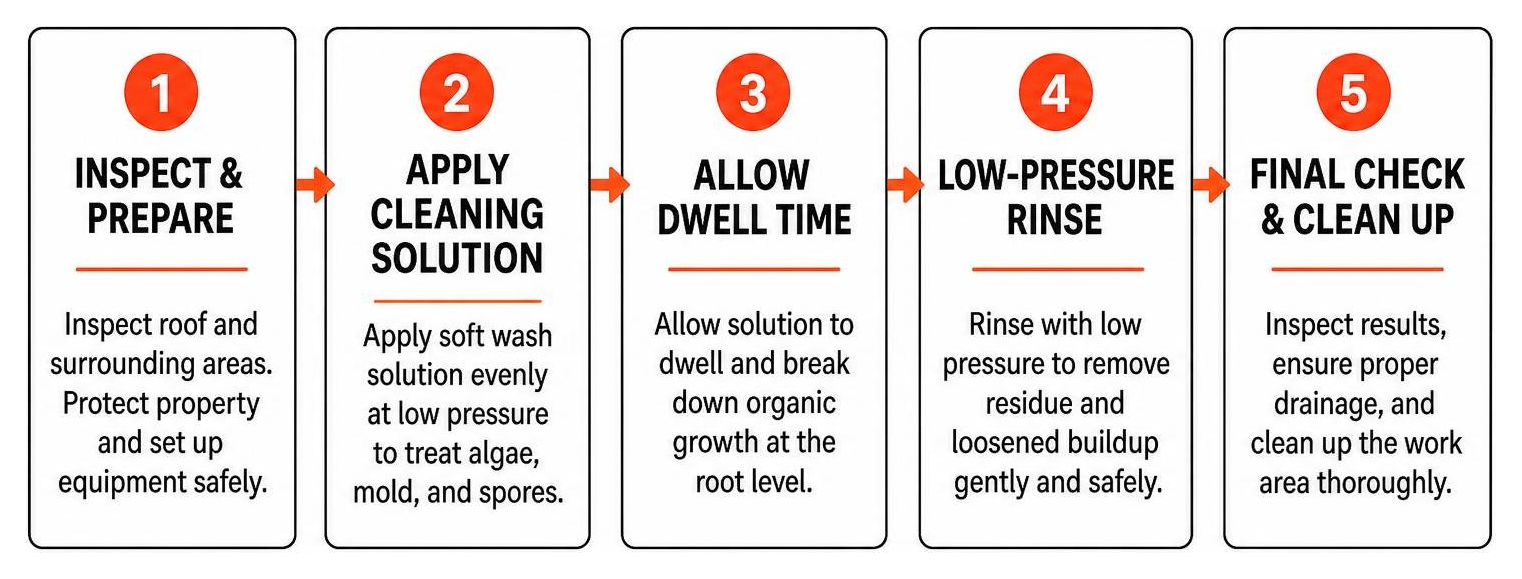
Step 1: Perform Ground Inspection and Gear Setup for Safe Pressure Wash Roofs
Before assembling equipment, conduct a complete ground-level perimeter inspection using high-powered binoculars. Examine the eaves, fascia, gutters, and shingle courses for pre-existing damage, loose shingles, exposed nail heads, or compromised flashing.
Set up commercial-grade ladder safety systems. Secure ladders at a strict 75-degree angle, extending at least 3 feet above the roof line, and equip ladder stand-offs (stabilizers) fitted with padded foam arms to prevent crushing edge trim or damaging metal gutters.
For high-eave access or steep roof slopes, technicians must attach personal fall arrest systems (PFAS), including full-body safety harnesses, shock-absorbing lanyards, and certified roof anchors conforming to strict OSHA standards.
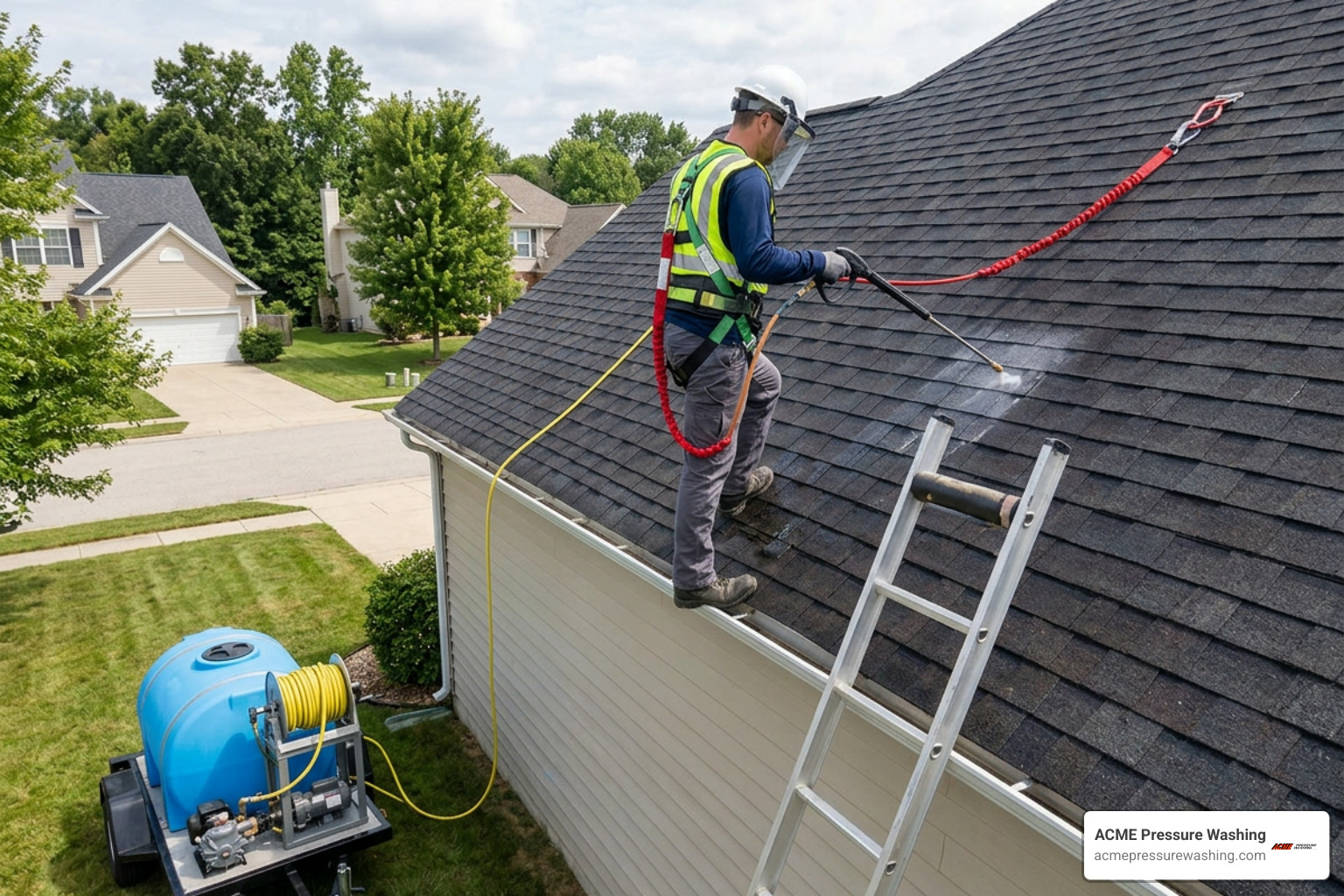
Step 2: Protect Surrounding Landscaping and Property
Roof cleaning chemical solutions effectively break down organic growth, meaning surrounding plant life must be thoroughly protected.
- Pre-Soak Vegetation: Spray all surrounding trees, shrubs, foundation plantings, and turf grass heavily with clean, fresh water before applying any cleaning agents. Saturated leaves and soil cannot absorb chemical runoff.
- Tarp Sensitive Species: Cover delicate ornamental plants and garden beds with breathable protective tarps or polyethylene sheeting.
- Manage Gutter Runoff: Direct downspout outlets away from landscaping beds. Attach flexible extension pipes to downspouts to collect runoff directly into containment vessels or guide it safely into storm management areas.
- Maintain Continuous Rinsing: Keep an auxiliary team member on the ground continuously flushing foliage and exterior siding with clean water throughout the entire chemical application phase.
Step 3: Mix and Apply the Safe Pressure Wash Roofs Cleaning Solution
The core of low-pressure roof cleaning lies in chemistry rather than mechanical force. The industry standard cleaning solution utilizes sodium hypochlorite (SH) blended with dedicated surfactant agents.
For effective treatment of biological growth, prepare a soft wash solution containing approximately 3% to 5% active sodium hypochlorite combined with a specialized, high-foaming roof surfactant. The surfactant reduces surface tension, allowing the solution to cling to steep shingle slopes rather than immediately running off. For detailed insights on identifying organic roof stains, read our guide on black streaks on roof causes and cleaning.
Apply the mixture using a dedicated low-pressure chemical pump (such as a 12-volt diaphragm pump or specialized downstream injection setup) delivering 50 to 150 PSI. Always apply the solution starting from the lower eave line and work upward toward the ridge line. Applying chemical bottom-to-top prevents dirty runoff from running down dry shingles, which can create permanent uneven chemical trail marks.
Step 4: Allow Proper Chemical Dwell Time
Once applied, allow the solution a dwell time of 15 to 30 minutes. During this active dwell phase, the chemical oxidation process takes place:
- Gloeocapsa magma algae cells are completely sanitized at the cellular root level, transitioning from dark black or green to a clear or light translucent state.
- Lichen clusters absorb the surfactant mixture, releasing their calcified grip on the shingle granules.
- Moss structures absorb the active solution, neutralizing active spores and beginning a natural decomposition process.
Never allow the chemical solution to dry completely on the roof surface. If warm weather or direct sunlight accelerates drying, mist the roof surface lightly with a thin coat of additional soft wash solution to maintain active moisture levels.
Step 5: Rinse Gently from Ridge to Eave
After achieving a full biological kill, perform a gentle low-pressure rinse. Equipping a pressure washer with a wide 40-degree fan nozzle or an oversized wide-orifice soap tip (such as a brass downstream nozzle) reduces output pressure to safe levels below 100 PSI while delivering high water volume to flush away residue.
Always rinse from the top ridge downward toward the eaves. Ensure the spray wand is angled down the slope of the roof, parallel to the pitch. Never angle a spray wand upward under shingle tabs, as doing so forces water past protective overlaps, directly soaking the underlying roof deck.
Key Safety Equipment and Precautions for Roof Washing
Working at elevated heights on wet surfaces while handling chemical solutions presents clear safety hazards. Commercial cleaning operations mandate strict personal protective equipment (PPE) and rigorous job-site protocols.

Essential safety gear includes:
- Fall Arrest Gear: Full-body OSHA-compliant harness, self-retracting lifeline (SRL), and temporary or permanent roof anchors.
- Eye & Face Protection: Non-vented chemical splash goggles paired with a full-face shield during chemical mixing and application.
- Respiratory Gear: NIOSH-approved organic vapor/chlorine respirators when working in close proximity to concentrated solution mist.
- Footwear: High-traction, soft-rubber-soled work boots engineered specifically for wet, sloped surfaces.
- Hand & Body Gear: Heavy-duty chemical-resistant butyl rubber gloves and waterproof protective suits.
Never attempt roof washing operations on windy days (where chemical drift can contaminate neighboring properties) or when rain is expected within 12 hours. Always maintain two technicians on-site: one operating the elevated spray wand and one managing ground safety, water supply lines, and plant preservation. For New Hampshire commercial site managers coordinating high-elevation exterior cleaning with ACME Pressure Washing, the office phone is +1603-883-6900.
Preventative Maintenance and Long-Term Roof Care
Once a roof is restored, implementing proactive maintenance protocols prevents biological re-infestation and extends service life.
- Trim Overhanging Trees: Trim back tree limbs and canopy foliage to clear a minimum 6-to-10-foot buffer above the roofline. Increased sunlight exposure and enhanced airflow rapidly dry roof surfaces, eliminating the moist environments algae and moss require to thrive. To learn more about preventing regrowth, consult our resource on best ways to prevent roof moss.
- Install Zinc or Copper Strips: Installing pure zinc or copper flashing strips along the roof ridge line provides long-term biological defense. As rainwater washes over the metal strips, it leaches metallic ions down the roof slope, creating an environment that inhibits moss, lichen, and algae growth.
- Keep Gutters Clear: Clean gutter channels and downspouts semi-annually to ensure rapid roof drainage and prevent edge water pooling.
- Establish a Maintenance Schedule: Schedule professional soft wash inspections every 18 to 36 months, particularly for commercial properties located in shaded or high-humidity regions of Southern New Hampshire.
When to Hire a Professional Service
While small ground-level maintenance tasks may seem accessible, high-elevation roof cleaning on commercial facilities, steep-pitched structures, or multi-family complexes should be entrusted to trained professionals.
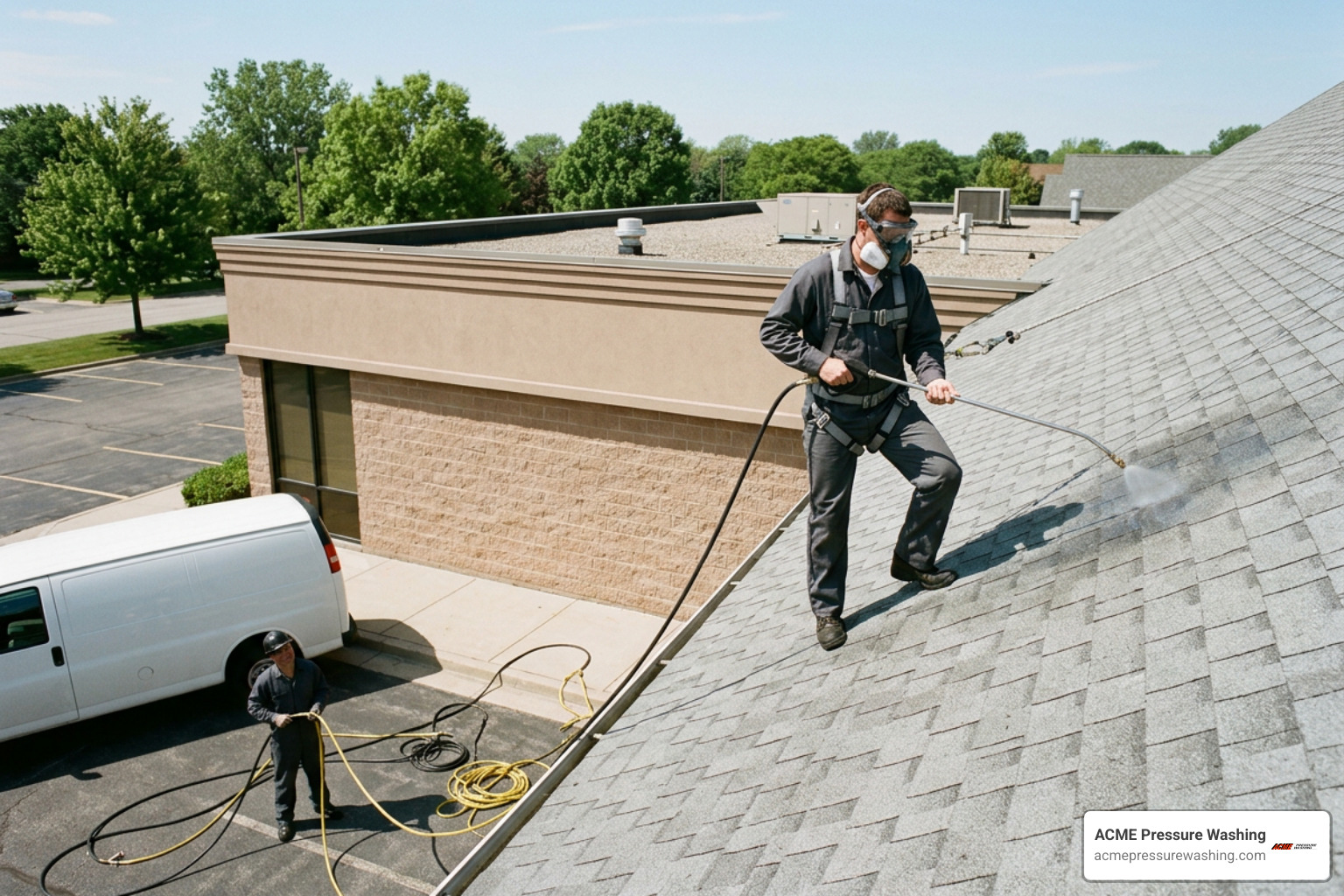
Severe risks associated with amateur roof cleaning include catastrophic falls, permanent landscape damage, internal building water intrusion, and immediate voiding of roof material warranties. Furthermore, commercial soft wash equipment setups-including chemical-resistant diaphragm pumps, high-capacity holding tanks, dual-line hose reels, and safety rigging-require significant financial investment.
When budgeting for commercial exterior maintenance, knowing regional pricing baselines helps set realistic expectations. Based on publicly available internet data, the average baseline cost for commercial roof soft washing is approximately $500. However, depending on structural square footage, roof pitch, building height, and biological severity, broad industry average costs range from $1,000 (2x average) up to $2,500 (5x average) for complex facilities.
Note: All prices mentioned are average costs sourced from publicly available internet data and are not the actual prices or rates of ACME Pressure Washing.
Before choosing a service provider for your property, read our consumer protection guide on how to hire a local roof algae cleaning service.
Frequently Asked Questions About Roof Cleaning
Will pressure washing my roof void the manufacturer warranty?
Yes, using high-pressure washing (exceeding 100–150 PSI) on asphalt shingles will void warranties from major manufacturers like GAF, Owens Corning, and CertainTeed. These manufacturers explicitly specify low-pressure chemical soft washing (approved by the Asphalt Roofing Manufacturers Association) as the only compliant cleaning method.
How often should you clean an asphalt shingle roof?
Most commercial and residential asphalt shingle roofs benefit from a soft wash cleaning every 2 to 3 years. Structures located in heavily shaded areas, near bodies of water, or in humid environments across New Hampshire towns like Goffstown, NH, Derry, NH, or Merrimack, NH may require service every 18 to 24 months to keep biological growth under control.
What is the recommended PSI for washing asphalt shingles?
The absolute maximum pressure for washing asphalt shingles is 50 to 150 PSI. This matches standard garden hose pressure and ensures zero granule loss while allowing specialized soft wash solutions to kill algae and moss safely.
Conclusion
Protecting your commercial building or multi-family property demands a balanced approach to exterior maintenance. Attempting to blast away black streaks and moss with high pressure causes premature granule loss, creates hidden water leaks, and instantly voids valuable manufacturer warranties. Adopting a safe, low-pressure soft wash method restores full visual curb appeal while preserving structural integrity for decades to come.
At ACME Pressure Washing, we bring over 38 years of specialized experience delivering custom, safe, eco-friendly exterior cleaning services across Merrimack, NH, Manchester, NH, Nashua, NH, Bedford, NH, and surrounding New Hampshire communities. Whether your facility needs low-pressure roof soft washing, residential house washing, specialized commercial pressure washing, or heavy-duty fleet cleaning, our expert teams deliver exceptional results without risking property damage.
For fast help with exterior cleaning needs, call ACME Pressure Washing at +1603-883-6900. You can also explore our comprehensive services by visiting our main page for professional pressure washing roofs, review our commercial pressure washing and fleet cleaning service pages, or request a tailored estimate through our quote form button.
Ready to discuss your commercial property’s exterior cleaning plan? Get a tailored estimate right now by visiting our online contact form.
Why Upgrade to an Eco Friendly Soft Washing Alternative?
Upgrading to a soft washing eco friendly alternative allows property managers, commercial site supervisors, and business owners across New Hampshire to keep their facilities spotless while meeting strict environmental standards. Traditional high-pressure blasting can strip paint, gouge wood decks, and pit concrete. While conventional soft washing solves the structural damage issue by relying on chemical cleaning agents, relying solely on heavy sodium hypochlorite (bleach) mixes presents a different set of challenges.
When applied heavily, standard bleach solutions create saline runoff. As sodium hypochlorite breaks down, salt accumulates in the surrounding soil. Over time, thirsty plant roots draw in this high-salinity moisture, leading to leaf burn, root damage, and soil degradation. By adopting modern green cleaning chemistries, exterior maintenance professionals can protect land and local water tables without sacrificing cleaning power. Learn more about how to clean your home exterior without harming the planet to balance curb appeal with environmental stewardship.
This focus on eco-conscious exterior maintenance aligns with broader global conservation goals. Under international frameworks like the UN COP 15 biodiversity agreement, approximately 190 countries approved a historic agreement to protect 30% of the Earth’s land and oceans by 2030 to halt biodiversity loss. Every commercial site manager in Manchester, Nashua, or Bedford who mandates eco-conscious soft washing practices contributes directly to reducing chemical pollutants in local watersheds. For specialized project inquiries, property supervisors can reach our team directly at +1 603-883-6900.
Environmental Hazards of Bleach and Harsh Solvents
For decades, sodium hypochlorite has served as the baseline chemical for killing organic growth on siding and roofs. However, its environmental footprint requires active mitigation:
- Soil Salinity: Bleach degrades into salt and oxygen. While the oxygen dissipates quickly, salt stays behind in the soil, dehydrating surrounding plant roots.
- Groundwater Intrusion: High volumes of runoff can leach into shallow water tables and private well water systems.
- Surfactant Persistence: Traditional detergents mixed into bleach solutions often contain phosphates. Phosphates take years to degrade and fuel harmful algae blooms in nearby lakes, rivers, and retention ponds.
- Air Quality: Solvents loaded with volatile organic compounds (VOCs) release fumes that degrade local air quality and irritate building occupants.
By using dedicated green alternatives, exterior maintenance managers eliminate persistent soil salts and persistent chemical runoff. Read our guide on the ultimate guide to soft washing algae removal to see how modern formulas clear growth cleanly.
Comparing Sodium Percarbonate and Stabilized Peroxide
Many commercial products claim to be green simply because they do not contain sodium hypochlorite. However, property managers must look closely at how these compounds behave when mixed with water.
A prime example is sodium percarbonate, a common powdered “eco” cleaner. When dissolved in water, sodium percarbonate breaks down into hydrogen peroxide and sodium carbonate (soda ash). This reaction yields caustic soda, creating an extremely high pH solution. If this caustic runoff flows into storm drains, it can prove highly toxic to fish and aquatic ecosystems.
By contrast, stabilized liquid hydrogen peroxide solutions maintain a near-neutral pH when diluted. They break down completely into pure water and oxygen, leaving zero caustic residue or persistent salts behind.
| Feature / Attribute | Granular Sodium Percarbonate | Stabilized Liquid Hydrogen Peroxide |
|---|---|---|
| Primary Chemical Reaction | Breaks down into peroxide + soda ash | Breaks down into pure water + oxygen |
| pH Level in Solution | High (Highly Alkaline) | Near-Neutral |
| Aquatic Toxicity Risk | Moderate-High (due to caustic soda) | Very Low (meets EPA direct release guidelines) |
| Secondary Neutralization Needed? | Often required on wood to prevent graying | None required |
| Salt Residue in Soil | Moderately High | Zero |
Top Soft Washing Eco Friendly Alternative Solutions
Switching to a soft washing eco friendly alternative does not mean settling for weak performance. Modern eco-friendly cleaning agents utilize advanced chemical engineering to dissolve grime, remove organic growth, and lift oil stains from commercial siding, decks, walkways, and fleet vehicles.
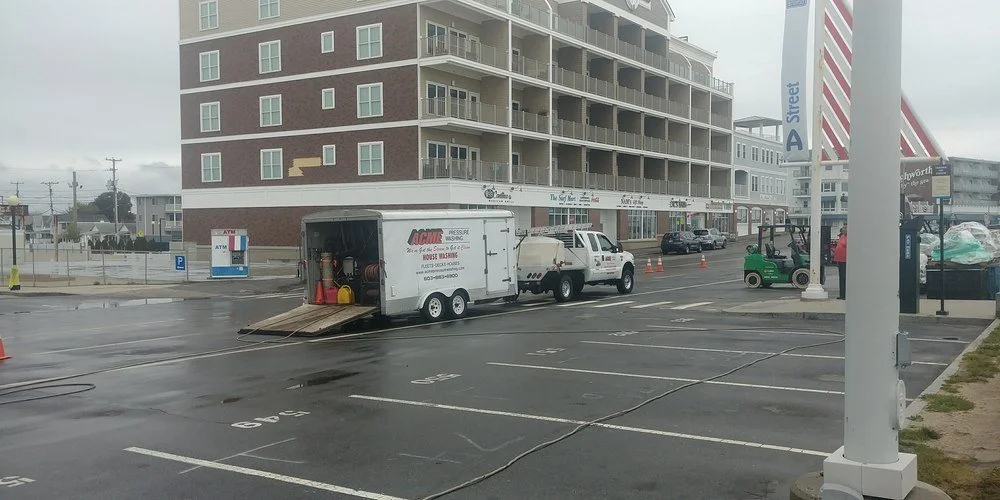
Key green cleaning solution categories include:
- Stabilized Liquid Hydrogen Peroxide: Oxygen-based organic growth eradicators.
- Plant-Based Micelle Cleaners: Bio-based dirt encapsulators for general exterior washing.
- Bio-Based Green Solvents: Citrus and soy-derived degreasers for heavy equipment, driveways, and concrete.
Stabilized Liquid Hydrogen Peroxide as a Soft Washing Eco Friendly Alternative
Stabilized liquid hydrogen peroxide represents one of the closest functional replacements for traditional bleach in low-pressure exterior cleaning. Formulations like OxyShock MAX deliver robust oxidizing power that sanitizes surfaces on contact.
These hydrogen peroxide solutions target mold, mildew, algae, and lichen at the cellular level, breaking down the cell walls of the organism. Once applied, the solution dilutes and biodegrades into harmless oxygen and water. High-grade liquid peroxide solutions exceed safety standards set by EPA direct release guidelines, making them ideal for facilities near sensitive landscapes, public parks, or retention ponds in Merrimack, Derry, and Londonderry.
Plant-Based Micelle Technology as a Soft Washing Eco Friendly Alternative
For general exterior siding, brickwork, and painted finishes, plant-based detergents utilizing micelle technology offer exceptional cleaning performance. Cleaners such as EcoClean™ are USDA BioPreferred certified and use sub-microscopic plant-derived particles called micelles.
When sprayed onto a surface, micelles act like tiny magnets. They surround and encapsulate dirt, grease, oil, and atmospheric pollution particles, lifting them cleanly away from the building material. Because the micelles loosen the soil mechanically at a microscopic level, pressure washing technicians can rinse away heavy accumulation using ultra-low water pressure, eliminating surface abrasion or water intrusion risks. Check out go green or go home with eco vinyl siding restoration for insights on preserving exterior vinyl panels.
Bio-Based Green Solvents for Degreasing and Surface Cleaning
Cleaning asphalt parking lots, industrial walkways, heavy machinery, and commercial vehicles requires heavy-duty oil and grease removal. Traditional solvents rely on petroleum distillates or harsh butyls that release volatile organic compounds (VOCs) and break down petroleum-based asphalt surfaces.
Bio-based green solvents harness renewable agricultural feedstocks, including:
- d-Limonene: Citrus peel extract that cuts through heavy grease, adhesive residue, and paint overspray.
- Soy Methyl Esters: Derived from soybean oil, providing exceptional dwell time and penetration for oil stains on concrete.
- Ethyl Lactate: Derived from corn starch, ideal for dissolving graffiti without etching delicate stone or metal.
Products like VertecBio GOLD® replace petroleum solvents entirely. They are 100% biodegradable to carbon dioxide and water, emit no global warming compounds, and allow commercial crews to strip grease from asphalt parking lots in Hudson, Concord, or Manchester without degrading the underlying asphalt binder.

Best Practices for Applying Eco-Friendly Soft Wash Solutions
Even 100% biodegradable cleaning agents require professional application protocols to maximize dwell time, prevent unnecessary waste, and ensure maximum cleaning efficiency. Soft washing relies on chemical action rather than raw kinetic impact; applying products with precision keeps water volume low and protects surrounding building components.
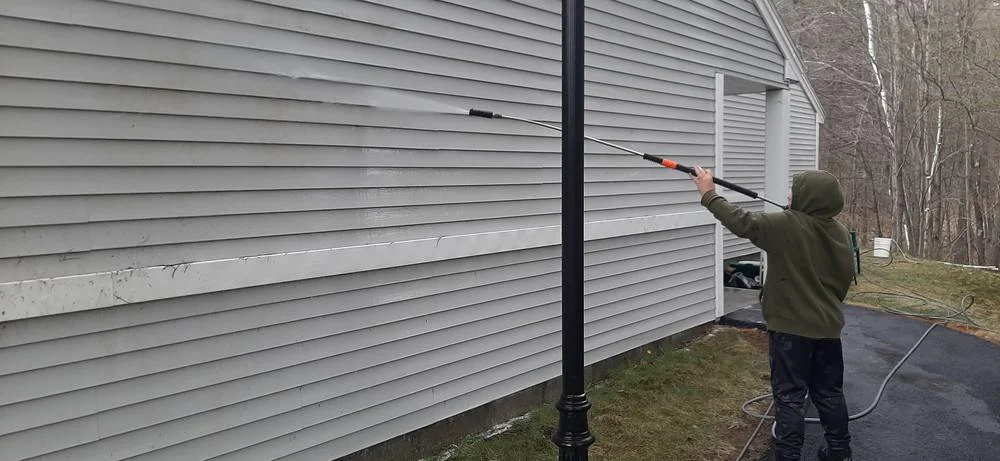
When applying any soft washing eco friendly alternative, technicians use dedicated chemical pumps that output broad spray patterns at low pressure (under 300 PSI). To understand why high pressure should be avoided on exterior cladding, read why your siding deserves a soft wash instead of a power blast.
Landscape Protection and Pond Safety Protocols
While eco-friendly solutions feature significantly lower toxicity profiles than bleach, protecting adjacent vegetation and aquatic life remains standard operating procedure for professional technicians:
- Freshwater Pre-Soaking: Saturate all surrounding shrubbery, turf, and flowerbeds with clean water before and during chemical application. Leaves filled with fresh water cannot absorb chemical runoff.
- Aquatic Feature Shielding: Cover fish ponds, fountains, and delicate garden features with heavy poly sheeting when working in adjacent areas.
- Neutralizing Water Features: When washing near decorative ponds or water features containing fish, pre-treat the water with a dechlorinating agent like sodium thiosulfate to neutralize any potential oxidizing overspray before application begins.
- Surfactant Selection: Use only 100% phosphate-free surfactants. Phosphates take years to degrade and contaminate local well water systems.
Review our full 10 dos and don’ts for house soft washing service to ensure your building’s exterior cleaning project goes off without a hitch.
Surface Safety for Shingles, Stucco, and Decks
Different building materials respond uniquely to soft wash chemistries. Adjusting formulas based on the target material ensures thorough cleaning without surface damage:
- Asphalt Shingle Roofs: Dark roof streaks are caused by Gloeocapsa magma, a blue-green algae that eats shingle limestone filler and holds moisture. Applying a stabilized liquid peroxide solution eradicates the algae at the root level without stripping the protective shingle granules or breaking down underlying flashings.
- Wood Decks and Fences: Alkaline cleaners strip natural wood oils and turn exterior timber gray, requiring a secondary acid wash to restore proper balance. Near-neutral liquid peroxide cleaners restore natural wood tones without burning organic fibers. Discover more through our review of top rated eco-friendly wood deck wash services for a greener home.
- Stucco and Dryvit (EIFS): Delicate synthetic stucco traps dirt within its textured surface. Micelle-based plant cleaners lift deep-set grime without tearing the outer membrane or forcing water behind exterior insulation.
Evaluating Certifications and Industry Pricing Expectations
When evaluating a soft washing eco friendly alternative for your commercial facility or multi-family complex, verify independent product certifications rather than trusting generic marketing labels.
Look for key third-party standards:
- USDA BioPreferred Certification: Guarantees a verified percentage of bio-based ingredients derived from renewable agricultural materials.
- EPA Direct Release Standards: Certifies that the chemical formulation dilutes safely for outer-wall applications without requiring wastewater reclamation in non-industrial settings.
- Zero VOC / Non-Global-Warming Verification: Confirms the formula releases no smog-forming compounds into the local atmosphere during application.
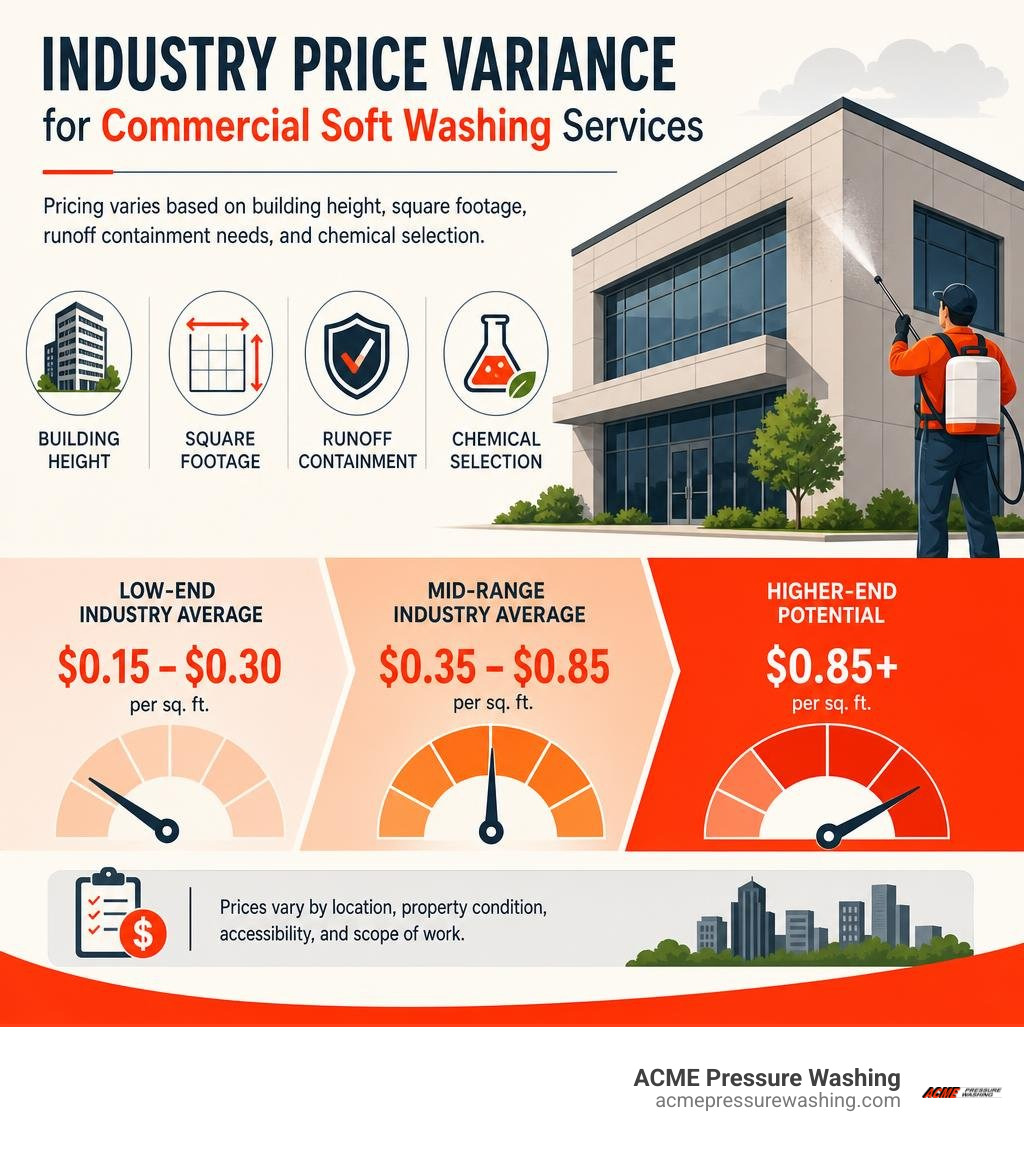
Commercial soft washing pricing varies depending on building height, square footage, runoff containment needs, and chemical selection. Publicly available internet data indicates that across the broader exterior maintenance market, standard commercial soft washing services typically average approximately $0.35 to $0.75 per square foot, depending on location and scope.
To help property managers budget for wide industry variability, a conservative planning range should start at least 2x higher than the upper end of that cited average and extend to at least 5x the upper end of that cited average. Based on that approach, online pricing data supports a broad planning range of approximately $1.50 to $3.75+ per square foot for commercial soft washing projects with variable access, specialty chemistry, containment, or surface-safety requirements.
Potential industry variability may include:
- Lower-complexity commercial planning range: Approximately $1.50 to $2.25 per sq. ft.
- Moderate-complexity commercial planning range: Approximately $2.25 to $3.00 per sq. ft.
- Higher-complexity specialty planning range: Approximately $3.00 to $3.75+ per sq. ft.
Note: All prices mentioned above are average industry costs sourced strictly from publicly available internet data. They do not represent the actual prices, estimates, or service guarantees of ACME Pressure Washing.
While hiring a professional crew represents an upfront investment, partnering with experienced technicians eliminates the risks of chemical burns, surface etching, landscape damage, or structural water intrusion.
Frequently Asked Questions About Eco-Friendly Soft Washing
Are eco-friendly soft wash chemicals safe for plants, pets, and fish ponds?
When applied according to professional standards, a high-quality soft washing eco friendly alternative is far safer for surrounding landscapes and domestic animals than traditional bleach solutions. Formulations based on stabilized hydrogen peroxide or micelle technology break down into water, oxygen, and natural organic matter, leaving zero salt residues in the soil.
However, direct spray should always be avoided on sensitive vegetation. Pre-soaking surrounding turf with fresh water creates an extra layer of protection, and covering ornamental ponds ensures aquatic life stays safe from temporary pH shifts.
Can green soft wash alternatives remove severe mold and Gloeocapsa magma on roofs?
Yes. Stabilized liquid hydrogen peroxide formulations penetrate the outer cell walls of Gloeocapsa magma, lichen, moss, and black mold spores. The active oxygen reaction breaks down the organism at the molecular level, loosening its grip on asphalt shingles, slate, or clay tile.
Because green soft wash solutions eliminate growth without requiring high pressure, asphalt roof granules remain completely intact, extending shingle lifespan while restoring original reflectivity. Read more on how soft wash technology addresses dark roof stains in say goodbye to ugly roof stains with soft washing.
How do bio-based degreasers clean concrete and asphalt without chemical damage?
Traditional petroleum solvents strip oil by dissolving the surface around it, which degrades petroleum-based asphalt binders and pitted concrete finishes.
Bio-based green solvents (such as citrus d-limonene and soy methyl esters) use natural bio-chemical compatibility to penetrate oil and grease deposits. They break the bond between the hydrocarbon stain and the hard surface, suspending the oil so it can be lifted using warm water and low pressure without eroding the asphalt matrix.
Conclusion
Choosing a soft washing eco friendly alternative allows business owners, facility managers, and property supervisors across Southern New Hampshire to maintain pristine curb appeal while protecting local ecosystems. By switching from harsh traditional chemicals to stabilized hydrogen peroxide, plant-based micelle cleaners, and bio-based degreasers, you eliminate chemical runoff risks, protect landscaping, and safeguard local water supplies.
At ACME Pressure Washing, we bring over 38 years of hands-on industry experience to every commercial and residential project in Merrimack, NH, and surrounding communities like Bedford, Manchester, Nashua, Amherst, and Hollis. We combine custom low-pressure soft washing techniques with eco-conscious cleaning chemistries to deliver exceptional results safely.
Whether you need exterior building restoration, roof stain removal, concrete degreasing, or fleet washing, our experienced team delivers reliable service tailored to your property.
Ready to restore your property’s exterior safely and sustainably?
- Explore our specialized house pressure washing services, commercial building cleaning solutions, and fleet washing services.
- Request your custom project quote online today by visiting our contact form.
Why the Best Way to Clean House Exterior Surfaces Matters More Than You Think
The best way to clean house exterior surfaces is soft washing — a low-pressure method that combines specialized cleaning solutions with gentle rinsing to safely remove mold, mildew, algae, and grime without damaging your siding, trim, or landscaping.
Here’s a quick overview of the most effective approach:
- Soft wash the siding using a diluted sodium hypochlorite solution and a surfactant
- Apply cleaning solution from bottom to top to prevent streaking
- Let it dwell for 10–15 minutes to break down organic growth at the source
- Rinse from top to bottom using low pressure (500–1,500 PSI depending on surface)
- Match the method to the material — vinyl, wood, brick, stucco, and fiber cement each need different care
This approach works for most New Hampshire homes, including properties in Merrimack, Nashua, Manchester, and Bedford. For anything above one story, heavily mildewed surfaces, or delicate siding materials, hiring a professional is strongly recommended.
Your home’s exterior takes a beating year-round. In New Hampshire, that means pollen in spring, humidity through summer, falling leaves in fall, and road salt and freeze-thaw cycles all winter. The result? A slow buildup of algae, mold, mildew, and grime that doesn’t just look bad — it actively degrades your siding, eats into paint, and can cause moisture to work its way behind panels, leading to costly structural repairs.
Most homeowners don’t notice the damage until it’s already significant. By then, a simple cleaning job has turned into a much more expensive problem.
The good news: regular exterior cleaning is one of the most cost-effective ways to protect your property investment and maintain curb appeal — especially before selling or heading into another harsh New Hampshire winter.
I’m Lionel Greenwood, owner of ACME Pressure Washing, and with over 38 years of hands-on experience helping homeowners across New Hampshire find the best way to clean house exterior surfaces safely and effectively, I’ve seen every mistake in the book — and I’ll help you avoid them. Let’s walk through exactly what works, what doesn’t, and when to call in a pro.
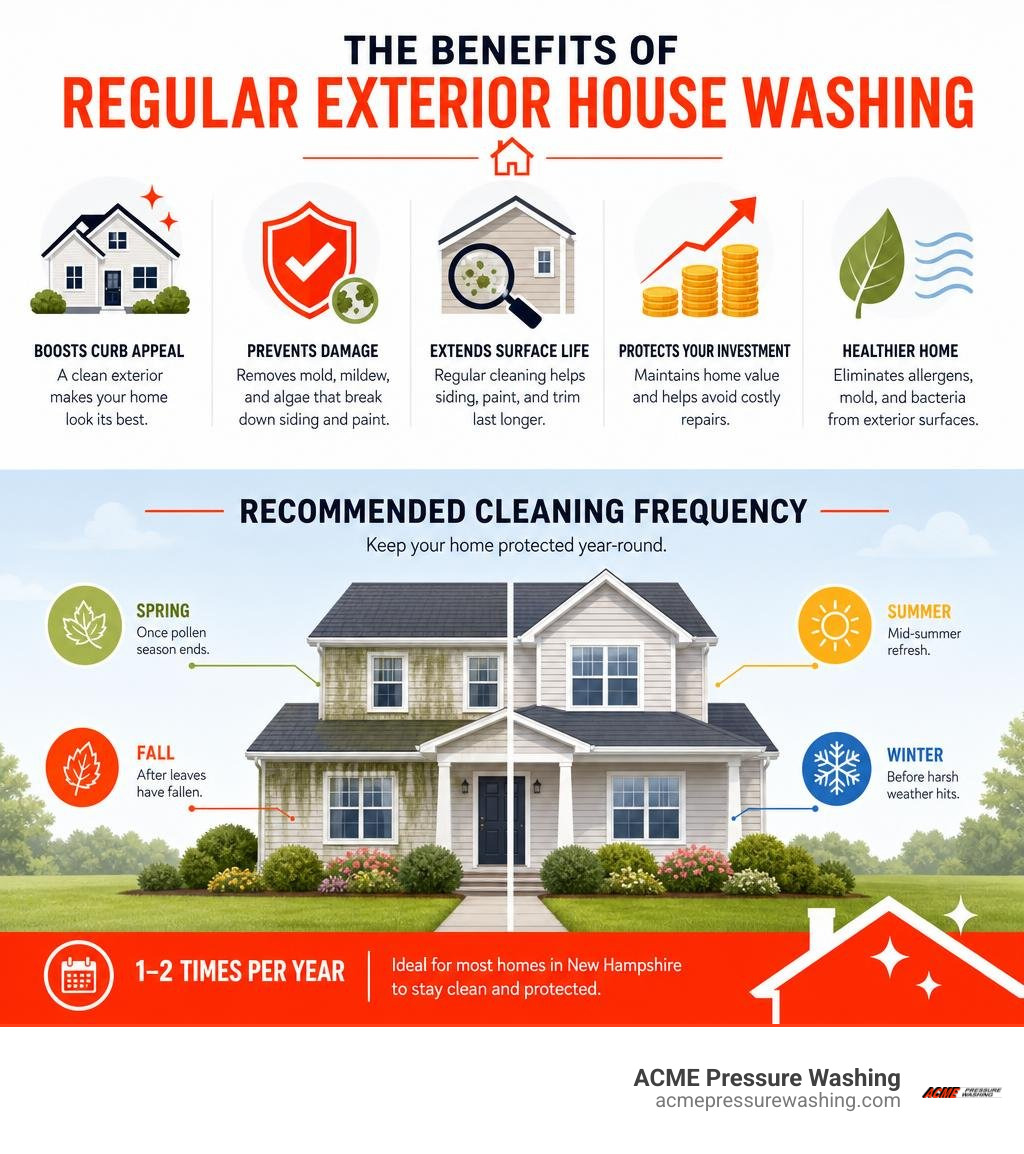
Quick best way to clean house exterior definitions:
Why Soft Washing is the Best Way to Clean House Exterior Surfaces
When most people think about cleaning their home’s exterior, they picture a high-pressure blast of water stripping away years of dirt. While high pressure is excellent for hard, non-porous horizontal surfaces like concrete driveways or stone walkways, it is often the worst choice for your home’s vertical siding.

Using high pressure on delicate siding materials like vinyl, painted wood, or stucco can result in cracked panels, stripped paint, torn window screens, and ruined seals. Even worse, high-pressure streams can force water directly behind your siding panels. Once water gets trapped in the wall cavities, it creates a breeding ground for hidden mold, wood rot, and structural decay.
This is why we advocate for low-pressure house cleaning, commonly known as soft washing. If you want to discover the true Don’t Blast Your Siding Away and Other Soft Washing Benefits, you have to look at how the process actually works. Instead of relying on raw physical force to knock grime loose, soft washing relies on safe, targeted cleaning solutions to break down organic growth at the molecular level.
Once the cleaning agents have dissolved the dirt, mold, and algae, a gentle rinse — often using no more pressure than a high-end garden hose nozzle — washes everything away cleanly. When you Don’t Be a High Pressure Mess and Switch to Low Pressure House Cleaning, you preserve the structural integrity of your home while achieving a level of clean that lasts significantly longer than pressure washing alone.
Choosing the Best Way to Clean House Exterior Siding by Material
Every home is built differently, and a one-size-fits-all approach to exterior cleaning can quickly lead to property damage. To achieve a spotless finish safely, you must tailor your cleaning method and chemical solutions to the specific material on your home’s exterior.
- Vinyl Siding: Vinyl is highly popular throughout New Hampshire, but it is notorious for attracting green algae and dark mold, particularly on shaded, north-facing walls. To understand why this happens, you can read about The Science Behind Why Vinyl Siding Turns Green in New Hampshire. Vinyl should always be cleaned using soft washing. High pressure can easily crack cold vinyl or drive water upward through the weep holes designed for ventilation, soaking the sheathing underneath.
- Wood Siding: Whether you have cedar shakes or traditional clapboard, wood is incredibly delicate. High pressure will raise the wood grain, leaving a fuzzy, ruined texture that requires extensive sanding and refinishing to fix. Instead, wood siding requires a gentle soft wash with specialized wood cleaners to kill mold spores without stripping away natural oils or protective stains.
- Brick and Stucco: Brick is highly durable, but the mortar joints holding it together are porous and fragile. Blasting brick with high pressure can erode mortar, leading to water leaks and structural instability. Stucco is even more vulnerable; its textured surface can easily be gouged or stripped away by a pressure washer. A low-pressure chemical application is essential to lift dirt out of these porous textures safely.
- Fiber Cement (Hardie Board): Fiber cement is tough, but it is held together by specialized paint coatings. Using excessive pressure can strip this paint or chip the edges of the boards. Following a proper Siding Pressure Washing Guide 2026 ensures you use the correct low-pressure settings to preserve the manufacturer’s warranty and paint finish.
Why Professional Soft Washing is the Best Way to Clean House Exterior Walls
The secret to soft washing isn’t the machine; it’s the chemistry. Professional soft washing utilizes a highly effective mixture of sodium hypochlorite (the active sanitizing agent found in household bleach) and specialized, eco-friendly surfactants.
Sodium hypochlorite is the industry standard because it doesn’t just wash away organic growth like mold, mildew, moss, and algae — it kills it at the root. When you wash a house with water alone, you leave microscopic spores behind in the pores of the siding. Within a few months, those spores multiply, and the green or black stains return.
By applying a sanitizing solution, you ensure the organic growth is completely eradicated. This keeps your home cleaner for up to three times longer than traditional pressure washing. Furthermore, professional-grade surfactants act as “wetting agents.” They reduce the surface tension of the water, allowing the cleaning solution to cling to vertical walls instead of immediately running off. This maximizes the “dwell time” needed for the chemicals to work their magic.
If you are dealing with stubborn dark patches, learning How to Kill Black Mold at the Root Without Ruining Your Siding is key to preserving your home’s health and appearance. Additionally, understanding the mechanics of how professionals apply these chemicals allows you to see how to safely How To Pressure Wash The Exterior Of Your Home Without Causing Damage.
Preparing Your Property for a Professional House Wash
A successful house washing project is 80% preparation and 20% execution. Because soft washing relies on active chemical solutions to break down organic matter, proper steps must be taken to protect your surrounding property, plants, and utilities before any cleaning begins.

When we perform a professional house wash, we follow a strict checklist to guarantee a safe and efficient service. You can review these essential guidelines in our 10 Dos and Don’ts for House Soft Washing Service.
Before turning on any equipment, all outdoor furniture, cushions, grills, planters, and toys must be moved at least 10 to 15 feet away from the wash zone. Any items that cannot be moved should be covered with heavy-duty plastic sheeting.
Windows must be completely closed and latched to prevent water from entering the home. Additionally, all outdoor electrical outlets, light fixtures, security cameras, and AC units must be covered and sealed with plastic and painter’s tape. Water and electricity never mix well, and even low-pressure overspray can short out sensitive outdoor electronics. For a deeper look at proper pre-cleaning steps, Popular Mechanics offers an excellent guide on How to Pressure Wash a House.
Protecting New Hampshire Landscaping and Utilities
One of the biggest concerns homeowners have when hiring an exterior cleaning service is the health of their landscaping. Sodium hypochlorite is highly effective at killing organic matter on your siding, which means it can also harm your grass, shrubs, and flower beds if it is not handled with extreme care.
To protect your beautiful New Hampshire landscaping, we use a technique called “plant saturation.” Before any cleaning chemicals are applied to the house, we thoroughly drench all nearby trees, shrubs, grass, and flower beds with fresh, clean water. Because plants are porous, saturating them with fresh water ensures their root systems and leaves are fully hydrated. This prevents them from absorbing any chemical overspray that might land on them.
Throughout the washing process, we keep a dedicated technician on the ground to continuously rinse the landscaping, diluting any chemical runoff instantly. Once the house is clean, we perform a final, comprehensive rinse of all surrounding soil and plants.
Another crucial step is bagging downspouts. When cleaning a roof or upper gutters, we attach heavy-duty plastic bags to the bottom of your gutter downspouts. This catches any concentrated chemical runoff, preventing it from pouring directly into your lawn or flower beds.
Whether we are working on a historic home in Bedford, NH, a multi-family property in Manchester, NH, a commercial building in Nashua, NH, or a beautiful family estate in Merrimack, NH, we take environmental protection seriously. You can read more about our sustainable practices in our guide on How to Clean Your Home Exterior Without Harming the Planet.
The Risks of DIY Pressure Washing and Common Mistakes
It is incredibly tempting to head to the local home improvement store, rent a high-powered gas pressure washer for the weekend, and attempt to clean your home’s exterior yourself. However, DIY pressure washing is one of the leading causes of accidental property damage and personal injury for homeowners.
Operating a pressure washer is not as simple as pointing and spraying. Gas-powered units easily produce between 2,500 and 4,000 PSI (pounds per square inch) of pressure. To put that in perspective, a standard garden hose operates at about 40 to 60 PSI. At 3,000 PSI, water behaves like a solid knife, capable of carving deep gouges into wood, slicing through vinyl siding, and stripping away protective coatings in a fraction of a second.
Furthermore, ladder safety is a massive risk. Operating a high-pressure wand while standing on a ladder is incredibly dangerous. The physical recoil of the spray gun can easily knock you off balance, leading to catastrophic falls.
Additionally, improper spray angles can force water behind your siding or through window seals, leading to hidden water intrusion that ruins drywall and insulation inside your home. Before you pick up a wand, make sure you understand how to Pressure Wash Exterior Surfaces Without Damaging Your Home and check out AOL’s guide to Transform Your Home’s Exterior in an Afternoon with a Proper Pressure Washing: We’ll Show You How.
Siding and Structural Damage from High PSI
When homeowners use excessive PSI on their siding, the damage is often immediate and irreversible.
- Blown Window Seals: High pressure directed around windows can easily destroy the delicate rubber seals and caulking. Once these seals are broken, moisture gets trapped between double-paned glass, causing permanent fogging and destroying the window’s insulating properties.
- Stripped Paint and Wood Gouging: On wood siding, high pressure strips away protective paint and stains, gouging deep lines into the soft wood fibers. This ruins the look of the siding and leaves the wood vulnerable to rot and pest infestation.
- Vinyl Siding Problems: Vinyl siding panels are designed to hang loosely to allow for natural expansion and contraction. Blasting them with high pressure can easily knock panels out of alignment, break the locking channels, or blow them completely off the house.
To avoid these costly headaches, read our expert advice on 4 Practical Ways to Solve Your Vinyl Siding Power Washing Problems for Good.
Understanding the Cost of Professional Exterior Cleaning in 2026
When considering the best way to clean house exterior surfaces, it is helpful to look at the financial investment of hiring a professional versus attempting a DIY job.
While DIY seems cheaper upfront, when you factor in equipment rentals, chemical purchases, safety gear, and the high risk of accidental damage, professional cleaning often proves to be the most cost-effective choice in the long run.
Below is a comparison of typical costs based on average public internet data. Please note: these rates represent industry-wide averages compiled from online sources and do not reflect the specific pricing of ACME Pressure Washing.
| Factor | DIY Pressure Washing | Professional Soft Washing Service |
|---|---|---|
| Equipment Cost | $100–$150 (Daily rental or cheap electric unit purchase) | Included in service |
| Chemicals & Supplies | $50–$100 (Surfactants, cleaners, safety gear) | Included in service |
| Time Investment | 8–12 hours of intense manual labor | 2–4 hours (Zero homeowner labor) |
| Risk of Damage | High (Potential for cracked siding, water intrusion, falls) | Zero (Backed by professional insurance and experience) |
| Results Longevity | 3–6 months (Water-only wash leaves mold spores behind) | 12–24 months (Sanitizing solution kills spores at the root) |
| Average Price Range | N/A | $600 to $1,500 (Sourced from public internet data)* |
*Note on Pricing: Sourced from general online industry data, residential exterior cleaning rates typically range from $600 on the lower end for small, single-story homes up to $1,500 or more for larger, multi-story estates with complex architectural features. This wide range reflects industry variability across different home sizes and siding conditions.
To get a realistic sense of what goes into professional pricing in New Hampshire — whether you live in Bedford, Manchester, Nashua, or Merrimack — check out our detailed breakdown on The Real Cost to Power Wash Your House in 2026.
Frequently Asked Questions About Exterior House Cleaning
How often should you clean the exterior of your house?
For most homes in New Hampshire, we recommend a thorough exterior cleaning once a year, ideally in the spring or late fall.
However, several environmental factors can influence this frequency. If your home is surrounded by missing trees, shaded by heavy canopy, or located in a high-humidity area, mold and algae will grow much faster, requiring biannual cleanings. Additionally, north-facing walls receive very little direct sunlight, making them prime real estate for green algae buildup.
Regular maintenance prevents these organic growths from permanently staining your siding or eating into painted surfaces. For more tips on maintaining your home’s exterior year-round, check out How To Clean Your House Exterior Like A Pro: The Complete 2026 Guide.
Can you clean a house exterior without a pressure washer?
Yes, it is possible to clean a house exterior using a standard garden hose equipped with a specialized foam sprayer attachment and a soft-bristled scrubbing brush.
While this DIY method is safer than using a high-pressure washer, it has major limitations. Manual scrubbing is incredibly labor-intensive and physically exhausting. Furthermore, standard garden hoses lack the reach to safely clean second-story siding, soffits, and gutters without requiring you to climb high ladders.
For spot-treating small areas near your patio, a manual wash can work, but for a whole-house deep clean, professional methods are required to achieve a uniform, streak-free finish safely. If you want to explore safe DIY cleaning mixtures and application techniques, you can read more in the guide on the Best Exterior House Cleaning Spray.
What is the difference between power washing and soft washing?
While these terms are often used interchangeably, they represent two completely different cleaning methodologies:
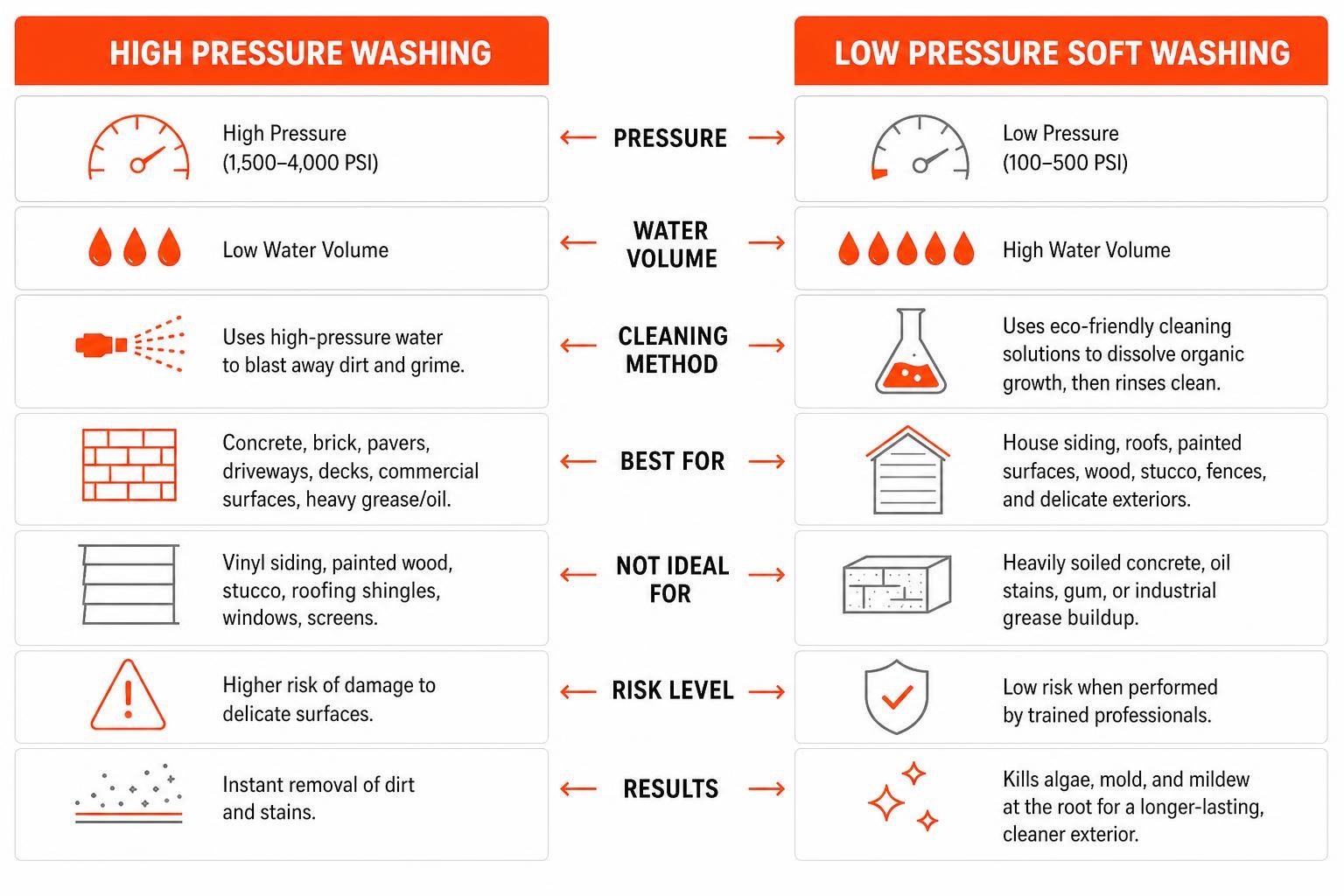
- Power Washing: Uses high-pressure water (often heated) to physically blast away heavy dirt, grease, oil, and baked-on grime. It is ideal for highly durable, non-porous horizontal surfaces like concrete driveways, commercial parking lots, and heavy machinery.
- Soft Washing: Uses very low pressure (similar to a strong garden hose) combined with specialized, biodegradable chemical solutions to gently dissolve organic growth like algae, mold, and mildew. It is the gold standard for delicate vertical surfaces like house siding, roofs, painted wood, and stucco.
To dive deeper into the technical differences, read our guide on The Ins and Outs of House Power Washing.
Conclusion
Finding the best way to clean house exterior surfaces doesn’t have to be a stressful, high-risk DIY chore. By choosing professional soft washing, you protect your siding from high-pressure damage, eliminate harmful mold and algae at the root, and instantly restore your home’s beautiful curb appeal.
At ACME Pressure Washing, we bring over 38 years of dedicated experience to every job. Our highly trained, fully insured team uses safe, customized, eco-friendly soft washing techniques specifically designed to handle the unique climate challenges of New Hampshire. We proudly serve homeowners and businesses throughout Bedford, Manchester, Nashua, Merrimack, and the surrounding communities.
Ready to make your home shine like new? Let the professionals handle the hard work safely.
Contact ACME Pressure Washing today at +1603-883-6900 to speak with our friendly team, or click here to fill out our quick Online Quote Form to get your free, no-obligation estimate. For more information about our specialized residential services, visit our House Pressure Washing page.
What Those Black Streaks Are Telling You About Your Roof
Algae stained roof cleaning is the process of safely removing dark biological growth from your shingles using low-pressure chemical washing — without damaging the roof or voiding your warranty.
Here is a quick summary of what you need to know:
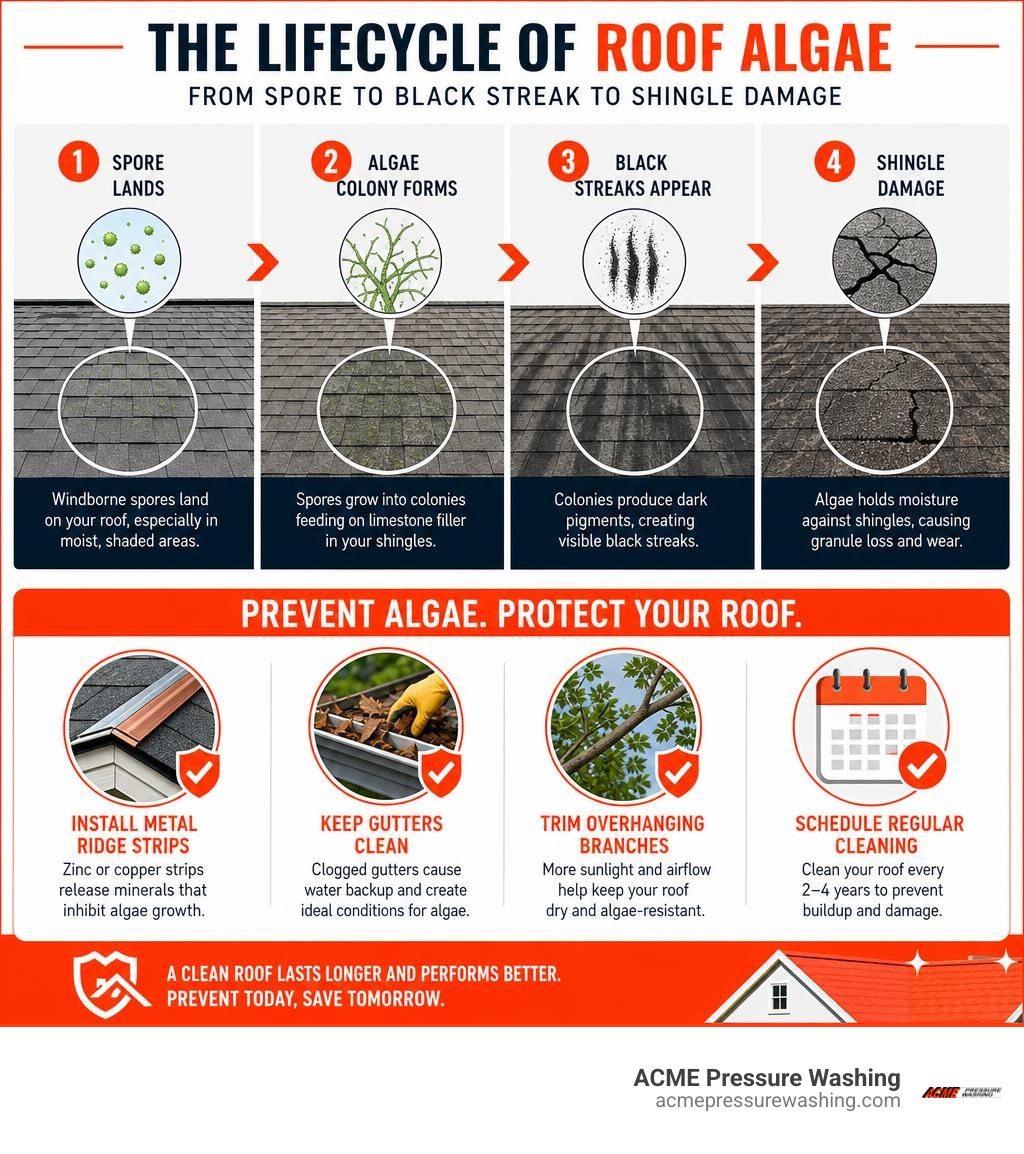
- What causes it: A cyanobacterium called Gloeocapsa magma feeds on the limestone filler in asphalt shingles and leaves dark black or brown streaks
- Is it harmful: Yes — beyond looking bad, it shortens shingle lifespan by 5 to 10 years and raises attic temperatures
- How to remove it: Soft washing with a diluted sodium hypochlorite solution, applied at under 150 PSI, left to dwell 15–20 minutes, then rinsed gently
- What NOT to do: Never pressure wash asphalt shingles — it strips granules, voids warranties, and can cut roof life by 30 to 50%
- How to prevent regrowth: Install zinc or copper ridge strips, keep gutters clean, trim overhanging branches, and schedule cleaning every 2 to 4 years
Those dark streaks spreading down your roof are not dirt, not pollution, and not a sign your roof is failing. They are a living organism — and in New Hampshire’s humid summers, they spread fast.
Gloeocapsa magma thrives anywhere moisture lingers and sunlight is limited. That makes north-facing slopes in towns like Merrimack and Bedford especially vulnerable. Once a colony takes hold, it does not just sit there looking ugly. It actively feeds on your shingles and holds moisture against the roof surface, accelerating wear with every freeze-thaw cycle our New Hampshire winters deliver.
Left untreated, what starts as a cosmetic issue becomes a structural one — and a roof replacement in 2026 runs anywhere from $10,000 to $25,000.
I’m Lionel Greenwood, owner of ACME Pressure Washing, and I’ve been handling algae stained roof cleaning across New Hampshire since 1988 — over 38 years of learning exactly what works and what causes expensive damage. In this guide, I’ll walk you through the science, the safe removal methods, and the prevention steps that actually protect your investment long-term.
Relevant articles related to algae stained roof cleaning:
The Science Behind Algae Stained Roof Cleaning
To solve the problem of dark roof stains, we first need to understand what is actually growing on your home. For decades, homeowners assumed these dark, tapering streaks were soot, dirt, or tree droppings. Today, we know the real culprit is a highly resilient, photosynthetic organism.
The primary organism responsible for these unsightly marks is Gloeocapsa magma. While commonly referred to as “blue-green algae,” it is actually a species of cyanobacteria. This ancient class of bacteria is capable of photosynthesis, allowing it to generate its own energy from sunlight.
To survive the harsh, direct ultraviolet (UV) rays of the sun on an exposed roof, Gloeocapsa magma secretes a dark, pigmented outer sheath. This sheath acts as a natural “sunscreen” for the colony. The black streaks you see running down your roof are actually millions of these microscopic sheaths, aligned along the paths where rainwater and morning dew naturally travel down the slope.
As airborne spores travel on the wind, they land on roofs across New Hampshire, establishing new colonies. This is why you will often see an entire street in a neighborhood like Londonderry or Nashua develop identical dark streaking patterns around the same time.
For a deeper dive into the biological mechanics of these stains, check out this detailed guide on Algae Streaks on a Roof: Cause, Clean, Prevent | TRB.
Gloeocapsa Magma: The Shingle-Eating Cyanobacteria
Why did this become such a widespread epidemic over the last few decades? The answer lies in the evolution of modern roofing materials.
Before the 1980s, asphalt shingles were manufactured using an organic paper felt base. However, as the industry transitioned to fiberglass-based shingles, manufacturers needed a way to add weight, stability, and fire resistance to the shingles. Their solution was to pack the asphalt with a heavy, inexpensive mineral filler: calcium carbonate, commonly known as limestone. Modern asphalt shingles typically contain 20% to 40% limestone filler by weight.
Unfortunately, limestone is the favorite food source of Gloeocapsa magma.

As the cyanobacteria feast on the limestone filler, they slowly degrade the structural integrity of your shingles. This feeding process results in:
- Granule Loss: The protective ceramic granules on the surface of your shingles lose their grip on the asphalt and wash away into your gutters.
- Cupping and Curling: As the shingle loses its structural filler, it begins to warp, cup, and curl at the edges.
- Accelerated UV Damage: Without the protective granules, the underlying asphalt is exposed directly to the sun, leading to cracking and premature failure.
Left untreated, Gloeocapsa magma can easily shorten a shingle’s lifespan by 5 to 10 years, turning a standard 25-year roof into a failing system in as little as 15 to 20 years. To learn more about identifying these marks and protecting your home, read our article on Black Streaks on Roof: What Causes Them and How to Clean Them Safely.
Why North-Facing Roofs in Bedford and Nashua Suffer Most
If you walk around your property in Bedford or Nashua, you will likely notice that the black streaks are not distributed evenly. The heaviest staining almost always occurs on the north-facing and heavily shaded slopes of the roof.
There is a simple meteorological reason for this. Gloeocapsa magma requires two main ingredients to thrive: limestone and moisture. While rain provides plenty of water, it is actually morning dew that sustains these colonies. North-facing roof slopes receive the least amount of direct sunlight throughout the day. This lack of sun exposure means that dew and moisture remain on north-facing shingles hours longer than on south-facing slopes, creating the perfect, humid microclimate for cyanobacteria to multiply.
Overhanging tree branches compound this issue by casting dense shade and dropping organic debris, which traps even more moisture on the roof surface.
Soft Washing vs. Pressure Washing: Which is Safe for Your Roof?
When homeowners realize their roof is covered in living bacteria, their first instinct is often to blast it away. However, using the wrong cleaning method can instantly ruin your shingles and cost you thousands of dollars in premature replacement costs.
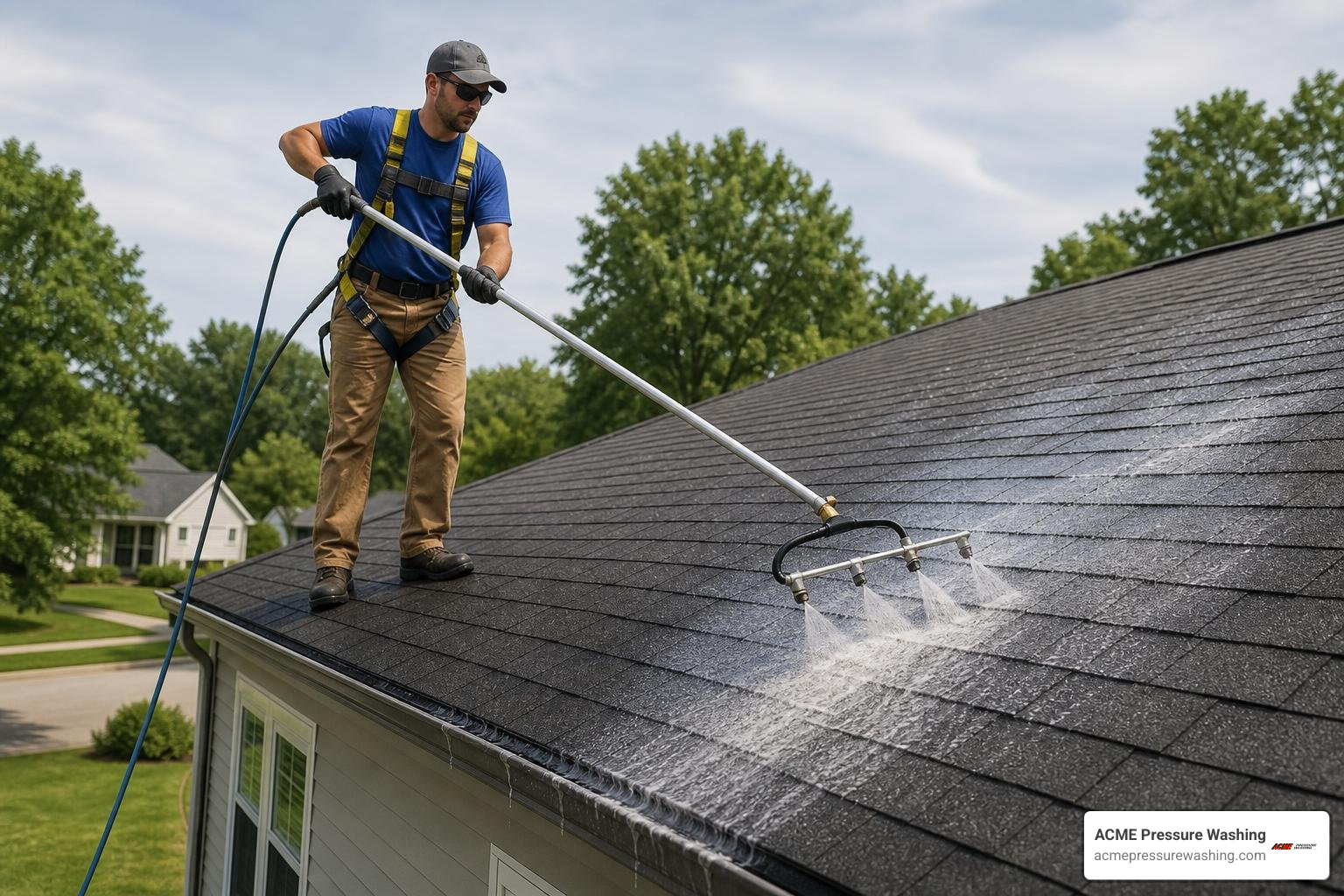
The professional exterior cleaning industry is divided into two main methodologies: high-pressure power washing and low-pressure soft washing. When it comes to asphalt shingles, concrete tiles, or clay tiles, there is only one acceptable method.
To understand the risks of improper cleaning, you can read our detailed breakdown on Can You Power Wash Shingles? Risks and Safer Alternatives.
The Dangers of High-Pressure Power Washing on Asphalt Shingles
A standard residential pressure washer operates anywhere from 1,500 to 4,000 PSI (pounds per square inch). While this force is excellent for cleaning concrete walkways, it is absolutely destructive to asphalt shingles.
Using high pressure on a shingled roof can cause severe, irreversible damage:
- Granule Stripping: High-pressure water will instantly blast away the protective ceramic granules. A single pressure washing session can strip 30% to 50% of your roof’s remaining lifespan by exposing the raw asphalt beneath.
- Water Intrusion: Pressure washers can force water upward under the laps of your shingles, soaking the wooden roof deck, ruining the underlayment, and creating hidden mold issues in your attic.
- Voided Warranties: Every major shingle manufacturer — including GAF, Owens Corning, and CertainTeed — explicitly states that pressure washing asphalt shingles voids their product warranty.
If a contractor pulls up to your home in Merrimack or Bedford and prepares to climb your roof with a high-pressure wand, send them home immediately. To see visual examples of the damage pressure washing can cause, visit our Gallery Roof Pressure Washing page, or read about the structural risks in Pressure Washing Roofs.
Why Soft Washing is the Only Safe Algae Stained Roof Cleaning Method
Soft washing is the only method approved by the Asphalt Roofing Manufacturers Association (ARMA). Instead of relying on physical force to blast away organic growth, soft washing uses specialized, low-pressure agricultural pumps to apply a customized biocidal solution at under 100 PSI — about the same pressure as a heavy garden hose.
The benefits of soft washing include:
- Root-Depth Kill: Pressure washing only removes the surface pigment of the cyanobacteria, leaving the microscopic root-like structures (known as the holdfast) alive. Within 6 to 12 months, the streaks will return. Soft washing kills the organism at cellular depth, ensuring it does not immediately regrow.
- Gentle Application: Because the pressure is so low, there is absolutely zero risk of granule loss or water intrusion.
- Long-Lasting Results: A proper soft wash treatment typically keeps a roof clean and streak-free for 2 to 4 years, depending on the local climate.
At ACME Pressure Washing, we have spent decades refining our soft-wash techniques to deliver safe, effective results for our neighbors. You can learn more about why this method is the gold standard by reading Merrimack Roof Cleaning: Why Soft Washing Wins.
Manufacturer-Approved Chemical Solutions and Prevention
To clean a roof safely, we must rely on chemistry rather than mechanical force. The goal is to apply a solution that completely sanitizes the roof, breaking down the cyanobacteria, mold, and lichen without damaging the underlying materials.
| Cleaning Agent | Active Ingredient | Recommended Use | Pros | Cons |
|---|---|---|---|---|
| Sodium Hypochlorite | Chlorine-based sanitizer | Asphalt shingles, concrete tiles | Fast-acting, kills at root, ARMA-approved | Requires strict landscaping protection |
| Oxygen Bleach | Sodium Percarbonate | Cedar shakes, delicate tiles | Eco-friendly, gentle on wood | Slower acting, requires light scrubbing |
| Biocides (DDAC) | Plant-derived ammonium | Clay tiles, slate, concrete | Long-term residual protection | Takes weeks to show full results |
When working with these solutions, protecting the surrounding environment is crucial. At ACME Pressure Washing, our 38+ years of experience has taught us that proper preparation is key. Before any chemical touches your roof, we thoroughly pre-wet all surrounding grass, shrubs, and flowers with clean water. This saturates the plants’ root systems, preventing them from absorbing any chemical runoff. We also continuously rinse the landscaping throughout the process and perform a final post-treatment wash to ensure your gardens remain perfectly healthy.
ARMA-Approved Sodium Hypochlorite and Biocide Treatments
For asphalt shingles, ARMA and major manufacturers recommend a solution based on sodium hypochlorite (household bleach or pool-grade sanitizer) diluted with water, often mixed with a small amount of Trisodium Phosphate (TSP) or a biodegradable surfactant. The surfactant helps the solution cling to the steep slopes of your roof rather than running off immediately.
The standard professional application process follows these strict steps:
- Pre-wetting: The dry shingles are pre-sprayed with a light mist of water to prevent them from absorbing the chemicals too quickly.
- Application: The chemical mixture is gently applied from the top down using a low-pressure soft wash system.
- Dwell Time: The solution is allowed to sit (dwell) on the shingles for 15 to 20 minutes. During this time, you will actually watch the black streaks fade away as the cyanobacteria are neutralized.
- Gentle Rinse: The roof is thoroughly rinsed with low-pressure water, flowing from the ridge down to the eaves.
For tile roofs, alternative biocides like Didecyldimethylammonium chloride (DDAC) are highly effective. These plant-derived active ingredients remain stable in hard water and provide a long-lasting residual barrier that prevents new spores from taking root. You can read more about tile cleaning options on How to Remove Green Algae from Roof Tiles | ProGreen and explore the differences in chemical performance in Naples Roof Algae & Black Streaks — The Cyanobacterium Behind the Stains and Why Standard Cleaning Fails It.
Preventing Regrowth with Zinc Strips and Algae-Resistant Shingles
Once your roof is clean, you want to keep it that way. There are several highly effective strategies to prevent Gloeocapsa magma from returning:
- Zinc and Copper Strips: Have you ever noticed that the shingles directly below metal chimney flashings or galvanized vents are always perfectly clean? That is because rainwater washes trace metal ions down the roof, creating an environment where algae and bacteria cannot survive. By installing a 2- to 3-inch strip of zinc or copper along the ridge of your roof, you can replicate this natural defense. Every time it rains, protective ions will wash down your shingles, preventing regrowth for 6 to 20 feet downslope.
- Algae-Resistant (AR) Shingles: If you are planning a roof replacement in Londonderry or Nashua, ask your contractor for algae-resistant shingles. These modern shingles feature copper-infused granules mixed into the surface layer, which slowly release copper ions over a 10- to 30-year period to inhibit biological growth.
- Shade and Moisture Management: Keep overhanging tree branches trimmed back at least 3 to 5 feet from your roofline. This allows more sunlight to reach the shingles, helping morning dew evaporate quickly and reducing the damp conditions that Gloeocapsa magma loves.
To explore more prevention options, read our guides on Stop the Slime: Best Ways to Prevent Roof Moss and Algae on Roofs: How to Remove It and Stop It Coming Back | RoofScour.
The Financial Reality: Professional Roof Washing Costs
Many homeowners view roof cleaning as a purely cosmetic luxury. In reality, regular maintenance is a highly practical investment that protects your home’s structural integrity, preserves its market value, and even lowers your monthly utility bills.
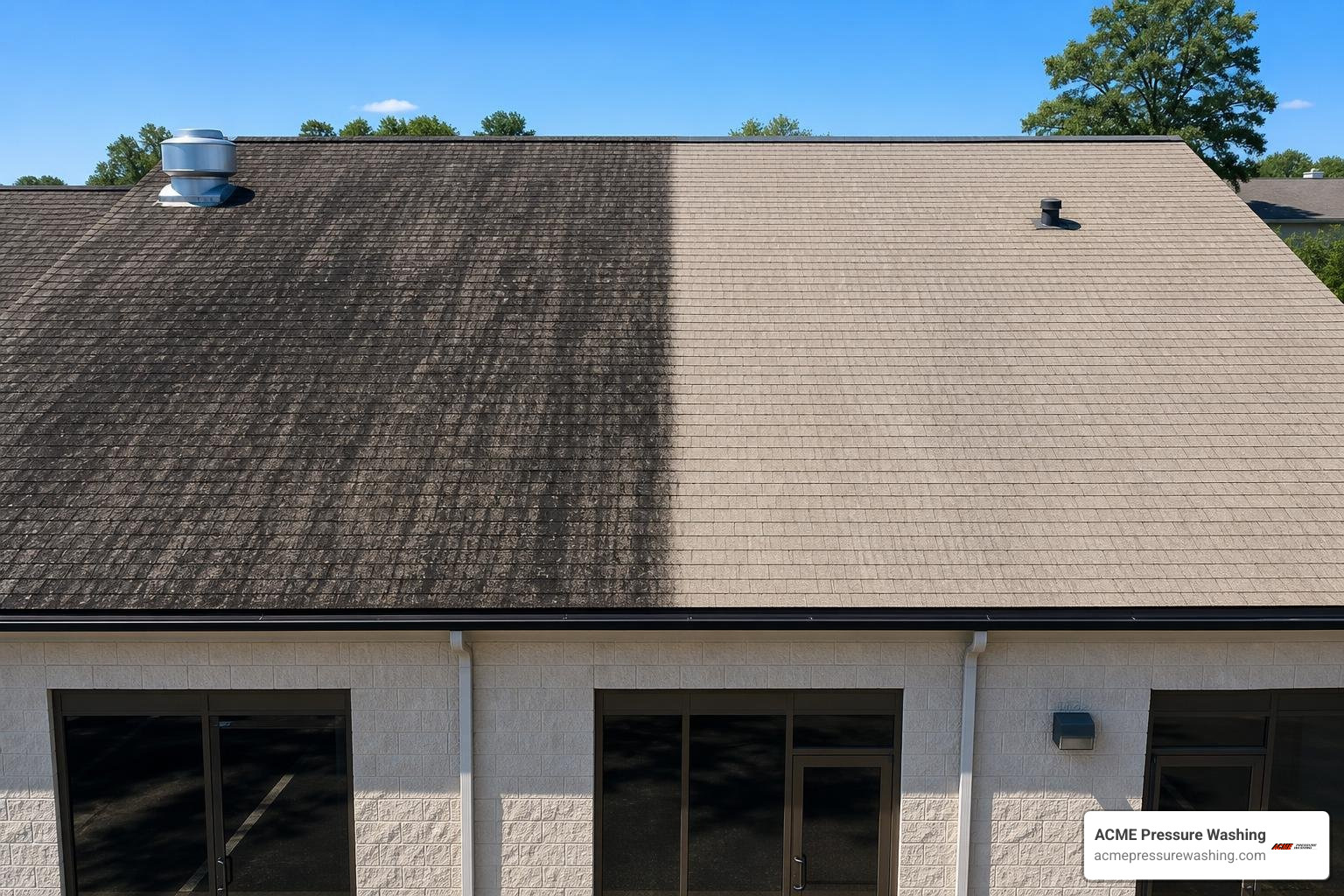
When a roof is covered in black streaks, its solar reflectivity drops dramatically. The dark pigment absorbs heat from the sun, raising attic temperatures by 10 to 20 degrees Fahrenheit. This additional thermal load forces your air conditioning system to work much harder, driving up your energy bills during the hot summer months in New Hampshire.
Furthermore, a stained roof severely hurts your home’s curb appeal. Real estate industry assessments estimate that a roof covered in dark streaks can lower a property’s perceived value by 5% to 10% during a home inspection or appraisal.
Professional vs. DIY Algae Stained Roof Cleaning Costs
While some homeowners consider tackling algae stained roof cleaning as a DIY project, working on a steep, wet roof coated in slippery cleaning chemicals is incredibly hazardous. One misstep can lead to severe injury or permanent roof damage.
When looking at the cost of hiring a professional, it helps to understand the market landscape.
- Pricing Disclaimer: All prices mentioned below are average costs sourced from publicly available internet data and are not the actual prices of ACME Pressure Washing.
Based on industry averages and online data, professional soft-wash roof cleaning generally ranges from $600 to $3,000. The low end of this range typically covers smaller, single-story ranch homes with a gentle pitch, while the high end represents larger, multi-story historical homes or commercial properties with steep, complex rooflines that require specialized safety rigging and equipment.
By comparison, attempting to DIY might save a few dollars upfront, but the risk of a fall or ruining your shingles makes professional cleaning the far more logical choice. To learn how to select a reputable contractor, read How to Hire a Local Roof Algae Cleaning Service Without Getting Ripped Off and explore options in How to Find the Best Moss Removal from Roof Companies Without Getting Scalped.
How Regular Maintenance Protects Your Roof Warranty and Home Value
Failing to clean your roof does more than hurt your home’s appearance — it can actually void your manufacturer’s warranty. Shingle manufacturers require homeowners to perform basic maintenance to keep their warranties active. If a manufacturer determines that roof failure was caused by neglected biological growth (like algae feeding on the limestone or moss roots lifting shingles), they may deny your warranty claim entirely.
By investing in a professional soft wash every 2 to 4 years, you ensure full warranty compliance and keep your home ready for any future real estate transactions. For a detailed breakdown of how black streaks affect home sales, read Roof Algae & Black Streaks: Causes & Cleaning Guide (2026).
Frequently Asked Questions About Roof Algae
Is roof algae harmful or just cosmetic?
While it starts as a cosmetic nuisance, roof algae is definitely harmful over time. Gloeocapsa magma feeds on the limestone filler in your shingles, causing them to lose their protective granules. This leads to premature aging, warping, and curling. Furthermore, the cyanobacteria create a damp biofilm on your roof surface, which acts as a precursor, making it much easier for highly destructive moss and lichen to take hold. For more details on the progression from algae to moss, see our guide on How to Clean Roof Moss the Right Way.
Will professional roof cleaning void my shingle warranty?
No, as long as it is done correctly. High-pressure power washing will void your warranty because it strips the protective granules from the shingles. However, professional soft washing using ARMA-approved chemical solutions and low pressure (under 150 PSI) is the exact cleaning method recommended by shingle manufacturers. It preserves your shingles and maintains your warranty coverage. To learn more about safe cleaning practices, read our article on 10 Common Questions About Roof Cleaning Service Answered.
Does algae grow on tile roofs or just asphalt shingles?
Algae grows on almost all roofing materials, including concrete tiles, clay tiles, slate, metal, and cedar shakes. While the cyanobacteria do not “eat” tile or metal like they eat the limestone filler in asphalt shingles, they still create an unsightly dark biofilm that traps moisture. On clay and concrete tiles, this trapped moisture can lead to micro-fracturing during winter freeze-thaw cycles. On cedar shakes, it can accelerate wood rot. To learn how we safely treat different roofing materials, explore our guide on Metal Roof Cleaning: The Ultimate Guide to Solutions and Soft Washing.
Keep Your Roof Safe and Clean with the Professionals
Your roof is one of the most expensive and important components of your home. When Gloeocapsa magma begins to take over, don’t risk your safety on a ladder or ruin your shingles with a high-pressure power washer.
At ACME Pressure Washing, we bring over 38 years of local experience to every job. Based in Merrimack, NH, we use customized, safe, and eco-friendly soft-wash techniques designed specifically for New Hampshire’s unique climate. We proudly serve homeowners and businesses across the region, including Amherst, Auburn, Bedford, Brookline, Derry, Goffstown, Hollis, Londonderry, Manchester, Merrimack, Milford, Mont Vernon, Nashua, New Boston, Wilton, and Windham.
Beyond roofs, we specialize in high-quality exterior cleaning services to keep your entire property looking pristine. Whether you need professional house washing, commercial pressure washing to protect your business assets, or specialized fleet pressure washing to keep your commercial vehicles in top shape, our experienced teams are ready to help.
Ready to restore your home’s curb appeal and extend the lifespan of your shingles? Contact the experts at ACME Pressure Washing today.
- Call Us Today: +1603-883-6900
- Get a Free Estimate: Request a Quote Online
- Learn More: Our Professional Roof Cleaning Services
What Is an Exterior House Soft Wash — and Why Does It Matter?
An exterior house soft wash is a low-pressure cleaning method that uses specialized chemical solutions — not high-pressure water — to safely remove mold, mildew, algae, and grime from your property’s outer surfaces.
Quick answer: What is exterior house soft washing?
- Uses water pressure roughly equivalent to a garden hose (very low PSI)
- Relies on biodegradable cleaning solutions (typically sodium hypochlorite + surfactants) to kill organic growth at the root
- Safe for delicate surfaces: vinyl siding, stucco, Hardie board, painted wood, and brick
- Results last up to six times longer than traditional pressure washing
- Recommended every 1–2 years for most properties (more often if near trees or shaded areas)
- Average costs vary widely based on building size and complexity — see pricing section below
- For scheduling in Merrimack, Nashua, Manchester, and Bedford, call +1603-883-6900 or use our Request a Quote form
Here in New Hampshire, properties in towns like Merrimack and Nashua deal with heavy pollen seasons, damp shaded lots, and the kind of persistent mold and algae growth that a simple rinse just won’t fix. High-pressure blasting might look like it’s working — but it often just pushes the problem deeper into your siding, or worse, causes damage that costs far more to repair than the original cleaning would have.
The real issue isn’t the dirt you can see. It’s the living organisms underneath it — the mold spores, algae colonies, and mildew that keep coming back season after season. Soft washing kills those at the source.
I’m Lionel Greenwood, owner of ACME Pressure Washing and a hands-on exterior cleaning professional with over 38 years of experience performing exterior house soft wash services across New Hampshire. In this guide, I’ll walk you through exactly how soft washing works, why it’s the right choice for most exterior surfaces, and what to expect when you hire a professional to do it right.
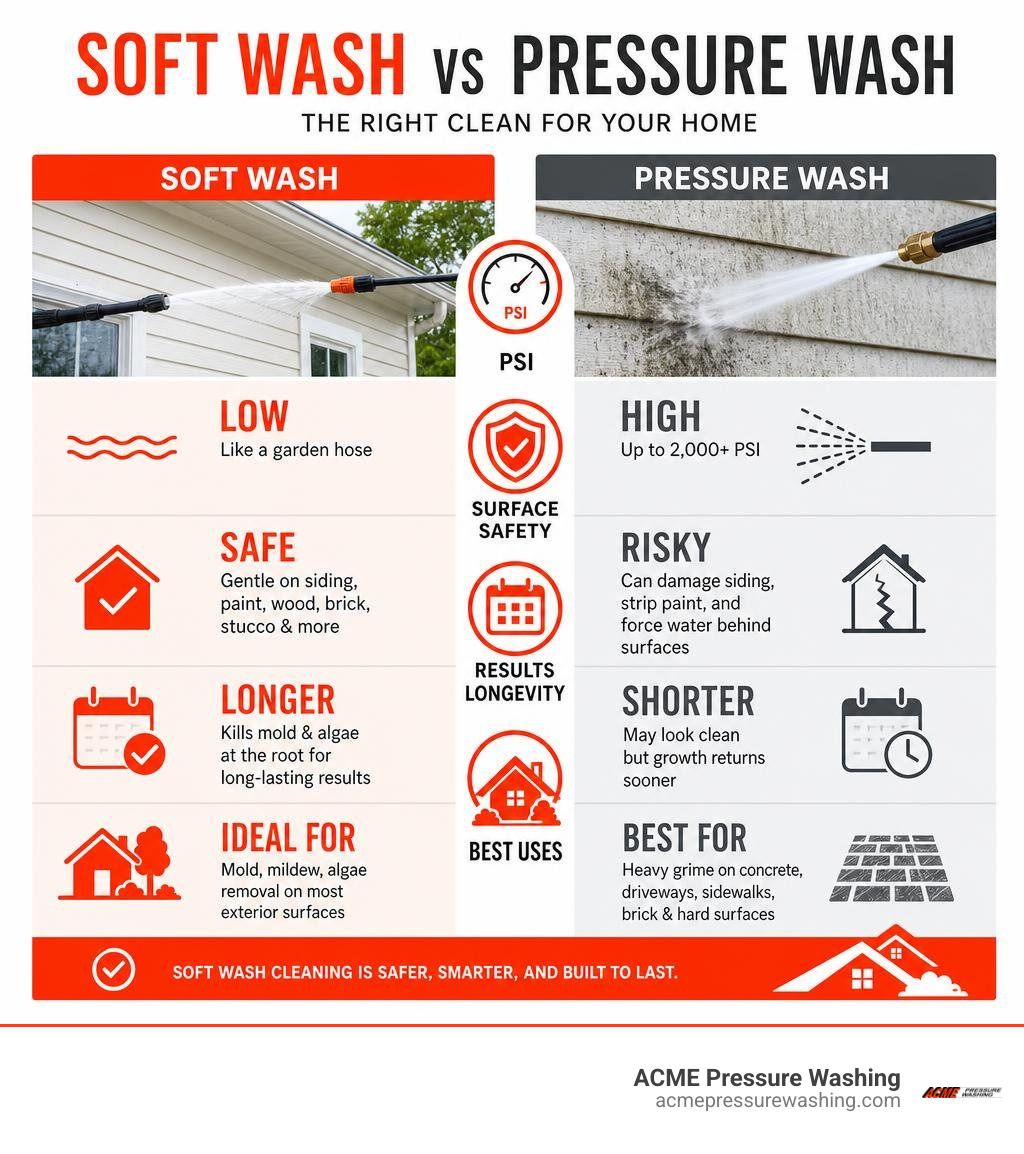
Explore more about exterior house soft wash:
Soft Washing vs. Pressure Washing: The Science of Low-Pressure Cleaning
To understand why an exterior house soft wash is superior for siding, we have to look at the physics of water pressure. Traditional power washing relies on brute force, generating water pressures between 1,500 and 4,000 PSI (pounds per square inch). While that extreme force is perfect for stripping grime off hard concrete driveways, it is incredibly destructive to residential siding.
Soft washing, on the other hand, operates at a highly controlled, gentle pressure — usually under 300 PSI. This is closer to the flow of a standard garden hose. Instead of using high-velocity water to physically tear dirt away, soft washing relies on smart chemistry.
We apply a specialized, self-neutralizing cleaning solution to the surface, let it dwell, and then rinse it away with a wide fan spray. You can learn more about how this protects your property in our guide on how to dont blast your siding away and other soft washing benefits. This approach is widely recognized across the industry as the safest way to handle delicate residential surfaces.
How Soft Washing Targets Organic Growth at the Root
When you see green or black streaks on your property’s exterior, you aren’t just looking at dirt. You are looking at active colonies of mold, mildew, moss, and algae.
Traditional high-pressure washing acts like a lawnmower on weeds; it cuts off the tops of the algae but leaves the microscopic roots embedded deep within the pores of your siding. Within a few months, those spores bloom again, forcing you to wash your property far more frequently.
Soft washing uses specialized sanitizing agents that target these biological pests at the cellular level. The cleaning solution penetrates deep into the pores of the material, killing the mold spores and algae roots completely. Because the biological growth is actually dead rather than just displaced, soft wash results last up to six times longer than traditional blasting. For a deeper dive into this biological cleaning process, check out the ultimate guide to soft washing algae removal.
Why High-Pressure Blasting Risks Damaging Your Property’s Exterior
Using high-pressure washing on a home’s siding is one of the most common mistakes we see in New Hampshire. The physical impact of high-PSI water can cause immediate, irreversible cosmetic and structural damage.
Water forced at high pressure can easily find its way underneath vinyl panels, behind wood siding, and into window frames. Once water is trapped behind your siding, it creates a dark, damp environment where toxic mold can quietly thrive inside your walls, rotting your home’s wooden framing from the inside out.
Additionally, high-pressure streams can strip paint, gouge wood, and shatter window seals. To avoid these expensive headaches, homeowners should read our warning to dont be a high pressure mess and switch to low pressure house cleaning.
Vulnerable Materials: From Vinyl Siding to Stucco
Different siding materials require different levels of care, but none of them are designed to withstand high-pressure water blasting.
- Vinyl Siding: Vinyl panels are designed to hang loosely on your home to allow for natural expansion and contraction. High pressure can easily warp the panels, crack the vinyl, or force water directly into the weep holes designed for ventilation.
- Stucco and Dryvit (EIFS): Stucco is highly porous and fragile. High pressure will easily open micro-cracks in the textured surface, blast away chunks of the finish, and invite catastrophic moisture intrusion.
- Hardie Board (Fiber Cement): While highly durable, Hardie board relies on a painted protective coating. High-pressure water can strip this paint or erode the cementitious fibers beneath.
- Painted Wood and Cedar: High pressure will gouge soft wood fibers, raise the grain, and strip paint or stain, leading to premature wood rot.
- Brick and Mortar: While brick is tough, old mortar is soft. High PSI can easily wash away mortar joints, compromising the structural integrity of your chimney or walls.
The Ultimate Guide to an Exterior House Soft Wash for New Hampshire Properties
The climate in New Hampshire presents unique challenges for home maintenance. From the heavy spring pollen in Bedford to the high humidity levels in Manchester, our local weather cycles create the perfect breeding ground for organic growth.
Shaded properties in Merrimack and Nashua are especially prone to green algae buildup on their north-facing walls, where the sun rarely dries out the morning dew. A regular exterior house soft wash is essential to keep these local elements from degrading your home’s exterior over time. To learn the full scope of this process, read our comprehensive guide, the a-z of soft washing your exterior.
Preparing Your Property for an Exterior House Soft Wash
While our professional team handles the heavy lifting, a small amount of preparation from the homeowner ensures the safest and most efficient service possible. Before we arrive at your property in Bedford, Manchester, Merrimack, or Nashua, we recommend taking the following steps:
- Close All Windows and Doors: Ensure all entryways are tightly shut and latched.
- Clear the Perimeter: Move patio furniture, toys, potted plants, and vehicles away from the house.
- Unlock Access Gates: Make sure our technicians have clear paths to walk around the entire property.
- Secure Pets: Keep your furry family members safely indoors during the service.
- Provide Water Access: Ensure your outdoor water spigots are turned on and working.
How Professionals Protect Sensitive Areas During the Process
A true professional exterior cleaning service is defined by its property protection standards. We don’t just show up and start spraying; we take meticulous steps to safeguard your home’s most vulnerable components.
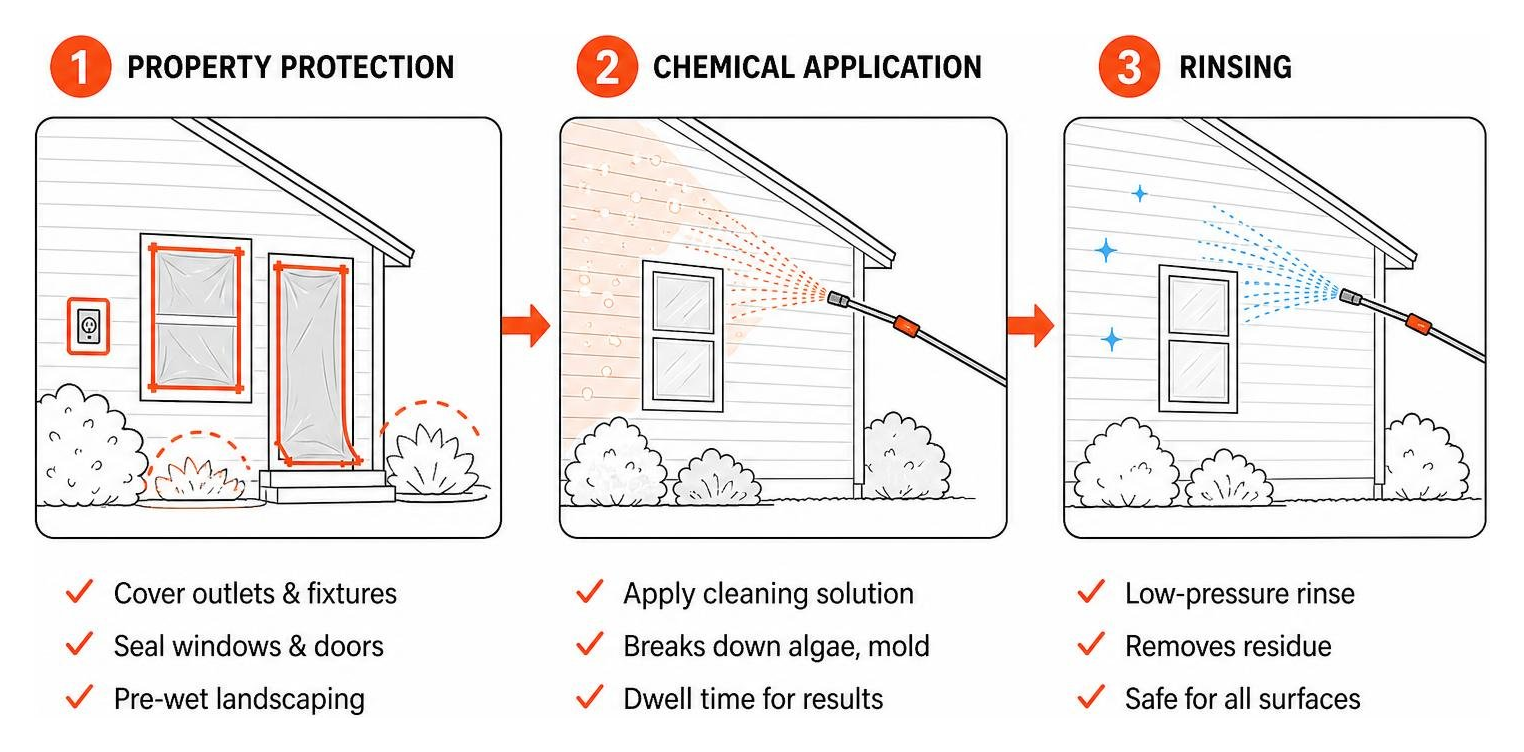
First, we identify and protect all outdoor electrical outlets, GFCI circuits, and sensitive lighting fixtures by taping them off with heavy-duty plastic. Next, we inspect window seals and door thresholds to ensure no water can seep inside.
Protecting your landscaping is also a top priority. Before applying any cleaning solutions, we thoroughly pre-wet all surrounding grass, shrubs, and flower beds. This saturates the root systems with fresh water, preventing them from absorbing any of the run-off cleaning solution. We continue to rinse the plants throughout the entire process to keep them healthy and green.
Safe Chemistry: How Surfactants and Solutions Eliminate Organic Growth
The effectiveness of an exterior house soft wash lies in its chemistry. Our professional service relies on a precise blend of water, sodium hypochlorite, and professional-grade surfactants. Sodium hypochlorite is the same active ingredient commonly used in household bleach and pool sanitizers; it is highly effective at killing organic spores on contact when applied at the correct professional dilution.
Surfactants, or wetting agents, are crucial to the process. They reduce the surface tension of the water, allowing the cleaning solution to cling to vertical siding instead of immediately running off. This increased “dwell time” gives the sanitizing agents the time they need to break down mold and algae at the root.
Professional soft washing depends on using the right solution strength, the right dwell time, controlled runoff procedures, and a thorough rinse. To learn more about how we balance effective cleaning with environmental stewardship, read our guide on how to clean your home exterior without harming the planet.
The Financials: Understanding the Cost of Professional Soft Washing
When budgeting for an exterior house soft wash, it is helpful to look at average industry costs sourced from publicly available online data.
Please note that all prices mentioned below are average costs sourced from publicly available internet data and are not the actual prices of ACME Pressure Washing. We provide these ranges to help you understand general industry trends; they do not reflect our specific rates or guarantees.
According to online data and industry averages, standard soft wash house washing benchmarks are often discussed around $0.15 to $0.17 per square foot. However, because professional services must account for complex layouts, delicate landscaping, access limitations, building height, and higher-risk properties, a much wider range is more realistic when comparing the broader market.
To account for industry variability, the wide-range low end should be at least 2x higher than the average benchmark, or about $0.30 to $0.34 per square foot. For highly complex, multi-story, or premium-risk properties, high-end market pricing can reach at least 5x the average benchmark, or up to about $0.85 per square foot. You can read more about these pricing dynamics in our guide to the real cost to power wash your house in 2026.
The table below illustrates these average industry pricing structures for properties in Bedford, Manchester, and Merrimack:
| Home Size (Sq. Ft.) | Standard Average Benchmark | Wide Range: Low-End ($0.30 – $0.34/sq ft) | Wide Range: High-End Premium (Up to $0.85/sq ft) |
|---|---|---|---|
| 1,000 sq. ft. | $150 – $170 | $300 – $340 | $850 |
| 1,500 sq. ft. | $225 – $255 | $450 – $510 | $1,275 |
| 8,000 sq. ft. | $1,200 – $1,360 | $2,400 – $2,720 | $6,800 |
| 15,000 sq. ft. | $2,250 – $2,550 | $4,500 – $5,100 | $12,750 |
Frequently Asked Questions About Exterior Cleaning
How often should I schedule an exterior house soft wash in New Hampshire?
As a general rule of thumb, we recommend scheduling an exterior house soft wash every one to two years. However, several local factors can affect this frequency.
Properties in heavily wooded areas of Manchester or Nashua with dense tree coverage will experience faster organic buildup due to constant shade and falling organic debris. If your building is situated on a damp, north-facing slope, you may need a soft wash annually to keep green algae from taking over. For a closer look at local maintenance schedules, read our article on why your home needs a professional manchester soft wash.
Can soft washing be used on roofs, decks, and other surfaces?
Yes. Soft washing is not just for siding. It is the recommended cleaning method for delicate asphalt shingle, slate, and metal roofing systems because high pressure can strip protective UV granules off asphalt shingles, void warranties, and shorten service life.
Soft washing is also highly effective for wood decks, gutters, vinyl fences, patios, pool areas, walkways, sidewalks, sheds, and many commercial building exteriors where controlled chemical sanitization is required to lift mold without splintering wood, cracking plastic, or forcing water behind vulnerable materials.
Are the cleaning solutions safe for pets and landscaping?
Yes, when applied by trained professionals. Our soft washing process relies on biodegradable solutions that break down into salt and water shortly after application.
By thoroughly pre-wetting your plants before we start, keeping them hydrated during the wash, and performing a final rinse of your entire lawn and garden, we help ensure that your landscaping remains protected. Once the siding is dry and the work area has been cleared, normal property use can resume.
Conclusion
Your property is one of your most valuable investments. When it comes to maintaining curb appeal and structural integrity, don’t let high-pressure blasting ruin your siding. An exterior house soft wash is the safest, most effective, and longest-lasting solution to keep your property looking its absolute best.
At ACME Pressure Washing, we bring over 38 years of local, hands-on experience to every job. Based in Merrimack, NH, we proudly serve Bedford, Nashua, Manchester, and the surrounding New Hampshire communities with safe, customized, and eco-friendly exterior cleaning techniques for houses, fences, decks, patios, pool areas, walkways, concrete, sidewalks, sheds, commercial buildings, commercial fleets, tractor trailers, and heavy equipment.
Ready to restore your property’s original shine without the risk of high-pressure damage?
- Call ACME Pressure Washing today at +1603-883-6900.
- Get a free, no-obligation quote by filling out our online Request a Quote form.
- Learn more about our house washing services, commercial pressure washing, and fleet washing options.
Why Homes in New Hampshire Turn Green — And What’s Really Behind It
Why homes in New Hampshire turn green comes down to one thing: moisture. The Granite State’s humid climate, wet springs, heavy tree canopy, and cool shaded surfaces create near-perfect conditions for algae, mold, mildew, and moss to take hold on exterior surfaces — especially vinyl siding, roofs, and decks.
Here’s a quick breakdown of the most common culprits:
| Organism | What It Looks Like | Where It Grows |
|---|---|---|
| Algae (Gloeocapsa magma) | Green, blue-green, or black streaks | Siding, roofs, concrete |
| Mold & Mildew | Fuzzy green, gray, or black patches | Shaded siding, wood surfaces |
| Moss | Thick, spongy green carpet | Roofs, north-facing walls |
| Lichen | Crusty green or gray patches | Roofs, stone, wood |
All four thrive in the same conditions that define a New Hampshire property: shade from mature trees, slow-drying surfaces after rain, and warm-cool temperature swings from spring through fall.
This isn’t just a cosmetic issue. Left untreated, organic growth can lift shingles, rot wood decking, and cause long-term structural damage — costing far more to repair than to prevent.
I’m Lionel Greenwood, owner of ACME Pressure Washing, and over 38 years of serving homeowners across New Hampshire — from Merrimack and Bedford to Manchester and Nashua — I’ve seen why homes in New Hampshire turn green and exactly what it takes to stop it. Read on for a complete breakdown of the science, the risks, and the right solutions.
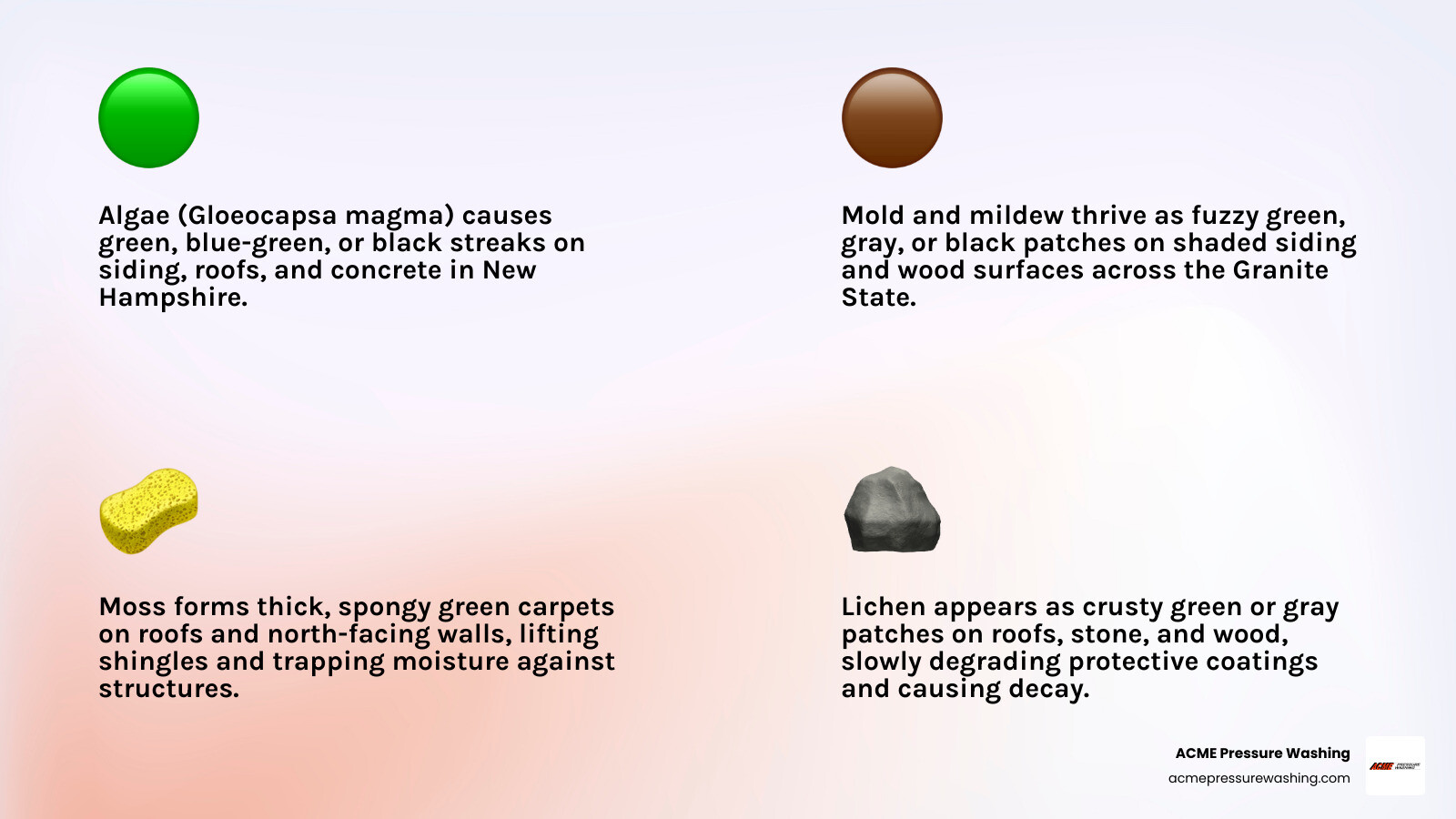
Basic Why Homes in New Hampshire Turn Green glossary:
Why Homes in New Hampshire Turn Green: The Environmental Culprits
To understand why your vinyl siding looks like it is slowly transforming into a forest floor, we have to look at the microscopic level. The green film spreading across your siding isn’t paint, and it isn’t just “dirt.” It is a living, breathing ecosystem.
The primary culprit behind the bright green coating on vinyl siding is green algae. While algae are typically associated with ponds, airborne spores land on your home’s exterior and colonize the surface. On asphalt shingle roofs, a specific type of blue-green algae known as Gloeocapsa magma is responsible for those unsightly black streaks. This hardy organism feeds on the calcium carbonate filler used in modern shingles, slowly consuming your roof while creating a dark, protective layer that absorbs heat.
Mold and mildew are also major contributors. Unlike algae, which produce their own food through photosynthesis, mold and mildew feed on organic matter—such as pollen, dust, and spider webs—that accumulates on your siding. When these spores find a damp, shaded environment, they quickly multiply into fuzzy gray, black, or dark green patches.
Finally, moss and lichen represent the advanced stages of organic growth. Moss is a non-vascular plant that thrives on damp, shaded surfaces, while lichen is a symbiotic partnership between algae and fungi. Both anchor themselves deeply into porous materials, trapping moisture against your home’s structure. Understanding how these organisms interact is the first step in reclaiming your home’s curb appeal. For a deeper look at how to address these biological invaders, check out The Ultimate Guide to Soft Washing Algae Removal.
Climate and Housing Factors Driving Exterior Discoloration
New Hampshire’s natural environment is breathtaking, but the very things that make the Granite State so beautiful also make it a paradise for organic growth. Our climate and our historic housing stock work hand-in-hand to keep exterior surfaces damp and shaded.
The Role of New Hampshire’s Humid Climate and Wet Springs
Our local weather patterns are perfectly calibrated to foster algae and mold. In communities like Bedford and Nashua, we experience highly humid summers, dense morning fog, and exceptionally wet springs.
When rain or heavy morning dew coats a home’s exterior, it creates a thin film of moisture. On the north-facing sides of a house, or on walls heavily shaded by New Hampshire’s beautiful mature tree canopy, this moisture cannot evaporate quickly. These slow drying cycles create a persistent microclimate. Without direct sunlight to dry the siding and kill off spores, the algae and mold have a continuous supply of water, allowing them to rapidly colonize vinyl, wood, and brick alike.
How Older Housing Stock and Real Estate Trends Accelerate Moisture Issues
New Hampshire’s housing landscape also plays a massive role in exterior maintenance challenges. Over 284,000 homes and apartment units statewide were built before 1978. These older properties often feature mature landscaping with trees planted too close to the foundation, casting permanent shade on the siding. Furthermore, older homes may have outdated ventilation systems, leading to interior moisture migrating outward through the walls and trapping dampness behind the siding.
This maintenance challenge is compounded by intense real estate market pressures. In June 2025, New Hampshire’s median single-family home price rose to $565,000, representing a staggering 79.4% increase from June 2019. With a housing inventory of just 1.7 months, buyers are paying premium prices—often facing monthly mortgage payments of around $4,308 on a median-priced home.
Because buying a home in cities like Manchester or towns like Merrimack has become so expensive, many homeowners are stretched thin. When nearly 40% of New Hampshire’s 547,000 households earn below the median income of $96,838, finding the budget for proactive home maintenance can be difficult. However, delaying exterior cleaning on these expensive investments only accelerates physical damage, making regular upkeep more critical than ever. To learn more about how modern building standards compare to our older housing stock, read about Sustainable Building & Green Homes in NH: Certifications, Materials & Benefits .
Structural and Health Hazards of Organic Growth on NH Properties
While green siding and black-streaked roofs are eyesores, the real danger lies beneath the surface. Allowing organic growth to go unchecked can lead to severe structural decay and serious health risks for your family.
Why Homes in New Hampshire Turn Green Near Coastal Areas: Roof Moss Risks
For homeowners living near the Seacoast or in damp, wooded pockets of southern New Hampshire, roof moss is a constant threat. The frequent coastal fog and high humidity prevent roof surfaces from drying out. When moss spores settle in the gaps between shingles, they begin to grow, acting like tiny sponges that trap water.
As the moss thickens, it physically lifts the edges of the shingles. This breaks the manufacturer’s water-tight seal, allowing wind-driven rain to blow underneath. Once water bypasses the shingles, it directly rots the underlying plywood roof decking, leading to costly structural leaks. During our freezing New Hampshire winters, this trapped water freezes and expands, cracking shingles and accelerating the destruction of your roof. To understand this process in depth, read about How Moss Damages Coastal Roofs in New Hampshire and explore our guide on How to Remove Moss from Roof in New Hampshire.
Health and Structural Hazards of Mold in New Hampshire Homes
Mold on your siding isn’t always content to stay outside. If your home has minor siding leaks or poor house wrap, exterior mold can work its way into your wall cavities. Once inside, mold destroys drywall, insulation, and structural framing.
Beyond the physical damage to your property, mold poses a direct threat to indoor air quality. Spores can easily enter your home through open windows, doors, and HVAC intakes. For children, the elderly, and anyone with asthma or allergies, airborne mold spores can trigger respiratory distress, headaches, and chronic allergic reactions. Addressing exterior mold quickly is essential to protecting both your home’s structural integrity and your family’s health. For safe remediation techniques, check out our guide on How to Kill Black Mold at the Root Without Ruining Your Siding.
Broader Environmental Hazards and Property Maintenance in the Granite State
Maintaining a home in New Hampshire requires a holistic understanding of our unique local environment. Beyond the green film on your siding, there are other natural and historic hazards that homeowners must navigate to preserve their property’s value and safety.
White Pine Needle Damage and Its Impact on Property Aesthetics
If you’ve noticed the majestic white pines on your property looking a bit sickly, you aren’t alone. In recent years, New Hampshire’s white pines have experienced widespread “orange needle” discoloration. This phenomenon is caused by a complex of native fungi that thrive during exceptionally wet, warm springs.
The fungi infect the pine needles as they emerge in the spring, but the visible orange and yellow damage doesn’t actually manifest until the following spring. While this seasonal needle drop can look alarming and leave your property littered with acidic needles, forest health specialists advise that the trees are usually not dying and will push out new green needles by late summer. However, the heavy drop of infected needles onto your roof and siding adds to the organic debris that traps moisture, directly fueling the growth of algae and moss. To learn more about this forestry issue, read Why are New Hampshire’s white pines turning orange? | Vermont Public .
Navigating Lead Paint, Radon, and Water Quality in NH Real Estate
When managing an older home in Bedford or Nashua, green siding is often just the most visible maintenance item on a list that includes several invisible environmental hazards:
- Lead Paint: With over 284,000 NH homes built before 1978, lead-based paint is a major consideration during renovations or exterior scraping.
- Radon Gas: New Hampshire’s famous granite bedrock naturally contains uranium, which decays into radon gas. An estimated 1 in 3 NH homes has elevated radon levels exceeding the EPA action level of 4 pCi/L.
- Water Quality: Roughly 1 in 5 private wells in New Hampshire contains dangerous levels of naturally occurring arsenic. New Hampshire enforces a strict arsenic limit of 5.0 ppb—the tightest in the nation.
Understanding these factors is essential for any local property owner. For a comprehensive overview of how to handle these issues, consult the guide on Environmental Hazards in NH Homes | Lead Paint, Radon & Mold | Dolloff Team and the New Hampshire First-Time Home Buyer Guide — Navigate Attorney Closings, Well Water, and Mill Rates | First Home Start Guide .
Professional Remediation and Prevention Strategies
Now that we know why homes in the Granite State turn green, let’s talk about how to solve the problem safely and effectively.
Why Homes in New Hampshire Turn Green: Soft Washing vs. High-Pressure Blasting
When homeowners spot green algae on their vinyl siding, their first instinct is often to use high-pressure water to blast it away. This is a critical mistake. High-pressure water can easily crack vinyl siding, strip away protective UV coatings, force water behind the siding panels (leading to hidden mold growth), and shred window screens.
At ACME Pressure Washing, we use a highly effective alternative called soft washing. Soft washing relies on specialized, eco-friendly cleaning solutions to kill algae, mold, and moss at the biological root, combined with a gentle, low-pressure water rinse that is no stronger than a garden hose. This method is incredibly safe for your siding, roof, and landscaping, and because it actually kills the spores rather than just blasting them around, the clean results last up to four times longer.
Whether you live in Manchester or Merrimack, soft washing is the gold standard for preserving your home’s exterior. To understand why low pressure is always the superior choice, read Don’t Blast Your Siding Away and Other Soft Washing Benefits and explore our approach to Go Green or Go Home with Eco Vinyl Siding Restoration.
The Cost of Professional Exterior Cleaning in New Hampshire
When budgeting for professional exterior cleaning, it is helpful to understand the general market rates. Based on publicly available internet data, the average cost of a basic professional house washing service in the United States is approximately $300.
However, because homes in New Hampshire vary widely in size, architectural complexity, and the severity of organic growth, actual industry rates vary significantly. To account for this high variability, a realistic price range based on regional online data spans from $600 on the low end (for smaller, moderately dirty homes) to $1,500 or more on the high end (for larger estate homes with severe moss or algae infestations requiring specialized soft wash treatments).
Please note: These figures represent general industry averages compiled from internet sources and do not reflect the specific pricing or service guarantees of ACME Pressure Washing.
Frequently Asked Questions about Green Siding in New Hampshire
What is the green stuff on my vinyl siding?
The green film is typically a combination of green algae, mold, and mildew. It thrives on the shaded, north-facing sides of your home where moisture from rain, morning dew, and fog takes the longest to dry.
Can I use high-pressure washing to clean my roof and siding?
We strongly advise against using high pressure on roofs or siding. High-pressure blasting can strip the protective granules off your roof shingles, break the water-tight seals on your siding, and drive moisture deep into your home’s framing, leading to rot. Professional soft washing is the only safe, recommended method.
How often should New Hampshire homes be professionally washed?
For most homes in southern New Hampshire, we recommend a professional soft wash every 12 to 24 months. Homes surrounded by heavy tree canopy or located in high-humidity areas near bodies of water may require annual cleanings to keep organic growth from taking hold.
Conclusion
Protecting your home from the damp New Hampshire climate doesn’t have to be a battle. At ACME Pressure Washing, we bring over 38 years of local experience using safe, customized, eco-friendly soft washing techniques designed specifically for the unique environment of the Granite State.
Whether your home is in Merrimack, Bedford, Manchester, or Nashua, we are here to restore your property’s beauty and protect its structural integrity.
Ready to banish the green monster from your siding? Contact us today to schedule your service:
- Call us at: +1603-883-6900
- Get a free quote online: ACME Pressure Washing Contact Form
- Explore our services: ACME Pressure Washing House Washing Services
Why Black Mold on Your Property’s Exterior Is a Bigger Problem Than It Looks
Soft washing black mold removal is the safest and most effective way to kill mold at the root – without damaging siding, shingles, fencing, concrete, or surrounding landscaping.
Quick answer: How professionals remove black mold from exterior surfaces with soft washing:
- Inspect affected areas – siding, roofing, gutters, soffits, fencing, decks, patios, walkways, and commercial surfaces
- Apply a low-pressure (40-100 PSI) sodium hypochlorite solution (1-6% concentration)
- Allow dwell time so the solution kills mold spores at the root level
- Rinse gently with low-pressure water to remove dead growth and chemical residue
- Protect plants and landscaping before and during application
That dark streaking spreading across siding, roofing, concrete, or other exterior surfaces isn’t just dirt. It’s living biological growth – and blasting it with a pressure washer won’t kill it. It only removes what you can see on the surface, leaving the root system intact to grow right back.
Black mold and algae thrive in the damp, shaded conditions common across New Hampshire, especially on properties in towns like Merrimack, Bedford, Goffstown, and Hollis. Left untreated, these organisms don’t just look bad – they break down building materials, shorten roof lifespans, and can create real health risks around occupied buildings.
I’m Lionel Greenwood, owner of ACME Pressure Washing, and I’ve spent more than 38 years helping property owners and managers across New Hampshire solve exactly this problem with professional soft washing black mold removal. In this guide, I’ll explain why high-pressure washing makes things worse – and what actually works.
For expert service, request a free estimate through our Quote Form. We also provide professional house washing, commercial exterior cleaning, and fleet and equipment pressure washing throughout southern New Hampshire.
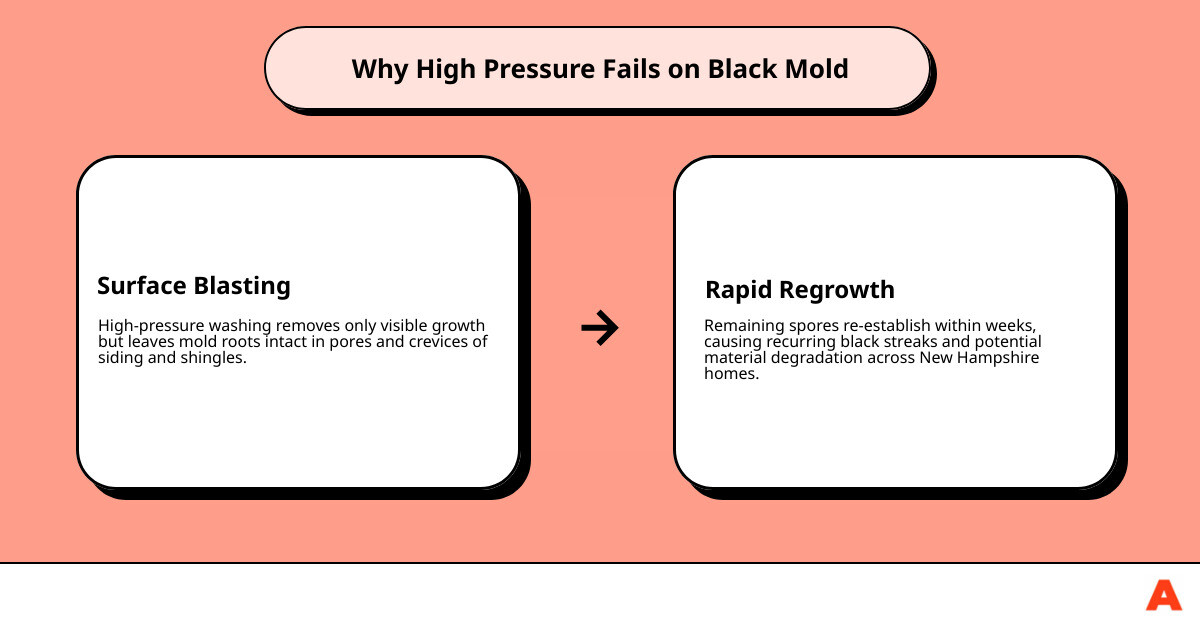
The Science of Black Mold on Exterior Surfaces (Why High Pressure Fails)
To understand why traditional high-pressure washing fails, we have to look at the biology of what is growing on exterior surfaces. The dark, unsightly streaks on New Hampshire roofs are often caused by a hardy type of cyanobacteria called Gloeocapsa magma. This bacteria feeds on the limestone filler used in modern asphalt shingles. As it grows, it creates a dark, protective pigment to shield itself from UV rays, resulting in those prominent black streaks.
True black mold, mildew, and algae are fungal and biological colonizers that thrive in moist, shaded environments. In areas like Bedford, Merrimack, Goffstown, and Hollis, where mature tree canopies and humid New England summers create the perfect microclimate, these organisms find a welcoming home on houses, commercial buildings, fences, decks, sidewalks, patios, pool areas, and fleet-related surfaces.
While mildew typically remains on the surface as a powdery white, gray, or yellowish layer, mold is far more insidious. Mold grows by sending out microscopic, root-like structures called filamentous hyphae. These hyphae penetrate deeply into porous building materials like wood clapboard, concrete, stucco, and even the tiny gaps in vinyl siding.
Leaving these organisms untreated on exterior surfaces poses two major threats:
- Structural Damage: Over time, mold and algae secrete acidic compounds that degrade building materials. On roofs, they can literally cut the lifespan of shingles in half by eating away the limestone and loosening the protective granules.
- Health Risks: As mold matures, it releases millions of airborne spores. When these spores gather around entryways, gutters, walkways, and loading areas, they can circulate around occupied spaces and trigger respiratory issues, asthma, and severe allergies.
Simply spraying these organisms with water does not solve the biological problem. To prevent their return, you must transition to a smarter methodology. For a deeper dive into why gentle methods always win, check out our guide: Don’t Be a High Pressure Mess and Switch to Low Pressure House Cleaning.
Why Traditional Blasting Fails for Soft Washing Black Mold Removal
A common mistake property owners make is turning to a 3,000 PSI pressure washer and blasting away at black mold.
While high pressure might temporarily strip away the visible dark patches, it behaves like mowing the top off a weed without pulling the root. The high-pressure stream merely shears off the surface growth. Because water alone does not kill the microscopic spores or the deep-set hyphae, the mold is left perfectly positioned to grow backoften thicker and faster than before, fueled by the moisture forced into the substrate.
Furthermore, traditional high-pressure washing poses a massive risk of physical damage to property:
- Vinyl Siding: High pressure can easily crack vinyl panels, strip away protective finishes, or force water behind the siding. This trapped moisture creates a hidden breeding ground for rot and interior mold.
- Asphalt Shingles: Blasting shingles with high pressure dislodges the protective ceramic granules, instantly aging the roof and voiding the manufacturer’s warranty.
- Wood, Stucco, and Concrete Surfaces: High-pressure streams can gouge wood clapboards, erode delicate stucco, and damage surface integrity on walkways, patios, and commercial flatwork.
To protect your property, you must avoid aggressive blasting. Learn more about protecting your siding by reading Don’t Blast Your Siding Away and Other Soft Washing Benefits.
The Soft Washing Solution: Gentle Pressure, Maximum Elimination
So, how do professionals eradicate black mold safely? The answer is soft washing.
Soft washing is a specialized cleaning methodology that swaps out mechanical brute force for chemical sanitization. Instead of blasting exterior surfaces with thousands of pounds of pressure, soft washing utilizes highly specialized, low-pressure pumps operating between 40 and 100 PSIessentially the same pressure as a standard garden hose.
This gentle pressure is used solely to apply a water-based biocidal solution to the surface and gently rinse it away. The chemical solution does all the heavy lifting, breaking down and neutralizing the organic matter on contact.
For properties in Goffstown, Merrimack, Bedford, and Hollis, this technique is the safest way to clean delicate siding, trim, roofing, fencing, decks, patios, walkways, and many commercial exterior surfaces. It is also the only roof cleaning method officially approved by the Asphalt Roofing Manufacturers Association (ARMA). If you want to see how this applies directly to New Hampshire properties, explore our specialized New Hampshire non-pressure roof cleaning resources.
How Soft Washing Black Mold Removal Works at the Molecular Level
The true magic of soft washing black mold removal happens at the molecular level. The primary active ingredient in professional soft washing solutions is sodium hypochlorite (NaOCl), typically applied at a carefully controlled dilution rate of 1% to 6% depending on the severity of the mold infestation.
Sodium hypochlorite acts as an oxidizing biocide. When it comes into contact with mold, mildew, or algae, it denatures the cellular proteins of the organism and destroys its chlorophyll. This reaction instantly neutralizes the living cells and kills the microscopic spores at their very root, preventing biological recolonization.
To ensure the solution works effectively, professionals mix it with surfactants. Surfactants serve two critical purposes:
- Surface Tension Reduction: They break the surface tension of the water, allowing the biocide to penetrate deep into the porous crevices where mold roots hide.
- Clinging Power: They create a thick, soapy lather that helps the solution cling to vertical siding and steep roof slopes. This ensures the biocide has adequate “dwell time” (typically 10 to 20 minutes) to completely sanitize the surface before being gently rinsed away.
For a closer look at how this process outperforms pressure washing on local properties, read Merrimack Roof Cleaning: Why Soft Washing Wins.
Safe Chemical Solutions and Surface Protection
A common concern among New Hampshire property owners is whether the chemicals used in soft washing are safe for people, pets, and landscaping. The short answer is yeswhen applied by trained professionals using proper safety protocols.
The specialized solutions we use are entirely biodegradable. Once they have neutralized the organic mold and algae, they break down naturally into simple salt and water, leaving no harmful chemical residues behind.
However, because these solutions are highly effective algaecides, they can temporarily stress or damage delicate garden plants and turf grass if applied carelessly. To prevent this, we practice strict plant protection protocols:
- Pre-Wetting: Before we apply any cleaning solution to siding, roofing, fencing, decks, patios, or commercial exteriors, we thoroughly saturate all surrounding plants, shrubs, and grass with fresh water. This fills the plants’ root systems and coats their leaves, preventing them from absorbing the cleaning solution.
- Rinsing and Dilution: During and after the soft wash process, we continuously rinse the landscaping to dilute any runoff to completely safe, non-toxic levels.
- Surface Compatibility: This gentle chemical approach is completely safe for delicate exterior materials, including limestone, wood clapboard, vinyl, fiber cement, and many masonry surfaces.
To make sure your next service goes smoothly, review our essential 10 Dos and Don’ts for House Soft Washing Service.
Protecting Your Landscaping and Siding Materials
In towns with mature landscaping like Hollis, Bedford, Merrimack, and Goffstown, protecting ornamental plants, flower beds, and shrubs is a top priority. Our team uses specialized tarps and plant covers where necessary, but our primary defense is constant hydration. By maintaining a wet barrier on all foliage, we help ensure that any surfactant runoff is heavily diluted and neutralized.
Furthermore, we carefully calibrate our soft wash mixtures to match the specific exterior material being cleaned:
- Vinyl Siding: We use a light surfactant blend to lift dirt and kill mold without causing oxidation or leaving soapy film.
- Wood Clapboard and Cedar Shingles: We apply a balanced biocide concentration that kills deep-set mold spores without stripping natural wood oils or damaging the wood fibers.
- Fiber Cement and Stucco: These highly porous materials require a slightly longer dwell time but benefit immensely from low-pressure application, which prevents water from penetrating the substrate.
- Concrete, Sidewalks, and Patios: We use surface-appropriate treatment methods to eliminate organic growth while preserving the material’s appearance and service life.
The Real Cost of Professional Soft Washing in New Hampshire
When considering professional exterior cleaning in 2026, it is helpful to understand how the industry structures its pricing.
Please note: All prices mentioned below are average industry costs sourced from publicly available online data. They do not reflect the actual rates of ACME Pressure Washing, but rather serve as a general guide to help you budget.
According to national industry averages and online data, a basic exterior home wash might average around $350. However, because New Hampshire homes vary wildly in size, height, architectural complexity, and mold severity, actual professional soft washing rates span a wide, realistic range. To account for this industry variability, you can expect average professional rates to range from $700 on the low end (about twice the national average for basic packages) up to $2,000 or more on the high end (at least five times the average cost) for larger, multi-story estates with heavy biological growth.
While soft washing may carry a higher initial price tag than a cheap high-pressure blast, it offers unparalleled long-term value. To see a detailed breakdown of how these costs compare over time, read our guide on The Real Cost to Power Wash Your House in 2026.
Comparison: Pressure Washing vs. Soft Washing
| Feature / Metric | Traditional Pressure Washing | Professional Soft Washing |
|---|---|---|
| Operating Pressure | 1,500 to 4,000 PSI | 40 to 100 PSI |
| Primary Cleaning Action | Mechanical force (blasting) | Chemical sanitization (killing) |
| Kills Mold Spores? | No (removes surface only) | Yes (kills down to the root) |
| Risk of Surface Damage | High (cracked siding, stripped wood) | Extremely Low |
| Average Clean Lifespan | 3 to 6 months | 12 to 18+ months |
| Warranty Protection | May void roofing warranties | Fully complies with ARMA guidelines |
Average Pricing and Long-Term Value
Investing in professional soft washing in Goffstown or Merrimack pays massive dividends in home maintenance savings. Because soft washing sanitizes the surface and kills the root systems of mold and algae, the results last up to 4 to 6 times longer than traditional pressure washing.
Additionally, keeping your roof and siding clean directly impacts your wallet:
- Extended Roof Lifespan: Removing Gloeocapsa magma prevents premature shingle decay, saving you tens of thousands of dollars in early roof replacements.
- Improved Energy Efficiency: Dark mold and algae streaks absorb solar heat, raising your attic temperature and forcing your air conditioning to work harder. A clean, light-reflective roof lowers cooling costs.
- Preserved Paint and Stain: Soft washing removes the organic acids that eat away at paint finishes, significantly extending the time between paint jobs.
Frequently Asked Questions About Soft Washing Black Mold Removal
How long do soft washing results last?
In our humid New England climate, a professional soft wash will typically keep your home’s exterior free of mold, mildew, and algae regrowth for 12 to 18 months. Because the process sanitizes the surface and kills the microscopic spores, the biological clock is completely reset, meaning you won’t see green or black stains creeping back after the first rainstorm. Homeowners in Bedford often find that an annual or bi-annual soft wash is all it takes to maintain pristine curb appeal year-round.
Can high-pressure washing void my roof warranty?
Yes, absolutely. The Asphalt Roofing Manufacturers Association (ARMA) explicitly warns against the use of high-pressure washing on asphalt shingles. High pressure strips away the protective mineral granules, which immediately compromises the shingle’s weatherproofing and voids your manufacturer’s warranty. Soft washing is the only industry-approved method for cleaning roofs safely. If you live in Hollis or the surrounding areas, always insist on a low-pressure chemical clean for your roof.
What is the best time of year to schedule soft washing in NH?
The ideal times to schedule soft washing in New Hampshire are Spring and Fall. During these seasons, moderate temperatures allow our biodegradable cleaning solutions to dwell on the siding and roof surfaces without drying out too quickly, maximizing their mold-killing effectiveness. Scheduling a service in the spring removes the winter’s damp accumulation, while a fall service prepares your home’s exterior to withstand the harsh, freezing winter months.
Conclusion: Trust New Hampshire’s Soft Washing Experts
When it comes to protecting your home from the destructive effects of black mold, you shouldn’t have to choose between a dirty house and damaged siding. Traditional high-pressure washing simply cannot solve a biological problem, and it risks causing thousands of dollars in physical damage to your property.
At ACME Pressure Washing, we have spent over 38 years perfecting safe, customized, and eco-friendly exterior cleaning techniques. Based proudly in Merrimack, NH, we serve homeowners and businesses across Bedford, Goffstown, Hollis, and the surrounding southern New Hampshire communities. Whether you need professional house washing, delicate roof cleaning, or commercial fleet and equipment pressure washing, our highly trained team has the experience and specialized equipment to get the job done right.
Don’t let black mold ruin your siding or cut your roof’s lifespan in half. Fill out our quick online Quote Form to request your free, no-obligation estimate. Let us restore your home’s beauty and protect your investment with the gentle, long-lasting power of professional soft washing!