




Algae Is Quietly Damaging Your Property Right Now
The soft washing algae removal technique is the most effective way to eliminate algae, mold, and mildew from exterior surfaces — without causing damage. Here’s a quick summary:
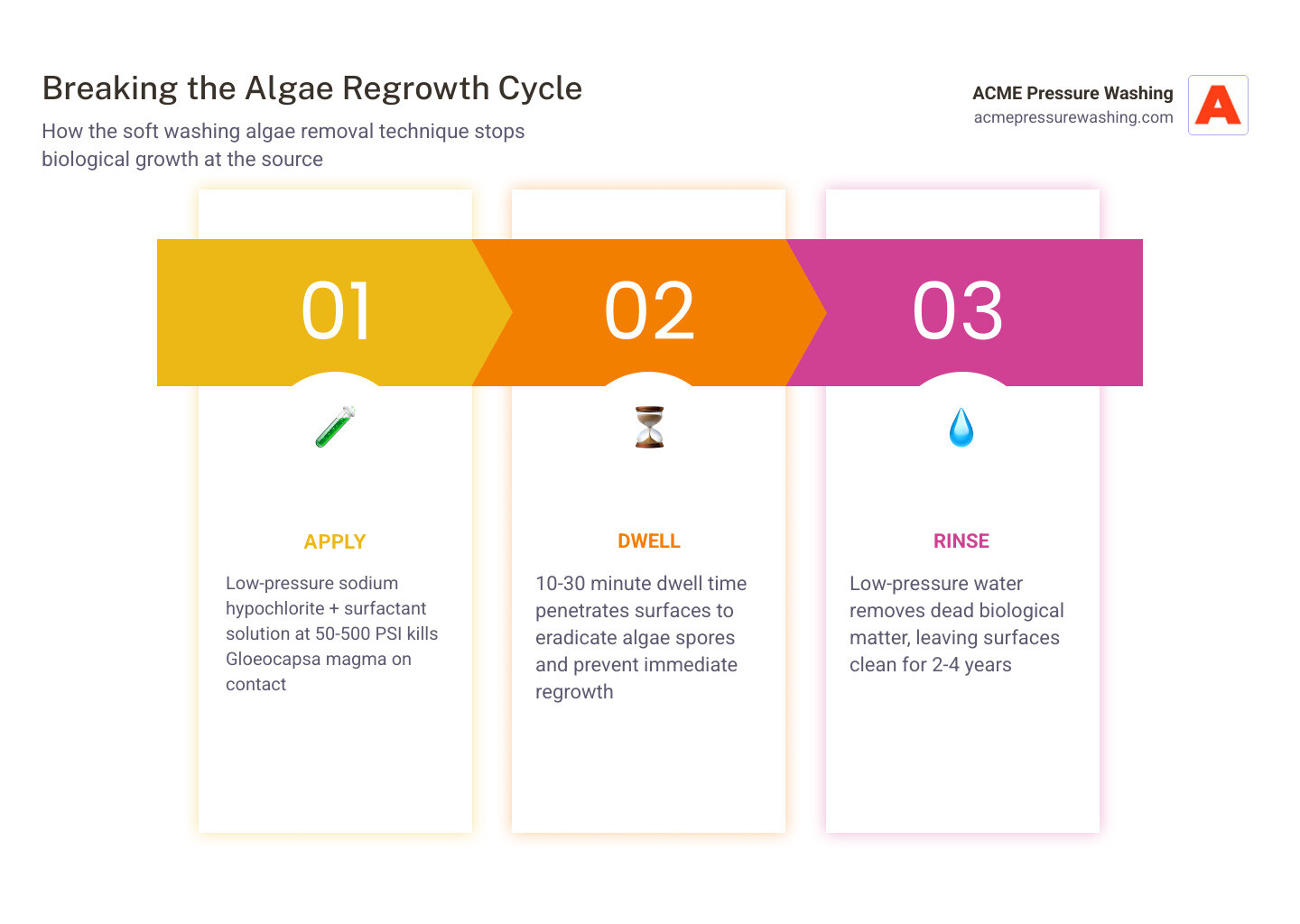
- Apply a low-pressure chemical solution (sodium hypochlorite + surfactant) at 50–500 PSI
- Dwell for 10–30 minutes to kill algae spores at the root
- Rinse with low-pressure water to remove dead biological matter
- Results last 2–4 years — up to 4–6x longer than pressure washing alone
Those dark streaks you see on roofs and building facades aren’t just dirt. They’re living organisms — specifically a cyanobacterium called Gloeocapsa magma — actively feeding on your surfaces.
Left untreated, this biological growth can take up to 10 years off the life of a roof. It traps moisture, degrades shingles, and spreads to siding, gutters, and surrounding structures. For commercial property owners in Merrimack and Bedford, this kind of damage is both a curb-appeal problem and a costly structural risk.
New Hampshire’s humid summers and cold, damp shoulder seasons create ideal conditions for rapid algae colonization. By the time streaks are clearly visible, the growth has already been working its way into your surfaces for months.
The good news? There’s a proven, industry-approved method to stop it — and protect your property for years.
I’m Lionel Greenwood, owner of ACME Pressure Washing, and I’ve been applying the soft washing algae removal technique on roofs, siding, and commercial facades across New Hampshire since 1988. Over 38 years, I’ve seen what untreated algae does to properties in towns like Merrimack, Manchester, and beyond — and how the right low-pressure chemical approach stops it for good.
What is the Soft Washing Algae Removal Technique?
To understand the soft washing algae removal technique, we first have to discard the idea that “higher pressure equals cleaner surfaces.” While traditional pressure washing relies on sheer mechanical force (often between 1,500 and 4,000 PSI) to blast away surface grime, soft washing takes a completely different, scientific approach.
Soft washing is a low-pressure cleaning method that operates at or below 500 PSI—and frequently as low as 40 to 100 PSI (which is comparable to the force of a standard garden hose). Instead of using raw physical impact to strip away contaminants, soft washing relies on a customized chemical sanitation process. This specialized solution is applied gently to the target surface, where it works at a molecular level to emulsify dirt, break down spiderwebs, and completely neutralize biological colonizers like algae, mold, mildew, and moss.
The primary benefit of this technique is absolute surface preservation. High-pressure water can easily crack vinyl siding, strip paint, erode mortar, and force water behind building envelopes, leading to hidden mold growth and structural decay. By switching to a low-pressure methodology, we eliminate these structural hazards entirely. For a deeper look into why high pressure can be a liability for your property, read our guide on how to switch to low pressure house cleaning.
Science Behind the Soft Washing Algae Removal Technique
The remarkable efficacy of soft washing lies in its chemistry. A professional soft wash solution is not a single chemical, but a carefully calibrated recipe designed to target organic life while remaining safe for the underlying substrate.
The core active ingredient in most soft wash formulations is sodium hypochlorite (NaOCl), typically utilized at a concentration of 1% to 6% depending on the severity of the biological load and the surface material being treated. Sodium hypochlorite acts as a highly effective biocide. When it comes into contact with algae, mold, or mildew, it denatures the proteins within the organism’s cellular structure and disrupts its lipid membranes. This chemical reaction kills the biological growth instantly, dissolving the root systems (or rhizines) that anchor these organisms to porous materials.
However, sodium hypochlorite alone cannot achieve optimal results. It requires a secondary component: a high-quality surfactant. Surfactants act as wetting agents that reduce the surface tension of the water. This allows the cleaning solution to penetrate deeply into the microscopic cracks, pores, and crevices of materials like stucco, concrete, and wood. Additionally, the surfactant acts as a cling agent, ensuring the solution does not simply run off vertical surfaces but remains in place to maximize contact time.
By killing the spores at the biological level, soft washing does not just clean the surface; it completely sanitizes it. This molecular-level eradication is the reason soft washing keeps surfaces clean up to three times longer than standard pressure washing. For more insights on how these chemical mechanics protect your home’s exterior, explore our article detailing the benefits of soft washing.
ARMA Guidelines and Roof Shingle Safety
When it comes to roof cleaning, the stakes are incredibly high. Asphalt shingles are manufactured with a protective layer of mineral granules. These granules serve a vital dual purpose: they protect the underlying asphalt from degrading under harsh ultraviolet (UV) rays and they provide essential fire resistance.
Unfortunately, Gloeocapsa magma (the cyanobacteria responsible for those unsightly black streaks) feeds directly on the limestone filler used to manufacture modern asphalt shingles. As the algae consumes this limestone, it loosens the protective granules. If a property owner attempts to clean these shingles using traditional high pressure, the mechanical force will instantly dislodge millions of these weakened granules, permanently reducing the roof’s lifespan and immediately voiding the manufacturer’s warranty.
Because of this severe risk, the Asphalt Roofing Manufacturers Association (ARMA) has published strict technical bulletins regarding roof cleaning. ARMA explicitly recommends low-pressure chemical washing as the only safe, approved method to remove algae discoloration from asphalt shingles.
By utilizing the soft washing algae removal technique, we can gently apply the ARMA-approved sodium hypochlorite and surfactant mixture to the roof. The solution neutralizes the algae at the root, allowing the dead organic matter to wash away naturally with subsequent rainfalls, without losing a single protective shingle granule. If you are dealing with moss or lichen alongside algae on your roof, it is critical to handle it correctly to avoid structural damage. Check out our comprehensive guide on roof shingle moss cleaning to learn how to clean these delicate surfaces safely.
Why Traditional Pressure Washing Fails Against Algae
To understand why traditional pressure washing is fundamentally unsuited for biological contamination, we must examine the difference between mechanical force and chemical sanitation.
| Feature | Traditional Pressure Washing | Soft Washing |
|---|---|---|
| Operating Pressure | 1,500 to 4,000+ PSI | 50 to 500 PSI (often 40–100 PSI) |
| Primary Mechanism | High-velocity mechanical force | Chemical sanitation & biocide action |
| Algae Spore Eradication | Only removes surface layers; leaves spores alive | Kills 100% of spores at the root |
| Risk of Damage | High (gouging wood, stripping granules, water intrusion) | Extremely low (safe for shingles, stucco, and siding) |
| Longevity of Results | Algae typically returns within 6 to 12 months | Results last 2 to 4+ years (up to 6x longer) |
When you use high-pressure water to clean algae, you are essentially “mowing the weeds.” The high-velocity stream rips away the visible surface layer of the algae, giving the temporary illusion of a clean surface. However, the microscopic root structures and spores remain deeply embedded within the porous substrate of your siding, brick, or shingles.
Because the organic growth is still alive, it immediately begins to recolonize. In fact, because high-pressure washing often etches the surface and increases its porosity, it actually creates a more hospitable environment for new spores to cling to. As a result, algae typically returns within 6 to 12 months after a high-pressure wash.
Furthermore, hitting a roof or commercial facade with 3,000 PSI of water pressure can cause catastrophic physical damage. It can force water behind vinyl siding, leading to trapped moisture and rot within the wall cavity. On commercial properties in Amherst, this can lead to expensive remediation bills.
Soft washing, by contrast, focuses entirely on total biological eradication. It acts as a sterilizing agent, ensuring that no viable spores remain to kickstart a new colonization cycle. This is why a professional low-pressure wash wins every single time. To understand why soft washing is the superior choice for local properties, read our analysis on why soft washing wins in Merrimack.
Step-by-Step Professional Soft Washing Process
A successful, professional soft wash requires a systematic, disciplined approach. It is not as simple as spraying chemicals and walking away; it requires careful preparation, precise chemical blending, and strict adherence to safety protocols to protect both the property and the surrounding environment.
1. Pre-Inspection and Site Assessment
Before any equipment is turned on, we perform a comprehensive walk-through of the property. We identify the specific types of biological growth present (such as green algae, black cyanobacteria, or deeply rooted lichen), assess the structural integrity of the siding or roofing materials, and locate any areas of potential water intrusion. We also map out the surrounding landscaping, noting any sensitive plants, shrubs, or ornamental trees that require protection.
2. Rigorous Property and Vegetation Protection
Because the biocides used in soft washing are designed to target organic matter, they can pose a risk to landscaping if handled improperly. To prevent damage, we implement a strict plant protection protocol:
- Pre-Wetting: We thoroughly saturate all nearby grass, plants, and shrubs with clean water. This fills the plants’ root systems and leaves with fresh water, preventing them from absorbing any overspray or runoff.
- Physical Barriers: When working in close proximity to highly sensitive foliage, we apply lightweight, breathable tarps to shield the plants.
- Continuous Rinsing: Throughout the application process, a technician continuously rinses the surrounding vegetation with clean water to dilute any accidental overspray instantly.
3. Equipment Setup and Chemical Proportioning
Unlike DIY methods, professional soft washing utilizes dedicated, low-pressure delivery systems and specialized proportioning techniques. These techniques allow us to adjust the chemical ratios on the fly, ensuring we apply the exact concentration required for the specific surface and biological load without wasting solutions.
To learn more about why professional preparation and local expertise make all the difference for properties in the area, read our guide on Manchester soft washing.
Executing the Soft Washing Algae Removal Technique Safely
Once prep work is complete, we begin the application process. Executing the soft washing algae removal technique safely requires deep technical knowledge of chemical dwell times and surface dynamics.
First, the technician applies the custom-blended solution using a specialized soft wash wand equipped with a wide-angle, low-pressure nozzle. The application always starts from the bottom of the structure and moves upward to prevent streaking. For residential siding, we typically use a sodium hypochlorite concentration of 1% to 2%, while heavily colonized roofs may require up to 4% to 6% to break down dense algae and lichen.
Once applied, the solution must be allowed to “dwell” on the surface. Dwell time is the critical window where the chemistry does the heavy lifting. For standard algae and mildew, a dwell time of 10 to 15 minutes is standard. During this time, you will visually see the dark green and black stains fade and disappear as the organic matter is oxidized and neutralized.
After the dwell time is complete, we perform a thorough rinse using high-volume, low-pressure water. This rinse removes the neutralized biological debris, surfactant residue, and salt compounds, leaving behind a completely sanitized, clean surface. Throughout this entire execution phase, our teams strictly adhere to safety standards across Manchester, Bedford, and all our NH service areas. For a detailed list of best practices and common pitfalls to avoid during this process, read our 10 dos and donts for house soft washing.
Post-Treatment Care and Longevity
One of the most remarkable aspects of the soft washing algae removal technique is that the cleaning action actually continues long after our trucks drive away.
When we treat a porous surface like concrete, brick, or asphalt shingles, a microscopic amount of the biocide remains safely embedded within the pores of the substrate. This residual barrier is highly alkaline (typically around pH 11). When natural rainfall occurs (which is slightly acidic, around pH 5.6), it reactivates this alkaline barrier. This natural reactivation process continues to sanitize the surface and repel new spores for months after the initial service.
Thanks to this residual protection, a professional soft wash keeps your property clean for 2 to 4 years, depending on local shade and moisture levels. To maximize this lifespan, property owners can take a few simple preventive steps:
- Trim Overhanging Trees: Cutting back tree limbs increases sunlight exposure and airflow, keeping surfaces dry and preventing the damp, shaded conditions that algae thrives in.
- Install Metal Strips: Installing zinc or copper strips along the ridge of a roof releases natural metallic ions during rainstorms, which act as a continuous, natural algaecide.
If your property is currently suffering from heavy moss or lichen buildup alongside algae, a specialized approach is required to ensure the roots are fully neutralized without damaging your shingles. For a step-by-step breakdown of how to handle these heavy infestations, read our guide on how to clean roof moss the right way.
Frequently Asked Questions About Soft Washing
How long do the results of soft washing last compared to pressure washing?
Soft washing results typically last 2 to 4 years, which is 4 to 6 times longer than conventional pressure washing. Because traditional pressure washing leaves microscopic spores alive in the pores of the material, algae regrowth usually occurs within 6 to 12 months. Soft washing completely eradicates these spores at the molecular level, breaking the biological regrowth cycle and keeping your surfaces cleaner up to 3 times longer.
What are the average costs for professional soft washing in New Hampshire?
Based on publicly available online data and general industry averages, the cost for professional soft washing varies widely depending on the size of the property, the height of the structures, and the severity of the biological growth.
Across the industry, average exterior cleaning costs can range from $800 on the low end to $4,500 on the high end for large estate properties or complex commercial structures. Please note that these figures are based entirely on general internet research and do not represent the actual rates or guarantees of ACME Pressure Washing. Every property is unique, and we provide custom, upfront quotes based on an in-person assessment of your specific needs.
Is soft washing safe for delicate siding and landscaping?
Yes, when performed by trained professionals, soft washing is completely safe for delicate siding materials like vinyl, stucco, and cedar shake, as well as your surrounding landscaping. Because we operate at pressures under 100 PSI, there is zero risk of physical surface damage. Additionally, our strict plant protection protocols—including pre-wetting, continuous dilution, and post-rinsing—ensure that your grass, flowers, and shrubs remain perfectly healthy throughout the process.
Conclusion
When it comes to protecting your property from the destructive effects of algae, mold, and mildew, brute force is never the answer. The soft washing algae removal technique represents the perfect marriage of chemistry and care—offering a gentle, highly effective, and long-lasting solution that preserves your property’s structural integrity while restoring its original beauty.
At ACME Pressure Washing, we have spent over 38 years perfecting our customized, eco-friendly exterior cleaning techniques. Based in Merrimack, NH, we proudly serve commercial and residential clients throughout Manchester, Bedford, Amherst, and the surrounding regions. Whether you need to restore a commercial building facade, clean a delicate shingled roof, or wash a fleet of trucks, our experienced team has the specialized equipment and technical expertise to deliver flawless results safely.
Don’t let algae degrade your property’s value and structural integrity. Contact us today to experience the difference that 38+ years of local expertise can make.
- Call Us Today: +1603-883-6900
- Get Your Free Quote: Request a Custom Estimate Online
Our Services
Like us on Facebook!
