Pressure washing can remove some loose efflorescence, but it does not correct the moisture that carried salts to the surface, and excessive pressure can damage brick or mortar. The right first step is to identify the deposit, trace the moisture pattern, and test the gentlest suitable cleaning method on a small area.
That distinction matters on Southern New Hampshire buildings and hardscapes. A white mark that appears after wet weather may be a removable salt deposit, a harder mineral deposit, residue from an earlier cleaning, or a sign that water is repeatedly moving through the assembly. Those conditions do not share one cleaning answer.
What efflorescence looks like
The Brick Industry Association describes efflorescence as a usually white, crystalline deposit left when water carries soluble salts through masonry and then evaporates. Its stain-identification guidance also warns that not every white mark is efflorescence.
Use appearance and location as clues, not as a final diagnosis:
- Powdery or crystalline material: This is consistent with efflorescence, especially when it brushes away dry and returns after wet conditions.
- Hard white or gray crust below a crack or weep: This may be lime run, which is less water-soluble and can be harder to remove.
- Irregular white or gray film after an earlier acid cleaning: This may be white scum rather than efflorescence.
- Soft, dusty concrete: The surface itself may be deteriorating. Cleaning should pause until the material is assessed.
When the source or composition is uncertain, the association recommends verification by experienced brick or masonry personnel before cleaning. The wrong chemistry can leave a more difficult stain or damage the masonry.
Why the white deposit returns
Efflorescence needs three things: soluble salts, water, and a path that lets the salt solution move to an evaporation surface. The Brick Industry Association's efflorescence technical note recommends identifying and correcting the water source before attempting to remove recurring deposits.
Document the pattern before cleaning:
- Does it appear after rain, snowmelt, irrigation, or a freeze-thaw cycle?
- Is it concentrated at the base of a wall, beneath a cap, around a downspout, or along one mortar joint?
- Is the masonry less than a year old, or is this a new symptom on an older wall?
- Are there open joints, failed sealant, cracked units, blocked drainage paths, or soil held against the masonry?
- Does the deposit return in the same place after it is brushed away?
This record separates a surface-cleaning task from a moisture-control or masonry-repair task. A cleaner may improve the appearance, but a mason, building-envelope professional, roofer, or drainage specialist may need to correct the source.
A five-step decision before pressure washing efflorescence
1. Try a dry observation first
Photograph the dry surface and lightly brush a small inconspicuous area with a nonmetallic fiber brush. Do not turn the entire wall into a test. Loose new-building bloom or light efflorescence may respond to weathering or gentle brushing.
2. Check the material and finish
Identify whether the surface is fired clay brick, concrete brick, poured concrete, natural stone, stucco, painted masonry, or a sealed product. A method suitable for one material can discolor or damage another. Record any coating and, when possible, the brick or cleaner manufacturer's instructions.
3. Resolve recurring moisture clues
If the deposit keeps returning, do not treat repeated cleaning as the fix. Investigate the water path first. A recurring band at the base of a wall calls for a different owner and repair question than temporary bloom on new masonry.
4. Require a test area
The Brick Industry Association's brick-cleaning guidance calls for matching the solution and method to the brick, using the gentlest effective method, and evaluating a trial area after it dries. The sample should include mortar as well as brick because both can change during cleaning.
5. Set a weather gate
Water-based masonry cleaning should not be squeezed into a New Hampshire freeze window. The same guidance says not to clean during freezing weather or when freezing is expected. For water-only methods, it prefers air temperatures of at least 40°F that remain above freezing until the wall dries. The contractor should set the actual weather window for the material, method, and exposure.
Can more pressure solve stubborn efflorescence?
No. More pressure is not a substitute for correct identification or chemistry. On brickwork, the association recommends low-pressure rinsing and warns that excessive pressure can damage brick faces, erode mortar joints, or strip finishes. It also says not to use unbuffered muriatic or hydrofluoric acid.
Stubborn deposits may need a manufacturer-compatible proprietary cleaner, controlled application, thorough rinsing, and runoff management. That is a method-selection problem, not a reason to reach for the strongest nozzle or an improvised acid mix.
Choose the right next professional
- Exterior cleaner: The deposit has been identified, the surface is sound, the water source is not active or has been corrected, and you need a test-area cleaning plan.
- Mason or building-envelope specialist: Mortar is soft or missing, units are cracked or spalling, the wall has an unresolved leak pattern, or the deposit is hard and its identity is uncertain.
- Drainage, roofing, or waterproofing specialist: Water is entering from grade, a roof edge, flashing, irrigation, or another condition outside the cleaning scope.
For a sound exterior surface in Merrimack or Southern New Hampshire, ACME's commercial pressure washing service can help evaluate a surface-appropriate cleaning scope. Send photographs in dry and recently wet conditions, note when the deposit returns, identify the masonry or coating if known, and ask how the test area and runoff will be handled. If the surface is damaged or the moisture source is unresolved, address that condition before scheduling cleaning.
A useful commercial dumpster pad cleaning plan answers five questions before water reaches the surface: what is on the pad, where runoff can travel, what must be moved, when the work can happen, and what “ready to reopen” means. That short pre-walk protects the property manager from surprises and gives the cleaning crew a scope they can price and schedule accurately.
This matters in Southern New Hampshire because one service area can connect a loading lane, employee path, storm drain, and customer parking. Treating the pad as an isolated square of concrete misses the way the rest of the property functions.
Start with the material on the pad
Walk the enclosure before the service visit and separate ordinary buildup from anything that changes the job.
- Loose waste: Cardboard, bags, broken glass, food scraps, and windblown trash should be removed before washing begins.
- Routine residue: Dirt, tracked grime, and light organic buildup can be documented by location and severity.
- Grease or automotive fluids: Mark the affected area and tell the cleaner what is known about the spill. Do not wash an unknown liquid toward a drain.
- Unknown or hazardous material: Stop and use the property's spill-response procedure or an appropriate specialist. Exterior cleaning is not a substitute for hazardous-material handling.
The goal is not to diagnose every stain. It is to prevent a routine cleaning appointment from starting with an unreported condition that needs a different response.
Map three zones, not just the dumpster enclosure
A simple three-zone sketch turns a vague request into a workable site plan.
1. The clean zone
Mark doors, customer routes, employee walkways, food or product receiving areas, and anything that must remain accessible. Decide which route stays open while the service area is closed.
2. The work zone
Include the pad, enclosure walls, gates, bollards, adjacent pavement, and the space needed to move the container. Note damaged concrete, loose mortar, failed coatings, or joints that should be reviewed before cleaning.
3. The runoff zone
Follow the slope. Record every trench drain, catch basin, curb opening, low point, landscaped edge, and public way the water could reach. The EPA-hosted business stormwater guidance says not to wash trash, grease, or vehicle fluids into storm drains and advises blocking drains and collecting wash water during pressure-washing work. Local requirements and the actual drain connection still need to be confirmed for the property.
Ask the contractor to explain the containment and disposal plan for this site. “It runs downhill” is an observation, not a plan.
Coordinate the service window with real operations
Pick the cleaning window by working backward from the property's schedule:
- Confirm the waste-hauler pickup time and whether the container can be moved.
- Choose a period with the least customer, tenant, delivery, and employee traffic.
- Identify who will unlock gates, move vehicles, and keep the route clear.
- Allow time for final inspection and for the surface to reach the agreed reopening condition.
- Tell affected tenants or staff which path and entrance remain available.
An off-hours appointment is only useful if the crew can reach the pad and the container is not blocking the surface that needs cleaning. ACME confirms that it can schedule commercial exterior work around business hours, but the estimate should still name the exact access window.
Define success before the estimate
“Clean the dumpster area” can mean several different scopes. Decide what the quote should include:
- the concrete or asphalt pad;
- the inside and outside faces of the enclosure walls;
- gates, bollards, curbs, and the approach lane;
- localized grease or organic buildup that needs pretreatment;
- runoff containment and collection;
- before-and-after documentation; and
- a one-time reset or a recurring maintenance visit.
Also separate appearance goals from removal guarantees. A porous, worn pad can retain discoloration after removable residue is gone. A test area can help set a realistic expectation before the entire enclosure is treated.
Use condition triggers to choose a maintenance interval
There is no useful universal rule such as “clean every month.” A better plan watches for conditions that change the property:
- residue spreading beyond the enclosure;
- repeated leaks after pickups;
- loose trash collecting near drains;
- visible buildup on the customer or employee route;
- seasonal operations that increase waste volume; or
- a scheduled inspection, tenant turnover, or exterior maintenance project.
Record the condition before and after the first cleaning. That gives the property manager evidence for setting the next visit instead of guessing from a calendar.
Pause the job when the scope changes
Do not start routine pressure washing when the crew encounters an unknown spill, a drain path that cannot be controlled, unstable masonry, badly broken pavement, an unidentified coating, or a service area that cannot be separated from people and deliveries. Resolve the condition or bring in the appropriate specialist first.
If you are planning work in Merrimack or elsewhere in Southern New Hampshire, ACME's commercial pressure washing service includes dumpster pads, storefronts, sidewalks, parking areas, and other exterior surfaces. For a useful estimate, send the pad material, drain locations, pickup schedule, preferred service window, and photographs of any unusual residue.
Why Concrete Driveway Stain Removal Is Harder Than It Looks
Concrete driveway stain removal is one of the most frustrating property maintenance challenges homeowners and business owners face — and acting fast is the single most important factor in your success.
Here’s a quick answer to the most common questions:
| Stain Type | Best First Response | Best Removal Method |
|---|---|---|
| Fresh oil/grease | Cat litter or sawdust to absorb | Degreaser or enzyme cleaner |
| Old/deep oil | N/A — already set | Poultice or hot-water extraction |
| Rust | Blot and rinse immediately | Commercial rust remover or oxalic acid |
| Paint | Scrape surface layer | Chemical stripper matched to paint type |
| Tire marks | Rinse quickly | Alkaline cleaner + stiff brush |
| Mold/mildew | Rinse and dry area | Bleach solution or outdoor mold killer |
| Organic (leaves, tannin) | Sweep debris fast | Dish soap solution + scrubbing |
| Road salt / fertilizer | Rinse immediately | Commercial rust remover |
The core problem is concrete’s porosity. Concrete is made from natural materials — limestone, clay, sand, and iron ore — which makes it highly porous. Liquids don’t just sit on the surface. They wick into microscopic pores through capillary action, sometimes within minutes. Once a stain sets deep, even repeated cleaning may not fully remove it. In fact, older stains can resurface after cleaning as buried pigments migrate back up through the concrete matrix.
Research consistently shows that early intervention reduces stain removal difficulty by as much as 75%. That stat alone should motivate you to keep absorbent material — like plain clay cat litter or sawdust — on hand for spills.
I’m Lionel Greenwood, owner of ACME Pressure Washing, and I’ve been tackling concrete driveway stain removal across New Hampshire for over 38 years, working with residential and commercial properties throughout Merrimack, Londonderry, and beyond. In this guide, I’ll walk you through exactly what works — and what doesn’t — so you can make the right call for your driveway.
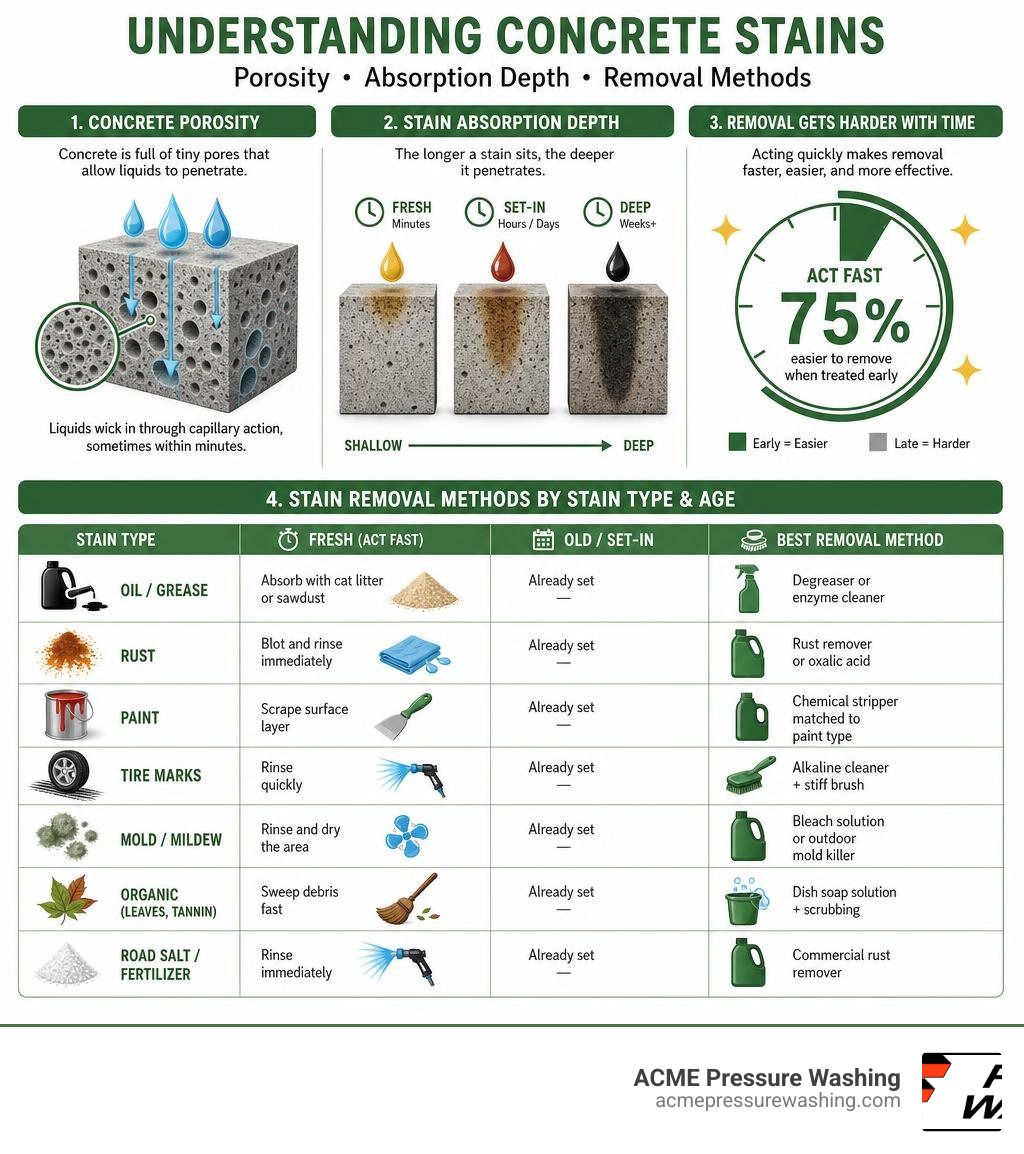
Concrete driveway stain removal terms you need:
Professional Concrete Driveway Stain Removal: Understanding the Science of Porosity
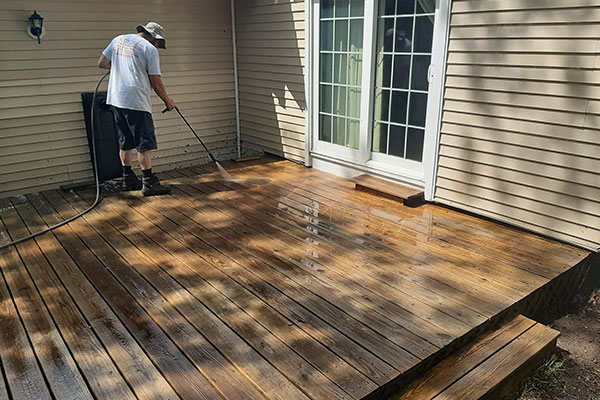
To understand why a simple garden hose and some dish soap won’t cut it for deep stains, we have to look at the microscopic structure of concrete. During the curing process, water evaporates from the concrete mix, leaving behind a network of tiny, interconnected voids called capillary pores. These pores generally range from 10 to 50 microns in diameter.
When a liquid contaminant like motor oil, hydraulic fluid, or fertilizer runoff is spilled, capillary action pulls the liquid deep into this sub-surface network. The cement paste itself contains calcium hydroxide, which carries a polar charge. This charge actively attracts hydrocarbons (found in oils and greases), creating a chemical bond that locks the contaminant into the concrete matrix.
As concrete driveways age, weathering and freeze-thaw cycles in New Hampshire open this pore structure even wider, allowing contaminants to penetrate even deeper. When you attempt a superficial clean, you only clear the top layer. Over time, the oil trapped deep within the capillaries migrates back to the surface in a process known as capillary rise, causing the stain to mysteriously “reappear” weeks later.
Understanding these dynamics is critical when considering your driveway pressure washing options, as professional-grade thermal extraction is often the only way to break these deep chemical bonds.
Why DIY Concrete Driveway Stain Removal Often Fails
Many property owners try to tackle concrete driveway stain removal themselves, only to end up with disappointing results or, worse, permanent damage to their driveway.
One of the most common issues we see in the field is a phenomenon called “shadow-ghosting.” When paint or dark oils penetrate the concrete, the sub-micron pigment particles (which are often smaller than 1 micron) become physically trapped inside the 10-to-50-micron pores. Even if you dissolve the surface resin using a standard hardware store solvent, these tiny pigments remain locked in place, leaving a permanent, faint “ghost” outline of the original stain.
Another major hazard of DIY attempts is physical surface damage. Property owners frequently resort to aggressive scraping, wire brushes, or highly acidic chemical washes in desperation. Wire brushes can scratch the smooth cream coat of the concrete, exposing the aggregate underneath and creating a permanently rough, discolored patch.
Using the wrong pressure washing equipment or techniques can also scar the surface. To avoid these costly errors, it is highly recommended to read up on how to avoid these common power washing mistakes before attempting any major cleaning project yourself.
According to a study on DIY surface maintenance, while 85% of homeowners found that chemical cleaners made stain removal easier, improper application frequently led to surface etching. For detailed breakdowns of chemical reactions on masonry, resources like How To Get Stain Out Of Concrete: Effective Methods For A Clean, Spotless Surface – ConcreteCaptain.com and How to Remove Concrete Stains (Oil, Paint, Rust & More) show that matching the exact chemical solvent to the specific resin or contaminant is essential to prevent permanent surface scuffing.
When to Call a Professional for Concrete Driveway Stain Removal
For commercial properties, large multi-car residential driveways, or deep-set stains that have lingered for months, professional intervention is almost always required.
Professional exterior cleaning companies utilize commercial-grade hot-water extraction units that can heat water up to 140°F (and sometimes higher) at the cleaning surface. This thermal energy is crucial because heat expands the concrete’s pores slightly while reducing the viscosity of trapped oils, allowing them to be flushed out. Cold-water DIY pressure washers simply cannot achieve this.
Furthermore, professional teams use specialized wastewater recovery systems to remain compliant with local environmental regulations. In towns like Merrimack, NH, and Goffstown, NH, washing hazardous automotive fluids directly into storm drains is a serious environmental violation. Professional recovery systems vacuum up the emulsified oil and dirty water on contact, keeping your property clean and compliant.
Common Driveway Contaminants in New Hampshire
Our driveways in New Hampshire face a unique set of harsh contaminants throughout the year:
- Motor Oil and Fuel: These petroleum-based hydrocarbons chemically bond to the aggregate and require heavy-duty surfactants or enzymatic breakdown.
- Hydraulic Fluid: A highly complex synthetic ester that wicks rapidly into the concrete matrix. If you are dealing with a leak from heavy equipment or a delivery vehicle, you can find a highly specific, step-by-step rescue plan on how to remove hydraulic fluid from concrete.
- Tannin Stains: Caused by decomposing organic matter like leaves, acorns, and pine needles left on the driveway over the winter. These leave stubborn brown, organic dyes.
- Fertilizer Rust: Iron compounds in lawn fertilizers oxidize when exposed to moisture, leaving bright orange or yellowish rust rings along the edges of your concrete.
- Tire Marks: Plasticizers and rubber compounds from hot tires can physically bond to concrete coatings or sealers.
- Road Salt and De-Icing Chemicals: While not a stain in the traditional sense, road salt leaves white mineral deposits and can cause physical scaling and structural damage over time.
Comparing Chemical, Poultice, and Hot-Water Extraction Methods
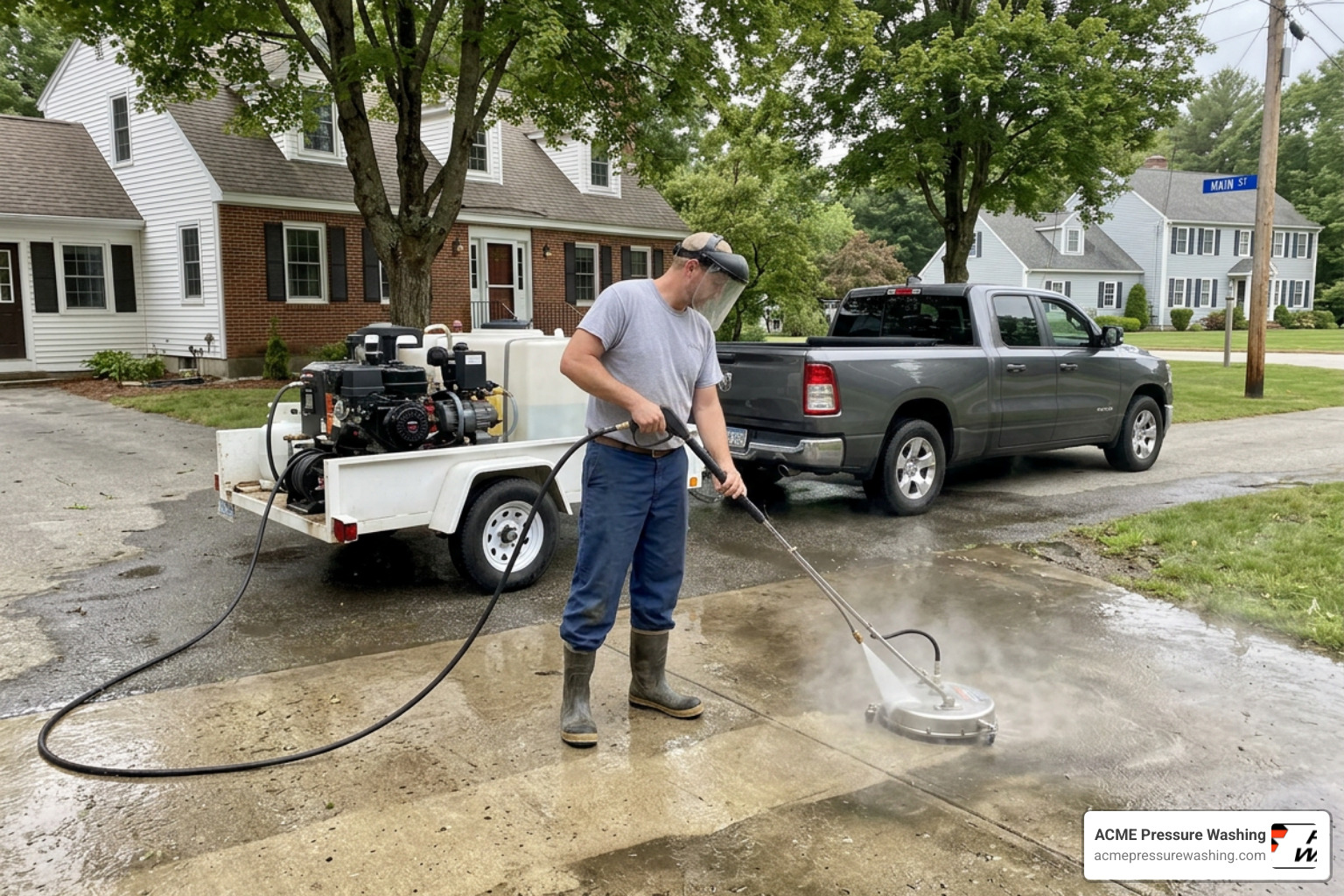
When choosing a method for concrete driveway stain removal, you generally have three primary approaches: chemical cleaners (such as enzymes), the poultice method, or professional hot-water extraction.
Choosing the right approach depends heavily on the age, depth, and type of the stain. For a comprehensive look at how these methods stack up specifically for petroleum spills, you can read more about concrete driveway oil stain removal methods and consult our guide on finding the best degreaser for stubborn oil stains.
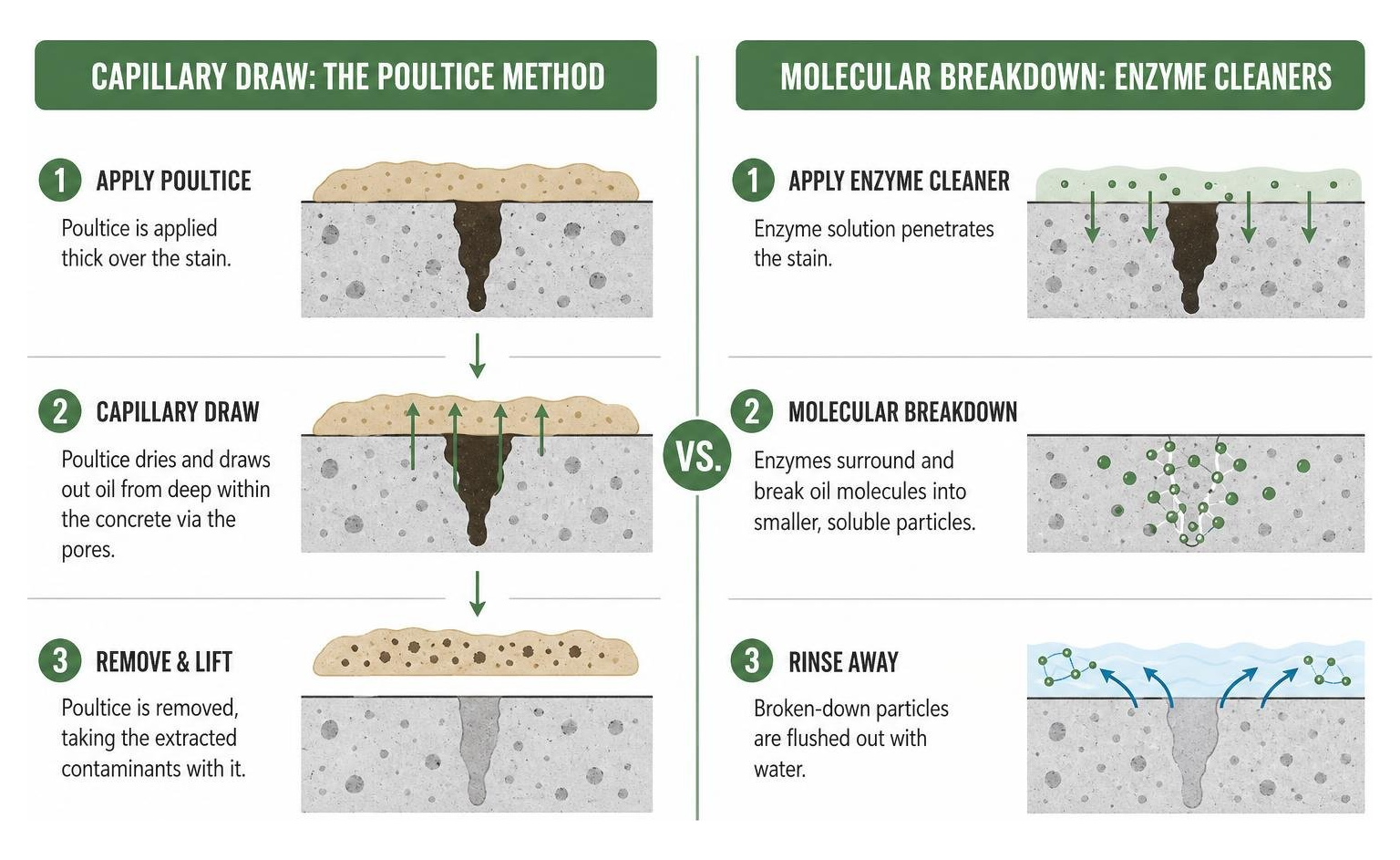
Below is a comparative breakdown of how these three methods perform across key metrics:
| Metric | Enzyme Cleaners | Poultice Method | Professional Hot-Water Extraction |
|---|---|---|---|
| Best Used For | Fresh to moderately old oil/grease stains | Deep-set, localized oil, paint, or rust stains | Large-scale cleaning, stubborn stains, and overall restoration |
| How It Works | Microorganisms digest hydrocarbon chains | Capillary action draws contaminants into an absorbent paste | High-heat thermal expansion emulsifies and flushes contaminants |
| Typical Timeline | 24 hours to several days (may require repeat applications) | 24 to 48 hours (drying time is critical) | Instant results (typically completed in a few hours) |
| Pros | Eco-friendly, easy to apply, no scrubbing required | Highly effective for drawing out deep, localized pigments | Safest for concrete integrity, cleans large areas uniformly, sanitizes |
| Cons | Ineffective on non-organic/non-petroleum stains | Labor-intensive, expensive for large areas, visually unsightly during process | Requires specialized professional equipment |
Enzyme Cleaners for Hydrocarbon Stains
Enzyme cleaners represent a major advancement in eco-friendly cleaning technology. Rather than relying on harsh acids or toxic solvents, these products contain active enzymes — specifically lipase (which targets fats and oils), protease (which breaks down proteins), and amylase (which targets starches).
When applied to an oil or grease stain, these enzymes act as catalysts to break down the complex, long-chain hydrocarbon molecules into simple water, carbon dioxide, and soluble organic byproducts. The bacteria in the solution then literally digest these harmless compounds.
For the best results, enzyme cleaners require a 24-hour timeline to allow the biological cultures to work. The concrete must remain damp during this period, as the enzymes require moisture to stay active. While highly effective for fresh, shallow oil spills, they struggle with old, deeply oxidized hydrocarbons or inorganic stains like rust and paint.
The Poultice Method for Deep-Set Pigments
The poultice method is a highly targeted, scientific approach designed to lift deep-set pigments out of concrete capillaries. It relies on the principle of capillary extraction.
To create a poultice, a chemical solvent or cleaner is mixed with an inert, highly absorbent carrier material — such as diatomaceous earth, kaolin clay, or even powdered talc — to form a thick paste with the consistency of peanut butter. For rust stains, an acid-based cleaner is used; for oil, a strong degreaser or solvent is applied. For a general reference of which solvents pair with specific stains, you can check How to Remove Stains from Concrete & Driveway | StainOut.
The paste is applied over the stain in a layer roughly 1/4 inch thick, extending about an inch beyond the stain’s edges. It is then covered with a sheet of 2-mil plastic wrap and taped down around the edges to prevent the solvent from evaporating too quickly.
As the solvent sits, it penetrates the concrete and dissolves the contaminant. Over the next 24 to 48 hours, as the moisture slowly escapes from under the plastic, the liquid is drawn back upward into the dry, absorbent powder of the poultice. Once completely dry, the powder is simply swept away, carrying the dissolved stain with it.
Why Professional Hot-Water Pressure Washing is the Safest Alternative to Destructive Grinding
When faced with incredibly stubborn, years-old stains, some property owners consider mechanical grinding. Grinding involves using a rotary machine with diamond-tipped abrasives to physically shave off the top layer of the concrete.
However, mechanical grinding carries massive risks. It permanently alters the surface texture of your driveway, stripping away the smooth, finished “cream” layer of the concrete and exposing the coarse aggregate beneath. This leaves a highly noticeable, permanently patchy, and rough area that is actually more susceptible to future staining because the newly exposed surface is highly porous.
Professional hot-water pressure washing is the safest, most effective alternative to this destructive method. By combining specialized, biodegradable chemical pre-treatments with water heated up to 140°F and delivered at a carefully calibrated pressure, we can safely emulsify and extract deep-set contaminants without altering the physical structure of your concrete. This preserves the structural integrity, uniform appearance, and longevity of your driveway.
Driveway Restoration Costs and Replacement Decisions in New Hampshire
As we look at property maintenance in July 2026, managing costs while preserving your property’s value is more important than ever. When dealing with a severely stained or weathered driveway, you must weigh the cost of surface restoration against the massive expense of a full concrete replacement.
Before making a decision, it is highly recommended to consult a comprehensive driveway cleaning cost guide to understand the market averages.
Our harsh New Hampshire climate plays a major role in this decision. The intense freeze-thaw cycles we experience in towns like Merrimack, NH, and Londonderry, NH, mean that any water trapped in concrete cracks or pores will expand when it freezes, rapidly accelerating structural damage.
When to Restore vs. Replace Concrete
How do you know when a driveway can be saved through professional stain removal and restoration, and when it is truly past its prime?
- Choose Restoration If: The damage is purely cosmetic (oil stains, rust, tannin discoloration, mold) and the concrete is structurally sound. Even if the stains are deep, professional hot-water extraction and sealing can restore the driveway to a like-new appearance at a fraction of the cost of replacement.
- Choose Replacement If: The concrete has deep, structural cracks that run entirely through the slab, or if you notice widespread “surface scaling” or spalling (where the top layer of concrete is actively flaking and crumbling away due to freeze-thaw damage). Once the structural bond of the cement paste has failed, no amount of cleaning can restore its integrity.
Average Costs for Professional Concrete Driveway Stain Removal
When budgeting for your driveway, it is helpful to look at general industry pricing. Please note that the pricing ranges below are average costs sourced from publicly available online industry data and do not represent the specific rates of ACME Pressure Washing.
- Professional Stain Removal & Restoration: Based on general online data, the average cost for professional concrete stain removal and deep cleaning ranges from $400 to $2,000, depending on the size of the driveway and the severity of the staining. To account for industry-wide variability (such as heavily neglected commercial lots or specialized chemical stripping), a realistic market range can span from $800 on the low end to $10,000 on the high end.
- Full Driveway Replacement: If the concrete is structurally compromised, replacement is required. Online data indicates that average driveway replacement costs range from $12,000 to $45,000. Depending on the square footage, decorative finishes, and excavation requirements, a wide industry range for replacement can run from $24,000 up to $225,000 for high-end commercial or expansive residential properties.
As you can see, investing in professional restoration early can save you tens of thousands of dollars compared to a premature replacement.
Frequently Asked Questions About Driveway Cleaning
What is the perfect PSI for cleaning concrete driveways?
For cleaning concrete driveways without causing damage, the industry standard is to use a pressure washer calibrated to roughly 3,000 PSI.
Using pressure higher than 3,500 PSI can permanently damage the concrete by etching the surface and stripping away the smooth cream coat, especially on concrete that is less than a year old. In towns like Amherst, NH, where properties feature beautiful, custom-poured concrete driveways, maintaining the correct pressure is vital to preserving the curb appeal and structural integrity of the surface. For a detailed breakdown of pressure settings, read our guide on the perfect PSI for concrete driveways.
How do you prevent future oil and rust stains?
The single most effective way to prevent future staining is to apply a high-quality, penetrating concrete sealer. Unlike topical sealers that sit on top of the surface and can wear away, penetrating sealers slip into the concrete capillaries and chemically react to form a water- and oil-repellent barrier.
You can perform a simple “water bead test” to check if your driveway is sealed: splash a cup of water onto the dry concrete. If the water beads up on the surface, the concrete is protected. If it immediately soaks in and darkens the concrete, it is time to reapply. In places like Londonderry, NH, we recommend reapplying a high-quality sealer every 1 to 3 years to protect against oil leaks, rust, and salt damage.
Can vinegar or bleach damage my driveway?
Yes, if used incorrectly. While vinegar is a popular DIY recommendation for light rust spots, it is highly acidic. Frequent or prolonged use of vinegar can dissolve the calcium carbonate bonds within the cement paste, weakening the concrete and leaving a rough, etched surface.
Bleach, on the other hand, will not structurally harm concrete, but using it at full strength is unnecessary and can cause uneven discoloration or strip the natural grey color of the concrete, leaving unsightly white splotches. In towns like Goffstown, NH, where driveways are highly visible, it is always best to use professionally formulated, pH-balanced concrete cleaners.
Conclusion
Restoring your driveway’s curb appeal doesn’t have to be a stressful, trial-and-error process. While DIY methods can handle very fresh, minor spills, deep-set oil, rust, paint, and environmental stains require specialized knowledge and commercial-grade equipment to fully resolve without damaging your concrete.
At ACME Pressure Washing, we bring over 38 years of experience using safe, customized, and eco-friendly techniques to protect and restore properties throughout Merrimack, NH, Londonderry, NH, Goffstown, NH, and the surrounding New Hampshire communities. Whether you need to clean a residential driveway, a commercial parking lot, or restore a weathered patio, our professional team is here to help.
Don’t let stubborn stains ruin your property’s first impression. Contact ACME Pressure Washing today at +1603-883-6900 or fill out our online quote form to get started. You can also schedule professional walkway and patio cleaning services to completely revitalize your outdoor living spaces!
Why Oil Stain Removal Matters for Your Property’s Safety and Value
Oil stain removal is one of the most urgent exterior cleaning problems property owners face — and one of the most commonly mishandled.
Here’s the short answer if you need it fast:
- Act immediately. Blot excess oil — never rub or rinse with water.
- Apply an absorbent (baking soda, cornstarch, or cat litter) to draw oil out of the surface.
- Use a surfactant-based degreaser (dish soap, commercial degreaser, or enzyme cleaner) and let it dwell.
- Rinse thoroughly — on concrete, a pressure washer with hot water delivers the best results.
- Never apply heat to fabric stains before confirming the stain is fully gone.
- For deep, set-in, or large spills on concrete — call a professional.
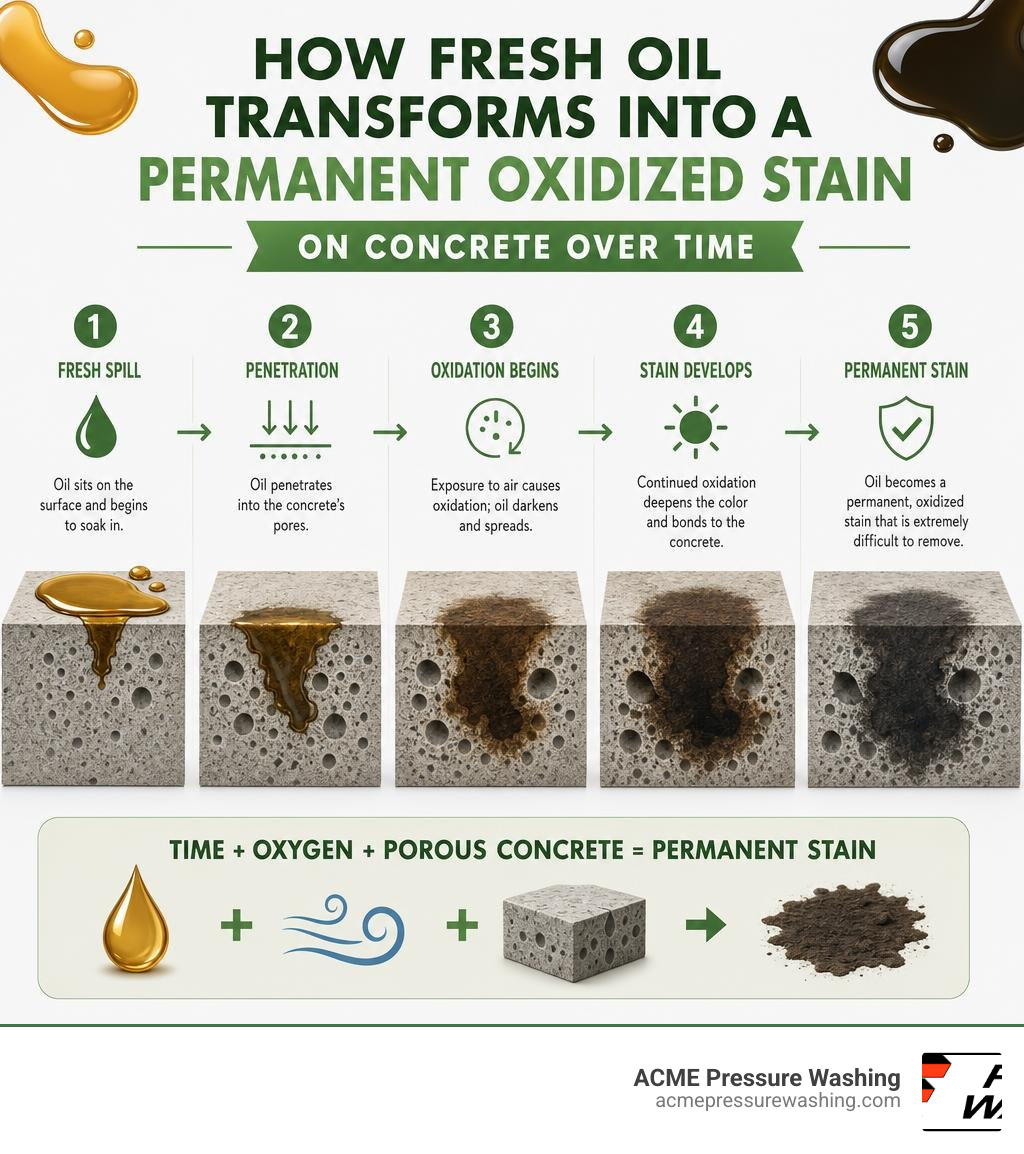
Oil stains are stubborn by nature. Whether it’s a slow drip from a parked vehicle on your Bedford driveway or a grease spill on a commercial loading dock in Londonderry, the problem rarely stops at the surface. Oil is hydrophobic — it actively repels water — and it penetrates porous materials like concrete quickly. Left untreated, it oxidizes, darkens, bonds more deeply to the surface, and eventually becomes extremely difficult or impossible to fully remove.
In New Hampshire, the freeze-thaw cycle makes this worse. Oil-softened concrete absorbs water, which then expands when it freezes — accelerating cracking and surface breakdown season after season.
I’m Lionel Greenwood, owner of ACME Pressure Washing, and I’ve spent more than 38 years tackling oil stain removal on driveways, commercial lots, walkways, and fleet yards across New Hampshire and Southern New England. In this guide, I’ll walk you through exactly what works — and what doesn’t — so you can protect your property the right way.
The Science of Hydrophobic Stains
To understand why oil is so incredibly difficult to clean, we have to look at its molecular structure. Oily substances consist of hydrophobic lipids, meaning they are chemically incapable of mixing with water. Standard water molecules have polar bonds, while lipids are non-polar. When you throw water directly onto a fresh oil spill, the water’s surface tension prevents it from penetrating the oil. Instead of washing the grease away, water simply sits on top of it or, worse, spreads the oil across a wider surface area.
Porous masonry surfaces like concrete and pavers act like dense, hard sponges. They are filled with microscopic channels and capillaries that pull liquid deep beneath the surface. When oil is spilled on concrete, capillary action draws the lipids deep into these pores.
Once inside, the oil begins to undergo oxidation. Much like metal rusting, exposure to oxygen causes the oil molecules to break down and bond chemically with the stone or concrete. Over time, this oxidized oil undergoes polymerization—a process where individual molecules link together to form long, complex chains. This transforms the liquid oil into a sticky, dark, varnish-like substance that is physically locked inside the concrete’s pores.
According to scientific studies on lipid chemistry, such as the Research on lipid stain chemistry, standard washing without specialized chemical intervention cannot lift these bonded lipids. Furthermore, petroleum-based oils can actually dissolve the binders in asphalt, leading to crumbling, potholes, and permanent structural damage. To safely lift these substances without ruining the material, you must use chemical agents that break these molecular bonds, as detailed in the Cornell University guide on stain removal.
Professional Oil Stain Removal for Concrete and Driveways
For hard exterior surfaces like concrete driveways, walkways, and parking lots in Merrimack and Goffstown, successful stain removal requires a combination of chemical emulsification and mechanical force.
When we tackle a heavy oil spill on a driveway or loading dock, we don’t just blast cold water at it. Cold water will only harden the grease. Instead, we utilize commercial-grade, eco-friendly degreasers paired with professional hot-water pressure washers.
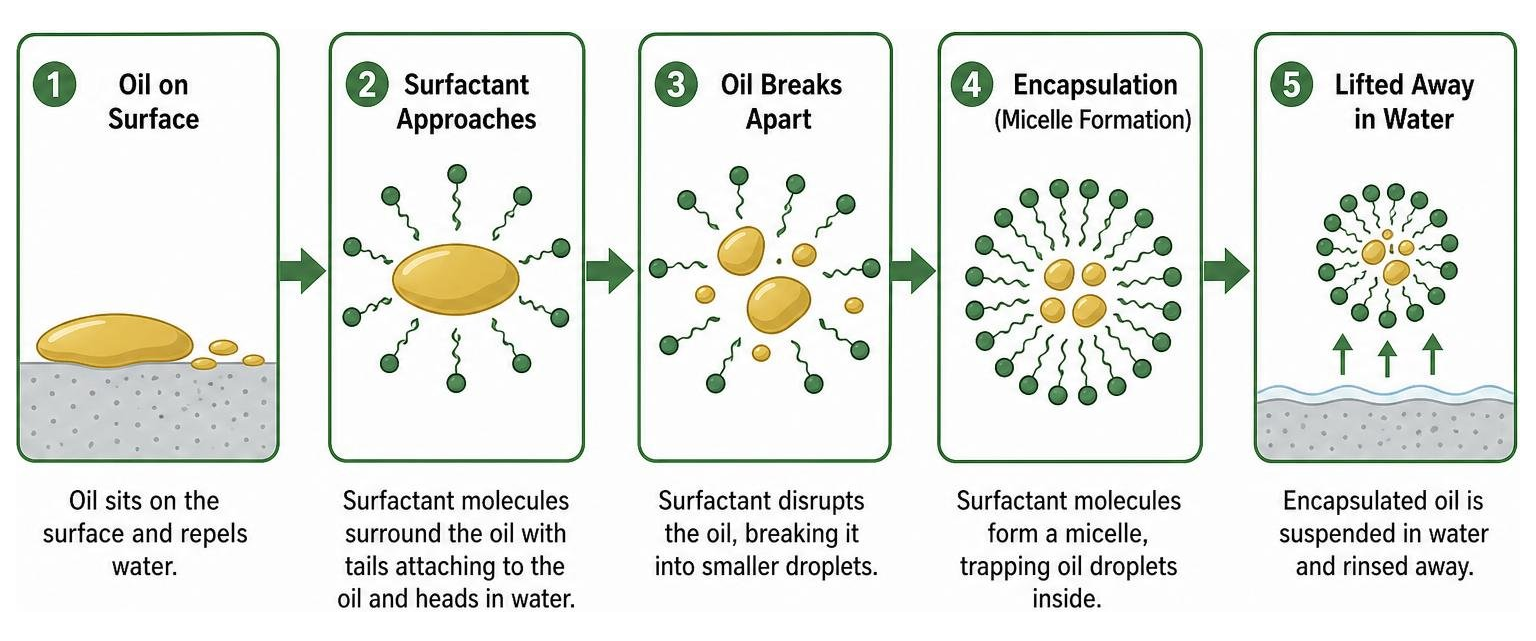
Our process begins with applying a specialized surfactant or poultice cleaner to the stain. These professional degreasers lower the surface tension of the water and penetrate deep into the concrete’s pores. The surfactant molecules have a dual nature: one end is attracted to water (hydrophilic), while the other end is attracted to oil (lipophilic). This unique structure allows the degreaser to surround individual oil droplets, breaking them down into microscopic particles suspended in water—a process known as emulsification.
Once the oil is emulsified, we use industrial pressure washers that heat water to over 200°F. The high temperature lowers the viscosity of the oil, liquefying the hardened grease so the emulsifiers can sweep it away. For more details on choosing the right chemicals for concrete, read our guide on Driveway Drama Finding The Best Degreaser For Stubborn Oil Stains.
During this process, managing water pressure is critical. Using too much force can etch the concrete, leaving permanent swirl marks or destroying the finished surface. We carefully adjust our equipment to the perfect level, as outlined in The Ultimate Guide To Finding The Perfect Psi For Concrete Driveways. Additionally, professional cleaning ensures full environmental compliance; we capture and contain the oily runoff so that toxic hydrocarbons do not enter local New Hampshire storm drains or damage your landscaping.
High-Level Fabric Oil Stain Removal Techniques
While our primary focus is on exterior surfaces, we frequently get asked how to handle oil spills on clothing or delicate indoor fabrics. The underlying science remains exactly the same: you must use surfactants to lift the hydrophobic lipids.
If you get grease or cooking oil on a fabric garment, keep these high-level tips in mind:
- Act Fast: Gently blot the fresh spill with a clean paper towel to remove excess liquid. Never rub, as rubbing pushes the oil deeper into the fabric fibers.
- Use Absorbent Powders: Sprinkle baking soda, cornstarch, or baby powder over the stain and let it sit for 30 to 60 minutes. These fine powders wick the liquid oil out of the fibers through capillary action before it can set.
- Apply a Surfactant: Work a high-quality dish soap (like blue Dawn) directly into the dry stain. Dish soaps are formulated with highly concentrated surfactants designed to strip food grease.
- The Heat Warning: Never put an oil-stained garment into a clothes dryer. The intense heat of the dryer will cause polymerization, permanently bonding the oil to the fabric fibers and creating a permanent “varnish” stain. Always air-dry the item and inspect it under bright light to ensure the oil is completely gone before machine drying.
Why Professional Oil Stain Removal Outperforms DIY Methods
Many property owners in Bedford and Londonderry attempt to remove driveway oil stains using rented pressure washers or hardware store degreasers. While these DIY methods might lighten a very fresh, minor spill, they almost always fall short on older, set-in stains.
First, standard consumer-grade pressure washers only use cold water. Without heat, cold water cannot reduce the viscosity of heavy motor oil or industrial grease, leaving the stain firmly locked in place. Second, consumer degreasers lack the molecular strength of industrial-grade surfactants.
Most importantly, improper pressure washing can easily destroy your masonry. We often see etched concrete, stripped joint sand in pavers, and ruined wood decks caused by well-meaning homeowners using too much pressure. Our team uses specialized hot-water systems and customized pressure levels to safely lift stains without causing structural damage. To learn more about the physical toll of manual scrubbing versus professional cleaning, check out our article on How To Deep Clean Your Patio Using Elbow Grease Instead Of Electricity.
The True Cost of Neglecting Exterior Oil Spills
It is tempting to look at a few oil spots on your driveway or loading dock and decide to “just let it go.” However, neglecting these spills leads to expensive, long-term damage.
In New Hampshire’s harsh climate, concrete and pavers are subjected to extreme freeze-thaw cycles. Because concrete is porous, it naturally absorbs water. When that water freezes, it expands, putting immense pressure on the concrete. Normally, high-quality sealants protect the surface. However, motor oil and hydraulic fluids break down these protective sealants and degrade the concrete binders. Once the concrete is weakened by oil, water penetrates deeply into the structure, leading to severe cracking, spalling, and surface scaling.
Additionally, oil spills create major safety hazards. Wet oil on walkways or commercial fleet parking areas in Goffstown and Merrimack becomes incredibly slick, creating immediate slip-and-fall liabilities for visitors, customers, and employees. For commercial fleet operations, keeping parking areas clean is also a key regulatory and branding requirement.
Investing in timely maintenance is far less expensive than replacing damaged concrete or paying for liability claims. For a detailed breakdown of maintenance costs, read our Driveway Cleaning Cost Guide For A Sparkling Entrance.
Below is a comparison of typical costs associated with DIY cleanup versus professional concrete maintenance:
| Cleaning Method | Average Cost (Based on Internet Data) | Typical Range (Based on Internet Data) |
|---|---|---|
| DIY Equipment & Chemical Rental | $150 | $300 – $900 |
| Professional Concrete Cleaning | $300 | $600 – $1,500+ |
Note: All prices mentioned in the table above are average costs sourced from publicly available internet data and do not reflect the actual pricing or guaranteed rates of ACME Pressure Washing. Actual costs vary based on surface condition, location, and contamination levels.
Frequently Asked Questions About Oil Stains
Can dried or set-in oil stains be completely removed from concrete?
Yes, in many cases, set-in oil stains can be significantly lightened or entirely removed. However, it requires professional hot-water extraction and industrial-strength degreasers to break the polymerized bonds deep within the concrete’s pores. If the oil has sat for several years, a faint “shadow” or discoloration may remain due to concrete etching, but the physical oil itself can be lifted.
Why does water make an oil stain worse during initial cleanup?
Because oil is hydrophobic, water cannot mix with or dissolve it. If you pour water onto a fresh oil spill, the water will simply sit on top of the grease or spread it around, pushing the oil into clean, dry areas of the concrete and expanding the size of the stain. You should always blot the stain with dry absorbents first.
Is pressure washing safe for all types of driveways and walkways?
Pressure washing is highly effective, but it must be tailored to the specific surface. High-pressure blasting can easily gouge wood, strip asphalt, or etch soft concrete. For delicate surfaces, we utilize a soft-washing technique that relies on specialized cleaning solutions rather than destructive physical force. You can read more about protecting your home’s exterior surfaces in our guide on how to Pressure Wash Exterior Surfaces Without Damaging Your Home.
Conclusion
When it comes to oil stain removal, quick action and the right scientific approach make all the difference. Trying to scrub away stubborn grease with cold water or harsh household chemicals often leads to permanent surface damage, expanded stains, and wasted time.
At ACME Pressure Washing, we bring over 38 years of experience to every job. We utilize safe, customized, hot-water pressure washing and eco-friendly techniques to completely lift stubborn oil stains without harming your property or the New Hampshire environment. From commercial fleets and warehouse floors to residential walkways, patios, and driveways, we serve communities across NH, including Merrimack, Bedford, Londonderry, and Goffstown.
Don’t let ugly, hazardous oil spills ruin your property’s curb appeal and structural integrity. Contact ACME Pressure Washing today at +1603-883-6900 or visit our Contact Page to request your free, customized service quote.
To learn more about how we can restore your property’s hard surfaces, check out our Professional Walkway and Patio Cleaning Services and our Commercial Pressure Washing Services.
The Honest Answer: Can You Pressure Wash Oil Stains?
Can you pressure wash oil stains? Yes — but not with a pressure washer alone, and not always completely.
Here’s what actually determines success:
| Factor | Impact on Results |
|---|---|
| Stain age | Fresh (under 24 hrs) = best results; over 12 months = limited |
| Water temperature | Hot water (180°F–200°F) dramatically outperforms cold |
| Degreaser use | Required — pressure alone pushes oil deeper |
| Surface type | Porous concrete and asphalt absorb oil fast, making removal harder |
| PSI | 2,000–3,500 PSI with the right nozzle is the professional standard |
Oil is hydrophobic — it repels water. High-pressure water without the right chemistry doesn’t dissolve oil. It spreads it, or drives it deeper into porous surfaces like concrete and asphalt.
The reality is this: pressure washing is the final step in a multi-step process, not the whole solution.
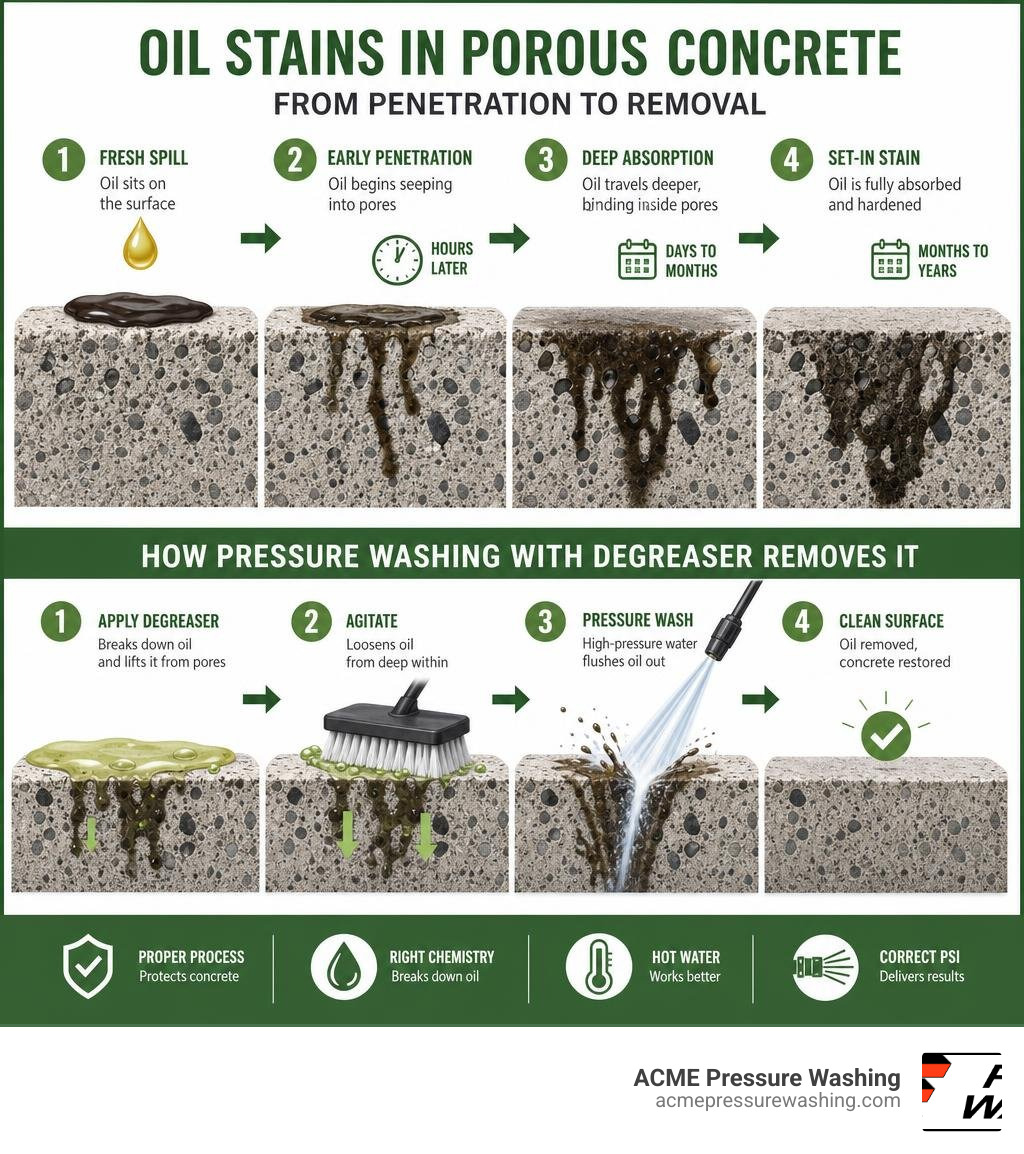
Think about what happens when a vehicle leaks oil on a driveway in Merrimack or Londonderry. Within hours, that petroleum-based fluid has already begun wicking down into the microscopic pores of the concrete. By the time most people notice the stain, it’s no longer sitting on the surface — it’s inside the material.
That’s the problem a garden hose or even a pressure washer on its own simply cannot solve.
I’m Lionel Greenwood, owner of ACME Pressure Washing, and in over 38 years of hands-on exterior cleaning across New Hampshire, I’ve seen what works — and what makes oil stains worse — when it comes to can you pressure wash oil stains from concrete and asphalt. In this guide, I’ll walk you through the honest truth about what pressure washing can and can’t do, and exactly how professionals get the best results.
Can You Pressure Wash Oil Stains Effectively?
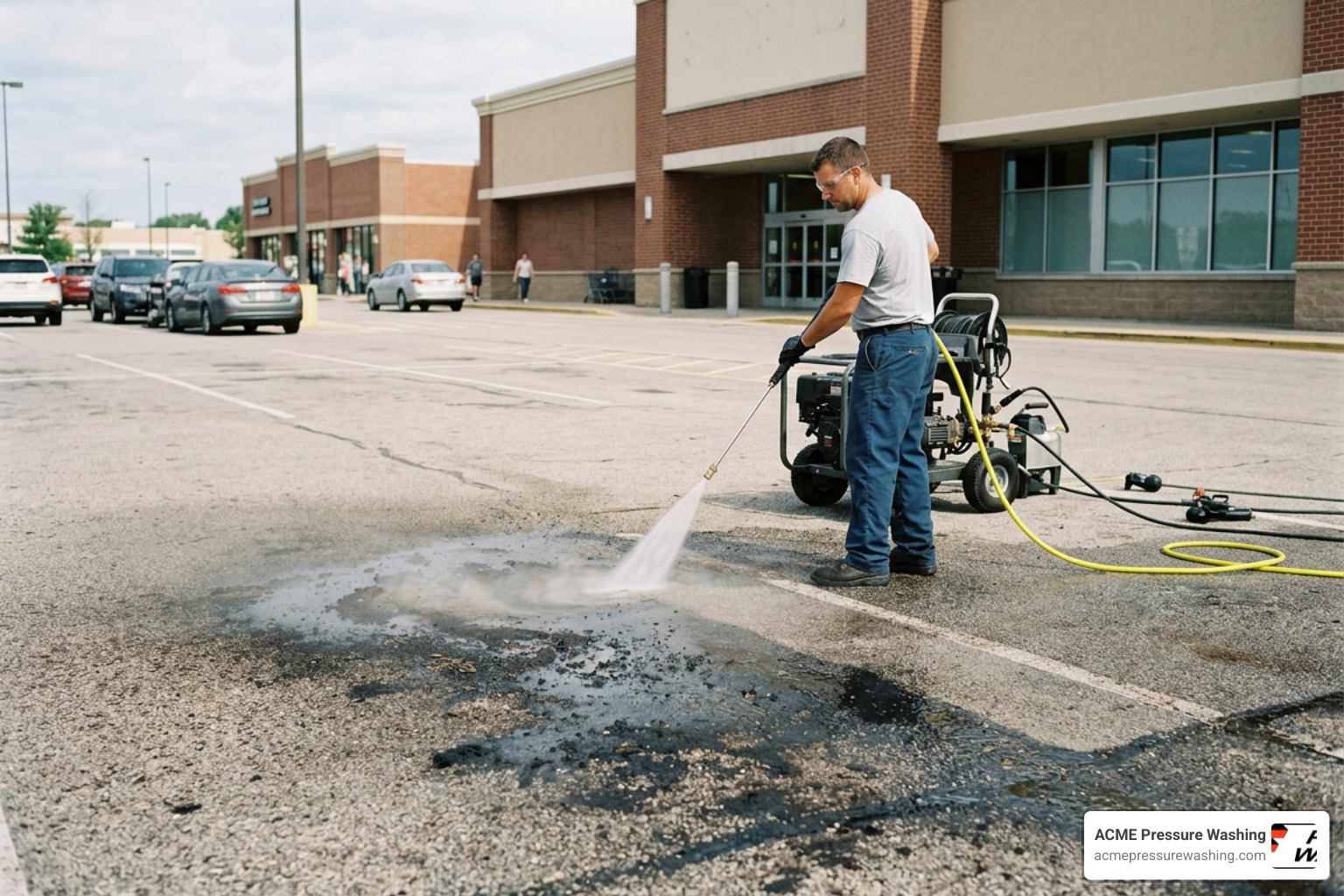
When property owners ask us if they can blast away vehicle leaks with high pressure, they are often surprised by the science behind the stain. To understand why a pressure washer alone fails, we have to look at the relationship between the oil and the substrate.
Concrete is essentially a hard sponge. It is highly porous, filled with millions of microscopic capillaries. When motor oil, transmission fluid, or cooking grease spills onto it, gravity and capillary action draw the nonpolar petroleum molecules deep into these voids.
Asphalt presents an even more delicate challenge. Unlike concrete, asphalt is a petroleum-based material held together by a tar-like binder. When motor oil leaks onto asphalt, the oil acts as a solvent, actively dissolving the binder. If you try to clean it using high pressure alone, you will not only fail to lift the stain, but you will accelerate asphalt degradation, stripping away the protective top layer and leaving a pitted, crumbling surface.
To safely and effectively remove oil, we must rely on a precise three-stage cleaning mechanism:
- Chemical Disruption: We apply specialized, professional-grade alkaline or biological agents to break the chemical bond between the oil and the substrate.
- Emulsification: Surfactants surround the suspended oil molecules, forming structures called micelles that allow the hydrophobic oil to mix with water.
- Mechanical Flushing: This is where the pressure washer finally comes in. We use the pressurized stream to flush the suspended, emulsified oil out of the pores and sweep it away.
Without the first two stages, pressure washing is just pushing water against oil. If you are trying to understand what your property needs, exploring driveway pressure washing service options can help clarify the difference between standard cleaning and heavy-duty restoration. For a deeper dive into whether a machine alone can do the trick, the guide on Will A Pressure Washer Remove Oil Stains? highlights these mechanical limitations.
The Science of Hot Water vs. Cold Water Power Washing
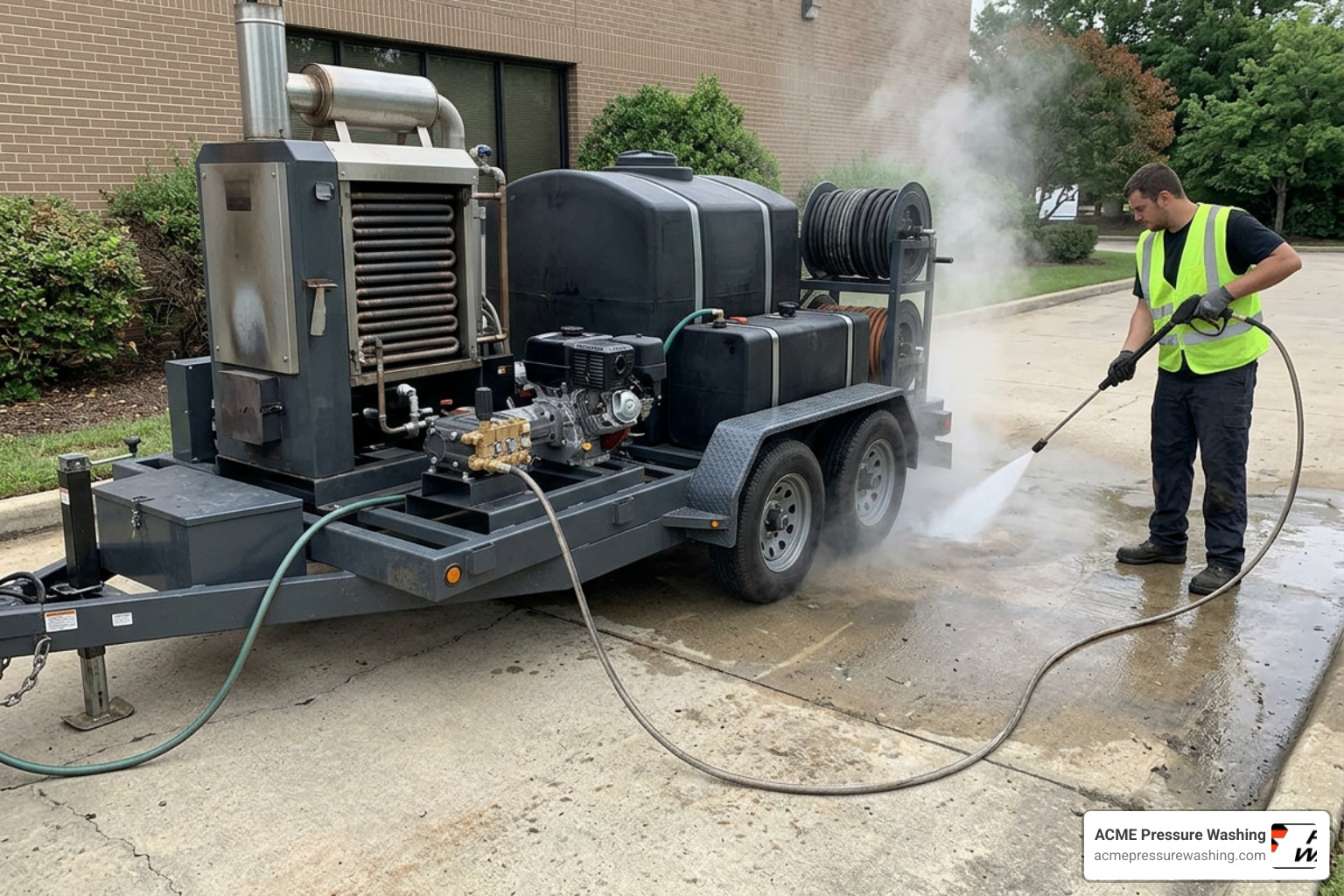
There is a major difference between pressure washing (using cold water) and power washing (using heated water). When it comes to petroleum-based contaminants, temperature is everything.
The Cleaning Equipment Trade Association (CETA) recognizes hot-water pressure washing systems as the absolute industry standard for grease and oil applications. The reason is simple physics: heat reduces the viscosity of oil.
Think of it like washing a greasy frying pan in your kitchen sink. If you rinse it with freezing cold water, the grease remains congealed and stuck to the surface. But when you turn on the hot water, the grease immediately softens, liquefies, and rinses away.
On driveways and commercial parking lots in Manchester or Derry, we use industrial-grade power washers that heat water to between 180°F and 200°F (82°C to 93°C). This extreme heat does several things at once:
- It breaks down the thick, viscous structure of polymerized motor oil.
- It accelerates the chemical activation of our degreasers, making them work twice as fast.
- It allows us to thoroughly flush the oil out of the concrete pores without needing to use destructive, ultra-high pressure.
Using cold water on an oil stain that has sat for more than 24 hours is one of the most common concrete power washing mistakes we see. Cold water will simply cool and harden the oil, locking it further into the pore structure and leaving a permanent shadow.
Recommended PSI, Nozzles, and Surface Protection
Using the wrong pressure or nozzle can instantly ruin a concrete driveway or tear a hole straight through asphalt. To clean safely, we must match our equipment settings to the specific surface we are treating.
For concrete surfaces, a pressure range of 2,000 to 3,500 PSI is highly effective for flushing out oil. However, the age of the concrete matters immensely. You should never pressure wash concrete that was poured less than 24 months ago. Young concrete is still curing and lacks the structural strength to withstand high pressure; blasting it can permanently strip the cream coat, leaving the rough aggregate exposed.
For asphalt surfaces, such as driveways in Bedford or parking lanes in Derry, we must lower our pressure. Asphalt should never be washed at more than 2,000 PSI to prevent aggregate displacement.
Nozzle selection is equally critical. We use color-coded spray tips to control the angle of the water:
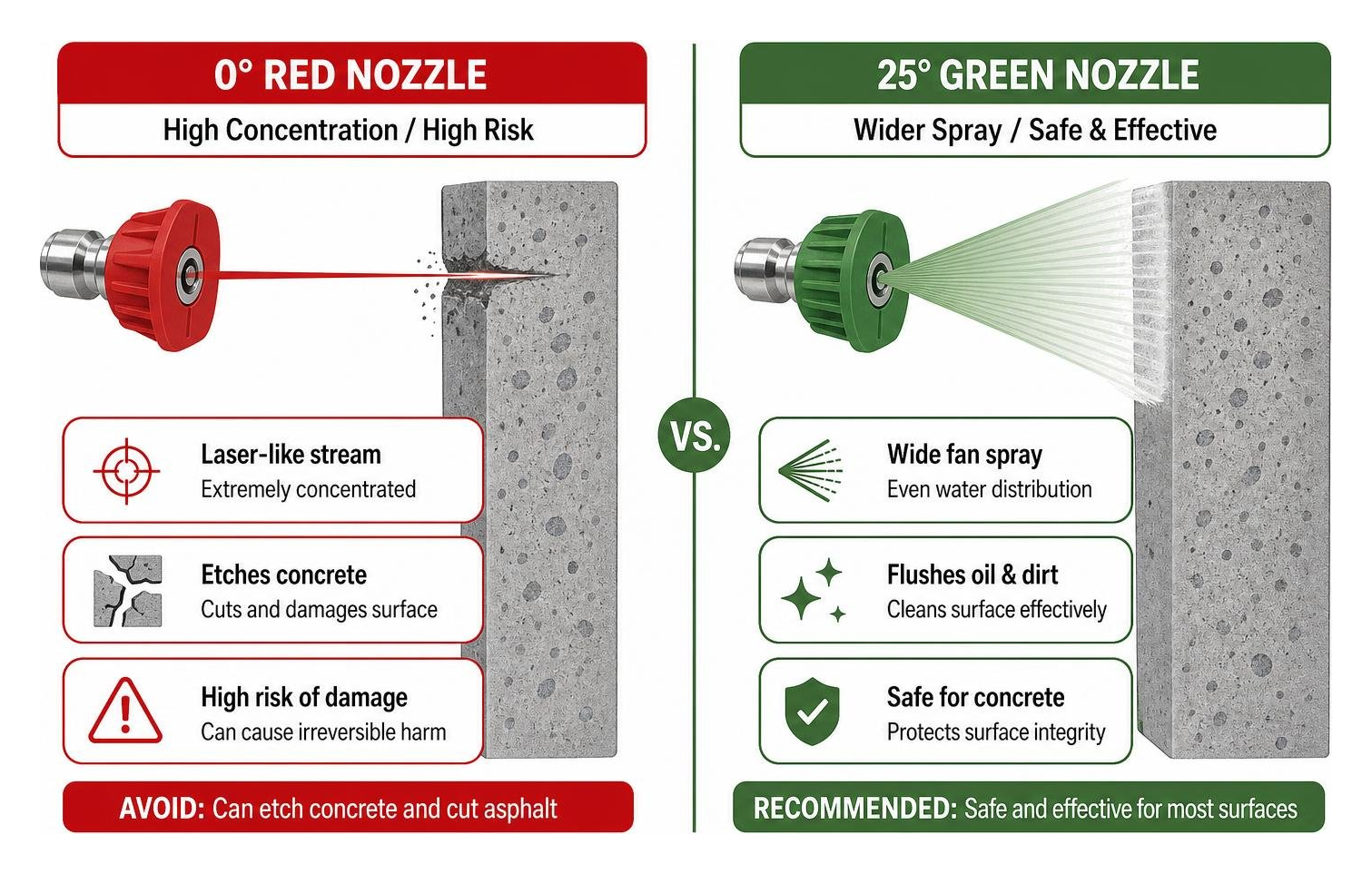
- Red Tip (0-Degree): Never use this. It focuses the water into a highly concentrated, laser-like stream that will etch concrete, cut through asphalt, and cause irreversible structural damage.
- Yellow Tip (15-Degree): Excellent for stripping and heavy-duty spot-cleaning on tough, uncolored concrete.
- Green Tip (25-Degree): The safest and most effective standard nozzle for flushing out emulsified oil stains on most residential and commercial surfaces.
- White Tip (40-Degree): Best for rinsing and washing delicate surfaces like decorative colored concrete.
When operating the wand, we always maintain a distance of 12 to 18 inches from the surface, moving in consistent, overlapping sweeping motions. Holding the tip too close or hovering over a single spot for too long will leave permanent circular scars on your pavement.
For more details on setting up your equipment, check out our guide on finding the perfect PSI for concrete. If you are dealing with asphalt specifically, you can read more about safe operating limits in this resource on Will Pressure Washer Remove Oil from Asphalt?.
The Crucial Role of Chemical Pre-Treatment and Degreasers
Because oil is hydrophobic, chemical pre-treatment is the most important step in the entire process. If you skip the degreaser, you are simply wasting your time and water.
Different types of oil stains require different chemical approaches:
- Alkaline Degreasers (pH 11–13): These are the workhorses of the industry. They work via saponification, chemically converting fats and heavy petroleum oils into soap-like compounds that dissolve easily in water. They are highly effective on heavy motor oil, transmission fluid, and diesel stains.
- Enzymatic Bio-Cleaners: These contain live, beneficial bacteria that literally eat hydrocarbons, breaking them down into harmless water and carbon dioxide. They are slower-acting but continue working deep within the concrete pores long after the initial wash is complete.
- Citrus-Based Degreasers (d-limonene): Excellent eco-friendly options for lighter oil drips, grease around commercial dumpster pads, or residential grilling areas.
To get the most out of any degreaser, proper technique is essential. We first lightly pre-wet the surrounding concrete to prevent the chemical from drying out or soaking into clean areas. Next, we apply the degreaser full-strength to the stain, allowing a dwell time of 15 to 30 minutes.
During this dwell time, we use a stiff-bristle scrubbing broom to manually agitate the stain. This mechanical action works the chemical deep into the concrete pores, ensuring it contacts all the trapped oil. We never allow the degreaser to dry on the surface; if it starts to dry, we mist it with a small amount of water to keep the chemical reaction active.
If you want to choose the right product for your specific driveway, take a look at our article on the best degreaser for stubborn oil stains. Whether we are treating a driveway in Londonderry or a commercial loading dock in Manchester, matching the chemical to the specific hydrocarbon is the key to our high success rate.
Environmental Regulations and Wastewater Management
Washing oil off a driveway isn’t just a cleaning challenge — it is a legal and environmental responsibility.
Under Section 402 of the Clean Water Act, it is illegal to discharge wastewater containing petroleum products, heavy metals, or toxic chemicals into municipal storm drains. Storm drains lead directly to our local streams, rivers, and groundwater supply without going through a water treatment plant.
If a contractor or homeowner washes oil off a driveway in Bedford or Derry and allows that contaminated runoff to flow down the street into a storm sewer, they can face severe environmental fines.
As a professional service provider with over 38 years of experience in New Hampshire, we take environmental compliance seriously. We use specialized wastewater containment systems, including:
- Inflatable Sand-Filled Booms: To block off storm drain inlets and prevent runoff from escaping the property.
- Vacuum Recovery Systems: To capture the wash water directly at the cleaning site.
- Petroleum Filtration Pads: To filter out hydrocarbons and suspended solids, allowing us to safely dispose of the treated water in accordance with local municipal regulations.
When dealing with asphalt, the environmental stakes are even higher due to the fragile nature of the binder. You can read more about responsible cleaning practices in this article on Getting Rid of Oil Stains in Asphalt.
Frequently Asked Questions About Oil Stain Removal
Can you pressure wash oil stains that are years old?
Yes, but you must have realistic expectations. When oil sits on concrete for months or years, it undergoes oxidation and chemically bonds with the concrete matrix. The volatile compounds evaporate, leaving behind a tough, dark carbon residue.
While hot-water power washing and industrial degreasers can dramatically lighten these old stains — often achieving a 20% to 50% visual improvement — complete removal is rarely possible. For deeply set, years-old stains in Londonderry or Manchester, alternative restoration methods such as mechanical grinding or a chemical poultice treatment (which draws the oil out over several days using an absorbent powder) may be required.
Can you pressure wash oil stains without using chemicals?
No. Because of oil’s hydrophobic properties, trying to wash oil with water alone is like trying to mix oil and vinegar without shaking the bottle. The high-pressure water will simply bounce off the petroleum, push the oil slick across your driveway, and create a larger, more unsightly shadow.
To break that surface tension and lift the stain, you absolutely must use a surfactant or degreaser to emulsify the oil first. Professional hot-water equipment makes a massive difference, but even hot water needs chemical assistance to fully release oil from concrete pores.
How much does professional oil stain removal cost in New Hampshire?
Professional oil stain removal costs vary depending on the size of the area, the age of the stain, and the equipment required.
The pricing information below represents average costs based on publicly available internet data. These are not the actual rates of ACME Pressure Washing, but are provided to show typical industry ranges.
| Stain Size / Severity | Average Internet Price | Typical Professional Range (Low to High) |
|---|---|---|
| Small Spot (Single drip, fresh) | $150 | $300 – $750 |
| Medium Area (Standard 2-car driveway drips) | $250 | $500 – $1,250 |
| Large/Severe (Commercial parking stall, heavy buildup) | $350 | $700 – $1,750 |
Because of the specialized hot-water equipment, chemical degreasers, and strict wastewater containment setups required to safely clean oil in towns like Londonderry or Manchester, professional rates reflect the high level of skill and liability involved in this type of work.
Conclusion
At the end of the day, dealing with oil stains on your concrete or asphalt is a race against the clock. The longer you wait, the deeper the oil penetrates, and the harder it becomes to clean.
While a DIY approach with cold water and consumer-grade equipment might lighten a very fresh spill, attempting to blast away deep, set-in oil stains usually leads to etched concrete, stripped asphalt, and environmental runoff issues.
At ACME Pressure Washing, we have spent over 38 years perfecting safe, customized, and eco-friendly cleaning techniques across New Hampshire. From our home base in Merrimack, NH, we serve residential and commercial properties with state-of-the-art hot-water power washing systems that melt away tough grease and oil while fully protecting your surfaces and complying with environmental laws.
Once your concrete is clean, we also highly recommend professional concrete sealing. A high-quality penetrating sealer fills those microscopic pores, creating a protective barrier that repels future spills and makes ongoing maintenance a breeze.
Don’t let ugly, slippery oil stains ruin your property’s curb appeal or create a safety liability. Let the experienced team at ACME Pressure Washing handle it the right way.
Ready to restore your concrete or asphalt?
- Get a Free Estimate: Request a Quote Online
- Explore Our Services: Learn more about our professional pressure washing services for homes, commercial properties, and fleets.
Algae Is Quietly Damaging Your Property Right Now
The soft washing algae removal technique is the most effective way to eliminate algae, mold, and mildew from exterior surfaces — without causing damage. Here’s a quick summary:
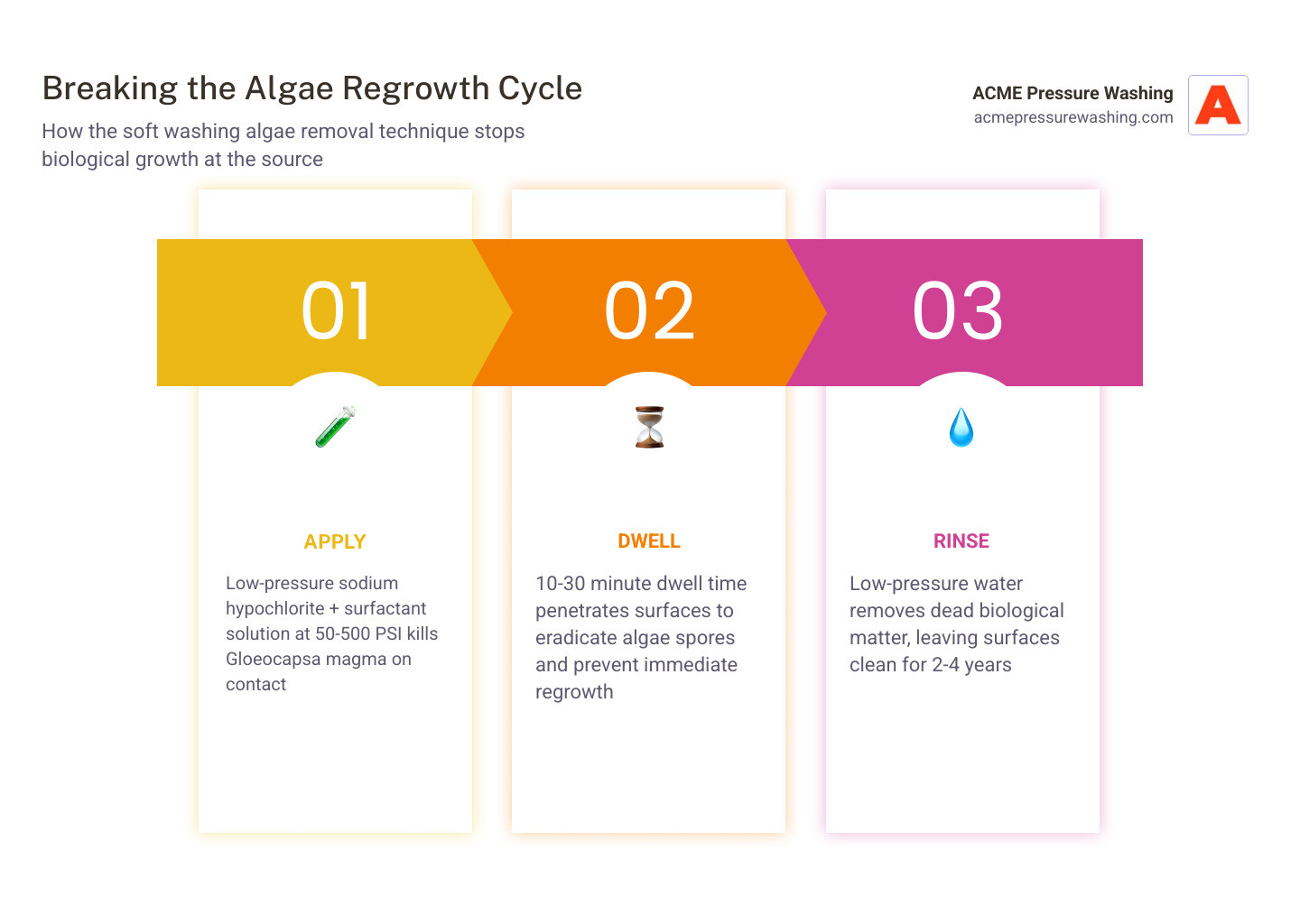
- Apply a low-pressure chemical solution (sodium hypochlorite + surfactant) at 50–500 PSI
- Dwell for 10–30 minutes to kill algae spores at the root
- Rinse with low-pressure water to remove dead biological matter
- Results last 2–4 years — up to 4–6x longer than pressure washing alone
Those dark streaks you see on roofs and building facades aren’t just dirt. They’re living organisms — specifically a cyanobacterium called Gloeocapsa magma — actively feeding on your surfaces.
Left untreated, this biological growth can take up to 10 years off the life of a roof. It traps moisture, degrades shingles, and spreads to siding, gutters, and surrounding structures. For commercial property owners in Merrimack and Bedford, this kind of damage is both a curb-appeal problem and a costly structural risk.
New Hampshire’s humid summers and cold, damp shoulder seasons create ideal conditions for rapid algae colonization. By the time streaks are clearly visible, the growth has already been working its way into your surfaces for months.
The good news? There’s a proven, industry-approved method to stop it — and protect your property for years.
I’m Lionel Greenwood, owner of ACME Pressure Washing, and I’ve been applying the soft washing algae removal technique on roofs, siding, and commercial facades across New Hampshire since 1988. Over 38 years, I’ve seen what untreated algae does to properties in towns like Merrimack, Manchester, and beyond — and how the right low-pressure chemical approach stops it for good.
What is the Soft Washing Algae Removal Technique?
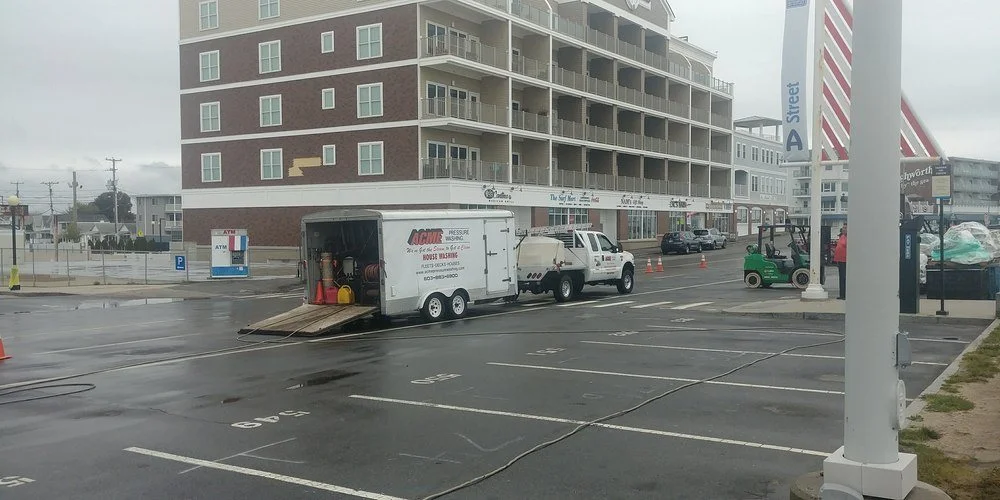
To understand the soft washing algae removal technique, we first have to discard the idea that “higher pressure equals cleaner surfaces.” While traditional pressure washing relies on sheer mechanical force (often between 1,500 and 4,000 PSI) to blast away surface grime, soft washing takes a completely different, scientific approach.
Soft washing is a low-pressure cleaning method that operates at or below 500 PSI—and frequently as low as 40 to 100 PSI (which is comparable to the force of a standard garden hose). Instead of using raw physical impact to strip away contaminants, soft washing relies on a customized chemical sanitation process. This specialized solution is applied gently to the target surface, where it works at a molecular level to emulsify dirt, break down spiderwebs, and completely neutralize biological colonizers like algae, mold, mildew, and moss.
The primary benefit of this technique is absolute surface preservation. High-pressure water can easily crack vinyl siding, strip paint, erode mortar, and force water behind building envelopes, leading to hidden mold growth and structural decay. By switching to a low-pressure methodology, we eliminate these structural hazards entirely. For a deeper look into why high pressure can be a liability for your property, read our guide on how to switch to low pressure house cleaning.
Science Behind the Soft Washing Algae Removal Technique
The remarkable efficacy of soft washing lies in its chemistry. A professional soft wash solution is not a single chemical, but a carefully calibrated recipe designed to target organic life while remaining safe for the underlying substrate.
The core active ingredient in most soft wash formulations is sodium hypochlorite (NaOCl), typically utilized at a concentration of 1% to 6% depending on the severity of the biological load and the surface material being treated. Sodium hypochlorite acts as a highly effective biocide. When it comes into contact with algae, mold, or mildew, it denatures the proteins within the organism’s cellular structure and disrupts its lipid membranes. This chemical reaction kills the biological growth instantly, dissolving the root systems (or rhizines) that anchor these organisms to porous materials.
However, sodium hypochlorite alone cannot achieve optimal results. It requires a secondary component: a high-quality surfactant. Surfactants act as wetting agents that reduce the surface tension of the water. This allows the cleaning solution to penetrate deeply into the microscopic cracks, pores, and crevices of materials like stucco, concrete, and wood. Additionally, the surfactant acts as a cling agent, ensuring the solution does not simply run off vertical surfaces but remains in place to maximize contact time.
By killing the spores at the biological level, soft washing does not just clean the surface; it completely sanitizes it. This molecular-level eradication is the reason soft washing keeps surfaces clean up to three times longer than standard pressure washing. For more insights on how these chemical mechanics protect your home’s exterior, explore our article detailing the benefits of soft washing.
ARMA Guidelines and Roof Shingle Safety
When it comes to roof cleaning, the stakes are incredibly high. Asphalt shingles are manufactured with a protective layer of mineral granules. These granules serve a vital dual purpose: they protect the underlying asphalt from degrading under harsh ultraviolet (UV) rays and they provide essential fire resistance.
Unfortunately, Gloeocapsa magma (the cyanobacteria responsible for those unsightly black streaks) feeds directly on the limestone filler used to manufacture modern asphalt shingles. As the algae consumes this limestone, it loosens the protective granules. If a property owner attempts to clean these shingles using traditional high pressure, the mechanical force will instantly dislodge millions of these weakened granules, permanently reducing the roof’s lifespan and immediately voiding the manufacturer’s warranty.
Because of this severe risk, the Asphalt Roofing Manufacturers Association (ARMA) has published strict technical bulletins regarding roof cleaning. ARMA explicitly recommends low-pressure chemical washing as the only safe, approved method to remove algae discoloration from asphalt shingles.
By utilizing the soft washing algae removal technique, we can gently apply the ARMA-approved sodium hypochlorite and surfactant mixture to the roof. The solution neutralizes the algae at the root, allowing the dead organic matter to wash away naturally with subsequent rainfalls, without losing a single protective shingle granule. If you are dealing with moss or lichen alongside algae on your roof, it is critical to handle it correctly to avoid structural damage. Check out our comprehensive guide on roof shingle moss cleaning to learn how to clean these delicate surfaces safely.
Why Traditional Pressure Washing Fails Against Algae
To understand why traditional pressure washing is fundamentally unsuited for biological contamination, we must examine the difference between mechanical force and chemical sanitation.
| Feature | Traditional Pressure Washing | Soft Washing |
|---|---|---|
| Operating Pressure | 1,500 to 4,000+ PSI | 50 to 500 PSI (often 40–100 PSI) |
| Primary Mechanism | High-velocity mechanical force | Chemical sanitation & biocide action |
| Algae Spore Eradication | Only removes surface layers; leaves spores alive | Kills 100% of spores at the root |
| Risk of Damage | High (gouging wood, stripping granules, water intrusion) | Extremely low (safe for shingles, stucco, and siding) |
| Longevity of Results | Algae typically returns within 6 to 12 months | Results last 2 to 4+ years (up to 6x longer) |
When you use high-pressure water to clean algae, you are essentially “mowing the weeds.” The high-velocity stream rips away the visible surface layer of the algae, giving the temporary illusion of a clean surface. However, the microscopic root structures and spores remain deeply embedded within the porous substrate of your siding, brick, or shingles.
Because the organic growth is still alive, it immediately begins to recolonize. In fact, because high-pressure washing often etches the surface and increases its porosity, it actually creates a more hospitable environment for new spores to cling to. As a result, algae typically returns within 6 to 12 months after a high-pressure wash.
Furthermore, hitting a roof or commercial facade with 3,000 PSI of water pressure can cause catastrophic physical damage. It can force water behind vinyl siding, leading to trapped moisture and rot within the wall cavity. On commercial properties in Amherst, this can lead to expensive remediation bills.
Soft washing, by contrast, focuses entirely on total biological eradication. It acts as a sterilizing agent, ensuring that no viable spores remain to kickstart a new colonization cycle. This is why a professional low-pressure wash wins every single time. To understand why soft washing is the superior choice for local properties, read our analysis on why soft washing wins in Merrimack.
Step-by-Step Professional Soft Washing Process
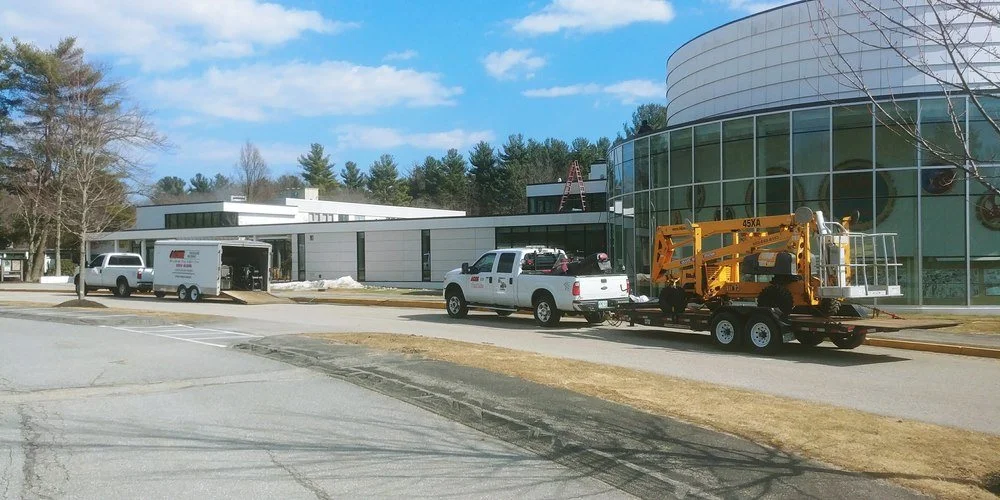
A successful, professional soft wash requires a systematic, disciplined approach. It is not as simple as spraying chemicals and walking away; it requires careful preparation, precise chemical blending, and strict adherence to safety protocols to protect both the property and the surrounding environment.
1. Pre-Inspection and Site Assessment
Before any equipment is turned on, we perform a comprehensive walk-through of the property. We identify the specific types of biological growth present (such as green algae, black cyanobacteria, or deeply rooted lichen), assess the structural integrity of the siding or roofing materials, and locate any areas of potential water intrusion. We also map out the surrounding landscaping, noting any sensitive plants, shrubs, or ornamental trees that require protection.
2. Rigorous Property and Vegetation Protection
Because the biocides used in soft washing are designed to target organic matter, they can pose a risk to landscaping if handled improperly. To prevent damage, we implement a strict plant protection protocol:
- Pre-Wetting: We thoroughly saturate all nearby grass, plants, and shrubs with clean water. This fills the plants’ root systems and leaves with fresh water, preventing them from absorbing any overspray or runoff.
- Physical Barriers: When working in close proximity to highly sensitive foliage, we apply lightweight, breathable tarps to shield the plants.
- Continuous Rinsing: Throughout the application process, a technician continuously rinses the surrounding vegetation with clean water to dilute any accidental overspray instantly.
3. Equipment Setup and Chemical Proportioning
Unlike DIY methods, professional soft washing utilizes dedicated, low-pressure delivery systems and specialized proportioning techniques. These techniques allow us to adjust the chemical ratios on the fly, ensuring we apply the exact concentration required for the specific surface and biological load without wasting solutions.
To learn more about why professional preparation and local expertise make all the difference for properties in the area, read our guide on Manchester soft washing.
Executing the Soft Washing Algae Removal Technique Safely
Once prep work is complete, we begin the application process. Executing the soft washing algae removal technique safely requires deep technical knowledge of chemical dwell times and surface dynamics.
First, the technician applies the custom-blended solution using a specialized soft wash wand equipped with a wide-angle, low-pressure nozzle. The application always starts from the bottom of the structure and moves upward to prevent streaking. For residential siding, we typically use a sodium hypochlorite concentration of 1% to 2%, while heavily colonized roofs may require up to 4% to 6% to break down dense algae and lichen.
Once applied, the solution must be allowed to “dwell” on the surface. Dwell time is the critical window where the chemistry does the heavy lifting. For standard algae and mildew, a dwell time of 10 to 15 minutes is standard. During this time, you will visually see the dark green and black stains fade and disappear as the organic matter is oxidized and neutralized.
After the dwell time is complete, we perform a thorough rinse using high-volume, low-pressure water. This rinse removes the neutralized biological debris, surfactant residue, and salt compounds, leaving behind a completely sanitized, clean surface. Throughout this entire execution phase, our teams strictly adhere to safety standards across Manchester, Bedford, and all our NH service areas. For a detailed list of best practices and common pitfalls to avoid during this process, read our 10 dos and donts for house soft washing.
Post-Treatment Care and Longevity
One of the most remarkable aspects of the soft washing algae removal technique is that the cleaning action actually continues long after our trucks drive away.
When we treat a porous surface like concrete, brick, or asphalt shingles, a microscopic amount of the biocide remains safely embedded within the pores of the substrate. This residual barrier is highly alkaline (typically around pH 11). When natural rainfall occurs (which is slightly acidic, around pH 5.6), it reactivates this alkaline barrier. This natural reactivation process continues to sanitize the surface and repel new spores for months after the initial service.
Thanks to this residual protection, a professional soft wash keeps your property clean for 2 to 4 years, depending on local shade and moisture levels. To maximize this lifespan, property owners can take a few simple preventive steps:
- Trim Overhanging Trees: Cutting back tree limbs increases sunlight exposure and airflow, keeping surfaces dry and preventing the damp, shaded conditions that algae thrives in.
- Install Metal Strips: Installing zinc or copper strips along the ridge of a roof releases natural metallic ions during rainstorms, which act as a continuous, natural algaecide.
If your property is currently suffering from heavy moss or lichen buildup alongside algae, a specialized approach is required to ensure the roots are fully neutralized without damaging your shingles. For a step-by-step breakdown of how to handle these heavy infestations, read our guide on how to clean roof moss the right way.
Frequently Asked Questions About Soft Washing
How long do the results of soft washing last compared to pressure washing?
Soft washing results typically last 2 to 4 years, which is 4 to 6 times longer than conventional pressure washing. Because traditional pressure washing leaves microscopic spores alive in the pores of the material, algae regrowth usually occurs within 6 to 12 months. Soft washing completely eradicates these spores at the molecular level, breaking the biological regrowth cycle and keeping your surfaces cleaner up to 3 times longer.
What are the average costs for professional soft washing in New Hampshire?
Based on publicly available online data and general industry averages, the cost for professional soft washing varies widely depending on the size of the property, the height of the structures, and the severity of the biological growth.
Across the industry, average exterior cleaning costs can range from $800 on the low end to $4,500 on the high end for large estate properties or complex commercial structures. Please note that these figures are based entirely on general internet research and do not represent the actual rates or guarantees of ACME Pressure Washing. Every property is unique, and we provide custom, upfront quotes based on an in-person assessment of your specific needs.
Is soft washing safe for delicate siding and landscaping?
Yes, when performed by trained professionals, soft washing is completely safe for delicate siding materials like vinyl, stucco, and cedar shake, as well as your surrounding landscaping. Because we operate at pressures under 100 PSI, there is zero risk of physical surface damage. Additionally, our strict plant protection protocols—including pre-wetting, continuous dilution, and post-rinsing—ensure that your grass, flowers, and shrubs remain perfectly healthy throughout the process.
Conclusion
When it comes to protecting your property from the destructive effects of algae, mold, and mildew, brute force is never the answer. The soft washing algae removal technique represents the perfect marriage of chemistry and care—offering a gentle, highly effective, and long-lasting solution that preserves your property’s structural integrity while restoring its original beauty.
At ACME Pressure Washing, we have spent over 38 years perfecting our customized, eco-friendly exterior cleaning techniques. Based in Merrimack, NH, we proudly serve commercial and residential clients throughout Manchester, Bedford, Amherst, and the surrounding regions. Whether you need to restore a commercial building facade, clean a delicate shingled roof, or wash a fleet of trucks, our experienced team has the specialized equipment and technical expertise to deliver flawless results safely.
Don’t let algae degrade your property’s value and structural integrity. Contact us today to experience the difference that 38+ years of local expertise can make.
- Call Us Today: +1603-883-6900
- Get Your Free Quote: Request a Custom Estimate Online
Our Services
Why Roof Moss Is a Bigger Problem Than It Looks
The best moss prevention for roofs isn’t just about curb appeal — it’s about protecting one of your biggest investments before the damage starts.
Here’s a quick summary of the most effective methods:
| Method | Best For | How Often |
|---|---|---|
| Zinc strips | Long-term prevention | Install once (20+ year lifespan) |
| Copper strips | Maximum coverage (15–20 ft down slope) | Install once |
| Zinc sulfate granules | Active moss kill + prevention | Annually, before fall rains |
| Liquid chemical treatments | Flat or low-pitch roofs | Annually or as needed |
| Tree trimming | Reducing shade and moisture | As needed |
| Professional soft washing | Full removal + prevention reset | Every 1–3 years |
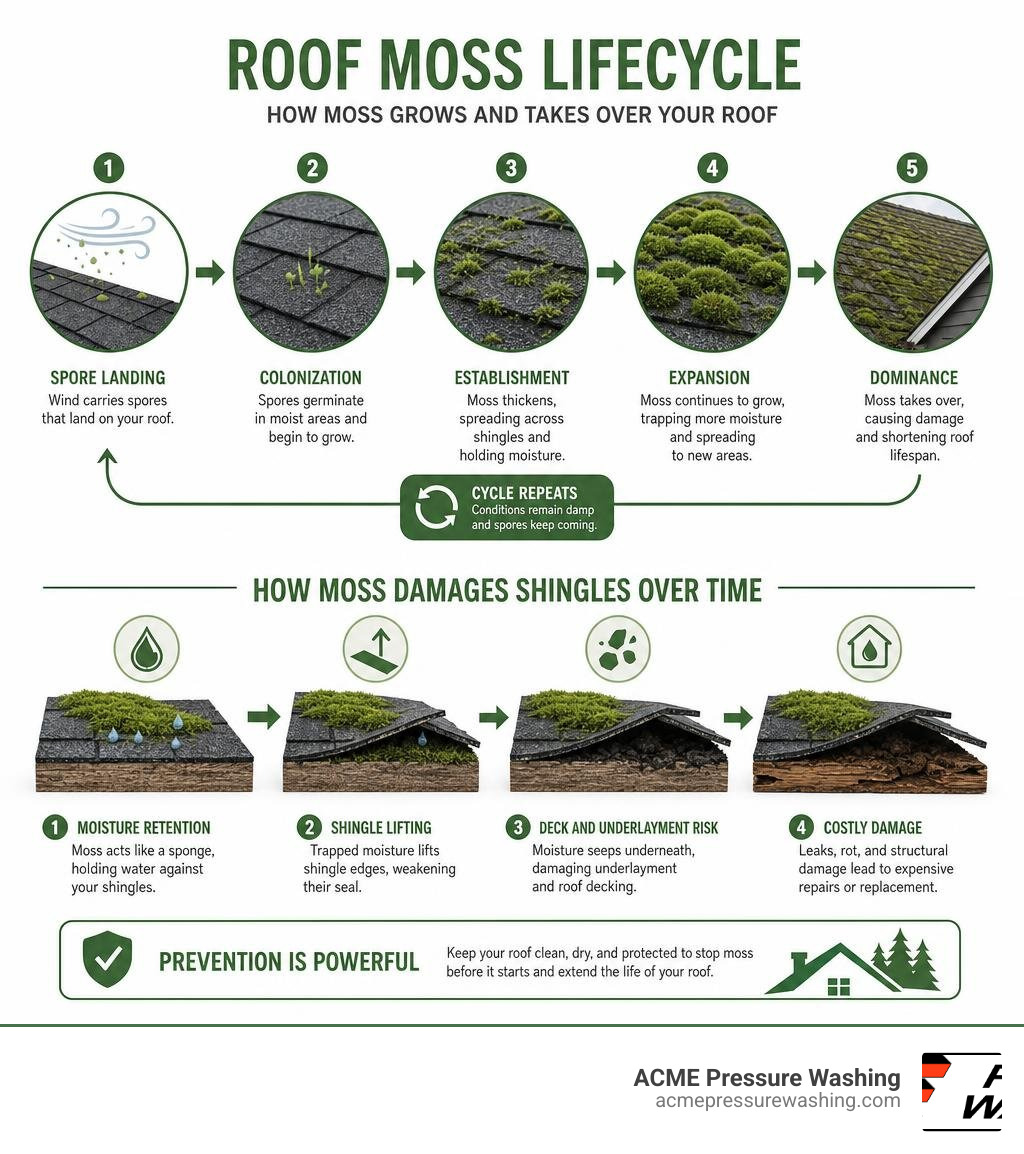
Moss might look harmless — even charming on an old cottage. But left untreated, it acts like a sponge, trapping moisture against your shingles around the clock. Over time, that constant dampness lifts shingle edges, invites fungal decay, and can work its way into the underlayment and roof decking. Research shows moss and algae growth can shorten shingle lifespan by up to 25% if ignored.
In New Hampshire, where damp springs, shaded lots, and north-facing rooflines are common, moss isn’t a rare problem — it’s almost inevitable without the right prevention in place.
I’m Lionel Greenwood, owner of ACME Pressure Washing, and after more than 38 years of hands-on roof cleaning across Merrimack, Nashua, Amherst, and beyond, I’ve seen what happens when moss goes untreated — and what the best moss prevention for roofs actually looks like in real-world conditions. In the sections below, I’ll walk you through the most effective methods so you can make a smart, informed choice for your property.
Basic best moss prevention for roofs glossary:
Why Moss Thrives on New Hampshire Roofs
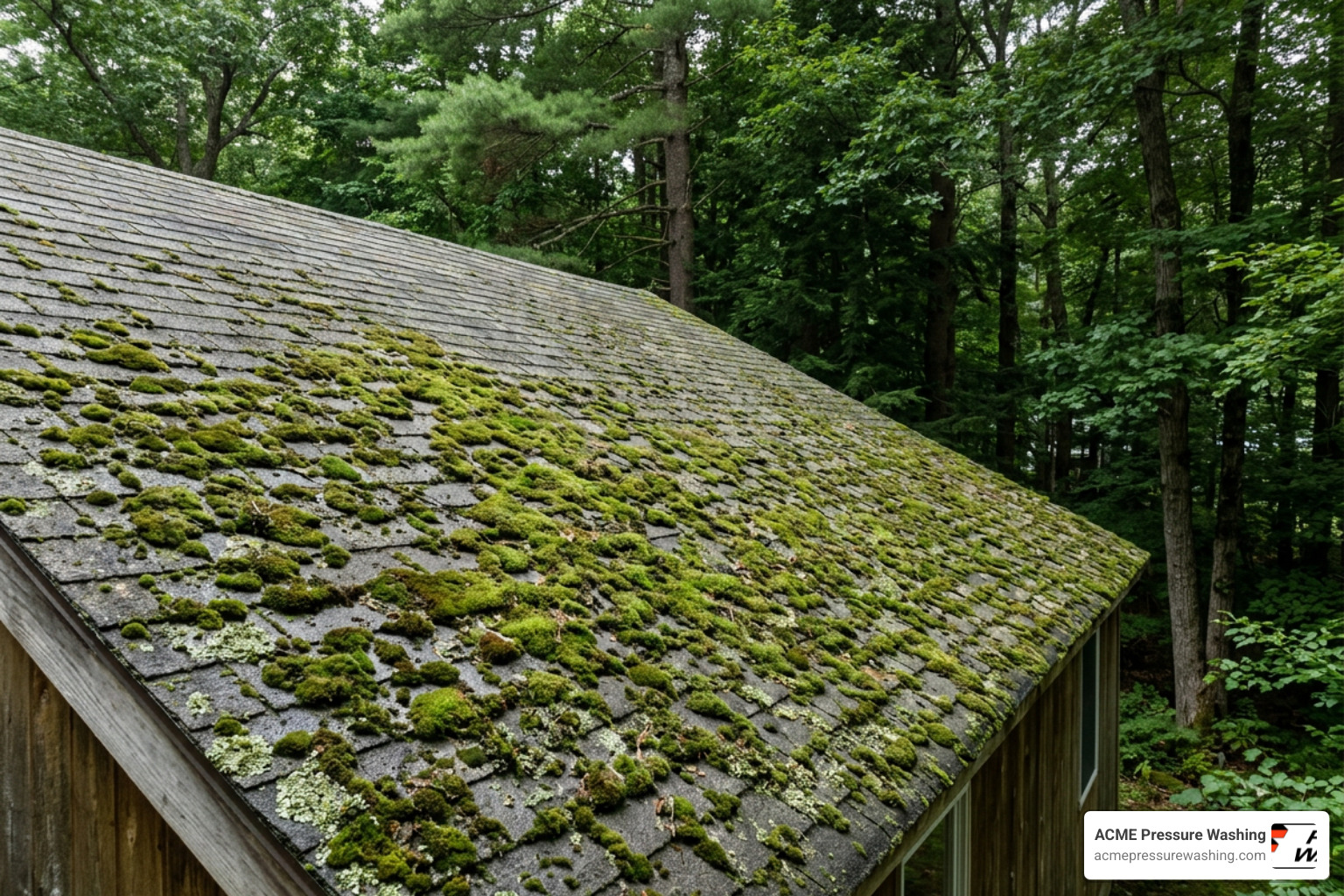
To stop roof moss in its tracks, we first have to understand why it loves our local roofs so much. Moss is a primitive, non-vascular plant. Unlike your lawn, it doesn’t have traditional roots to draw nutrients and water from the soil. Instead, it absorbs moisture directly through its leaves. This means it only needs two things to thrive: moisture and a surface to cling to.
Our beautiful New Hampshire climate provides the perfect breeding ground. Neighborhoods in towns like Amherst, NH, Nashua, NH, and Hollis, NH are famous for their mature, towering trees. While these trees offer incredible shade during hot summer days, they also block sunlight from drying out your roof. Shaded, north-facing roof planes remain damp long after the morning dew or a rainstorm, creating a microclimate where moss spores can easily establish themselves.
Furthermore, many homeowners confuse moss with the dark, ugly staining they see stretching across their shingles. Those black streaks are actually caused by a hardy species of blue-green algae called Gloeocapsa magma. This algae feeds on the limestone filler used in modern asphalt shingles.
While algae is primarily an aesthetic issue, moss is a structural threat. As moss grows, it wedges itself underneath the edges of your shingles. This physical prying lifts the shingles, making them highly vulnerable to wind blow-offs during severe weather. Even worse, the thick green mats trap dirt, leaves, and moisture. This trapped moisture rots the wooden underlayment and structural decking underneath, leading to expensive water leaks.
To dive deeper into how these organisms interact with your roof and how to handle them safely, you can read our guide on How to Clean Roof Moss the Right Way and explore our breakdown of Black Streaks on Roof: What Causes Them and How to Clean Them Safely. For a broader environmental perspective on managing growth without damaging local ecosystems, the Northwest Coalition for Alternatives to Pesticides offers excellent guidance on how to Prevent and Treat Moss on Roofs.
The Best Moss Prevention for Roofs: Top Methods Compared
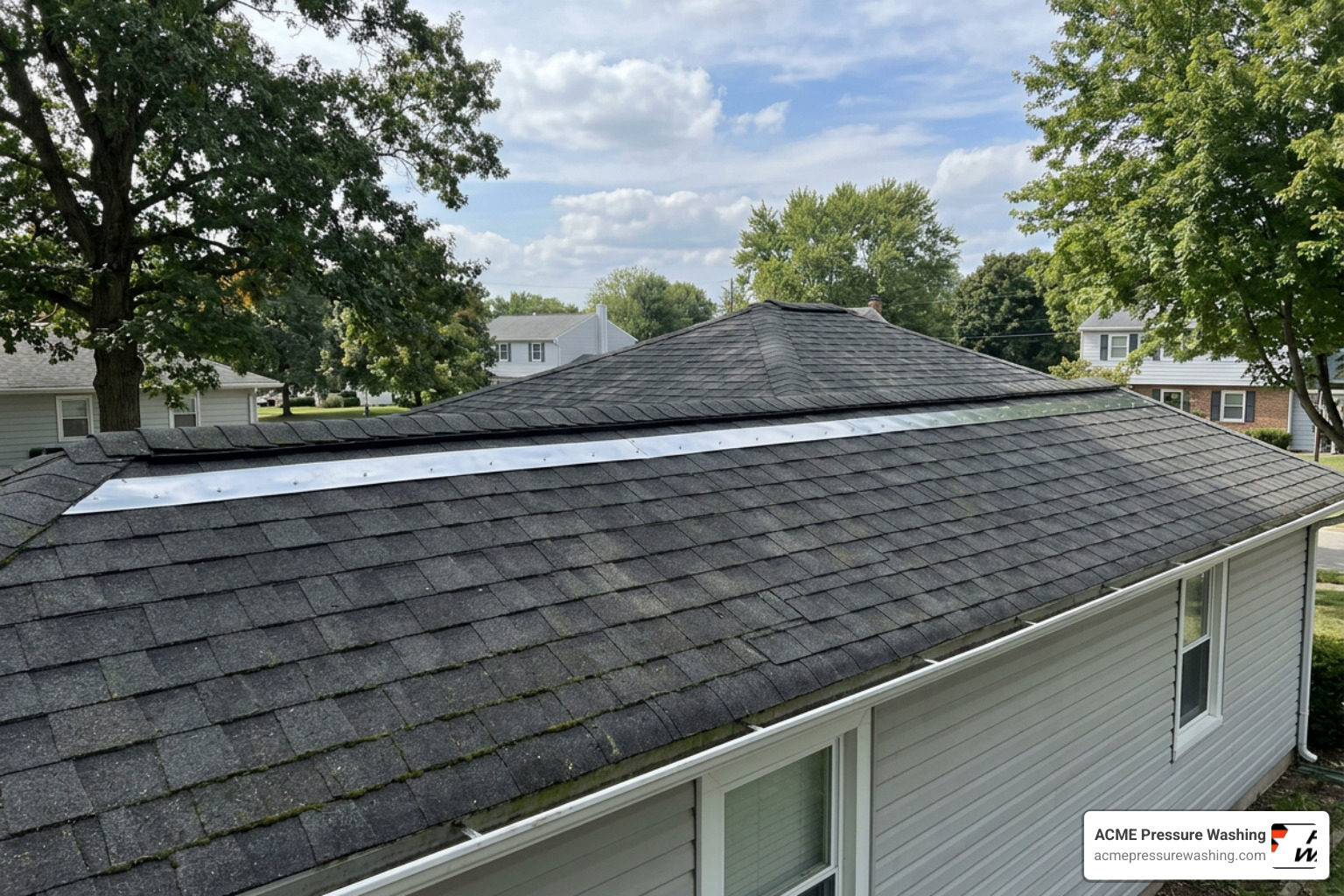
When looking for the best moss prevention for roofs, you will generally choose between two primary paths: physical metal barriers or chemical treatments. Both have distinct advantages, environmental considerations, and cost trade-offs.
To help you visualize how these preventative options stack up, let’s take a look at their key characteristics:
| Prevention Method | Active Mechanism | Lifespan | Environmental Impact | Ideal Roof Types |
|---|---|---|---|---|
| Copper Strips | Copper ions block growth | 20+ years | Low (natural mineral runoff) | Asphalt shingle, wood shake, tile |
| Zinc Strips | Zinc particles block growth | 20 years | Low to moderate | Asphalt shingle, wood shake |
| Zinc Sulfate Granules | Chemical toxicity to moss | 1–2 years | Moderate (requires plant protection) | Flat roofs, pitched roofs |
| Ammoniated Soap / Liquid | Fast-acting organic contact | Seasonally | Low (biodegradable) | Walkways, low-slope shingles |
Physical Barriers: Zinc and Copper Strips
Physical barriers are the closest thing to a “set-it-and-forget-it” solution. Typically installed as thin metallic strips tucked just under the ridge cap of your roof, these barriers rely on natural rain activation to do their job.
When rainwater washes over the exposed portion of the metal, it triggers a chemical reaction that releases metallic ions. As these ions wash down the roof slope, they create an invisible, hostile environment for moss, algae, and lichens, preventing them from ever taking root.
- Zinc Strips: Products like the Moss Boss 2-5/8 in. x 50 ft. Zinc Moss Killer are highly popular and cost-effective. Zinc strips are excellent at preventing growth but have a slightly shorter “reach” down the roof slope compared to copper, usually protecting about 8 to 10 feet of roofing material. For more technical details on how zinc prevents growth, you can check out the FAQs about Z-Stop zinc strips roof moss / algae prevention for roofs.
- Copper Strips: Copper is widely considered the premium physical barrier. Copper ions are more potent than zinc, allowing a single strip to protect up to 15 to 20 feet of roof slope. Additionally, as copper ages, it develops a beautiful, classic greenish-blue patina (verdigris) that blends beautifully with many architectural styles.
Regardless of which metal you choose, installing these strips requires a completely clean roof to start. If you install them over existing, thick moss, the rain-activated ions won’t be able to penetrate the dense growth. To learn more about preparing your shingles and protecting them from damage during the cleaning process, read our expert analysis on Roof Shingle Moss Cleaning: How to Avoid Damage.
Chemical Treatments: Liquid and Granular Preventatives
If physical metal strips aren’t a practical option for your roof’s design, chemical preventatives are a highly effective alternative. These are applied directly to the shingles to kill off microscopic spores before they can grow into visible green clumps.
- Zinc Sulfate Monohydrate: This is the active ingredient in many top-rated commercial powders, such as the 6 lbs. Roof Moss Killer (2-Pack) or the dry formula detailed in the MossOut 300028912 Roofs and Structures 6LB specifications. Highly concentrated zinc sulfate can be applied as dry granules along the ridge line or dissolved in water and sprayed. It provides up to two years of residual protection, as seen with products like the EPA-registered MBW21_Moss B Ware 3lb Label v1.
- Liquid Preventatives: Liquid formulas, including MossOut! For Roofs & Walks | Moss Control, often utilize ammoniated soaps of fatty acids. These are fast-acting, biodegradable, and ideal for quick seasonal touch-ups on low-slope roofs or adjacent walkways.
While chemical treatments are incredibly effective, they do require careful handling. Runoff from heavy rains can wash these chemicals into your gutters and down onto your prized landscaping. We always recommend thoroughly wetting down surrounding plants before and after application to dilute any potential overspray. For a deeper dive into safe handling and chemical options, see our guide on Rolling in the Green: How to Safely Remove Moss Growth on Roof Shingles.
Professional Soft Washing vs. DIY Roof Moss Prevention
Many homeowners are tempted to tackle roof moss prevention as a weekend DIY project. While buying a box of granules or climbing up with a garden hose seems straightforward, the reality of working on a roof can be incredibly dangerous and damaging to your home if you don’t have the proper training.
How DIY Methods Fall Short of the Best Moss Prevention for Roofs
The biggest issue with DIY moss control is safety. Climbing ladders and walking on sloped, slippery roofs is a high-risk activity. When you add water, soap, or chemical treatments to the mix, those shingles become as slick as ice.
Beyond personal safety, DIYers often cause severe, irreversible damage to their own roofs:
- High-Pressure Water Damage: Many homeowners attempt to blast moss away using high-pressure water streams, thinking a strong spray is the fastest way to clean off moss. This is a massive mistake. High pressure strips away the protective ceramic granules embedded in asphalt shingles, instantly aging your roof by a decade and voiding your manufacturer’s warranty. To understand why this is so dangerous, read our article: Can You Power Wash Shingles? Risks and Safer Alternatives.
- Incomplete Eradication: Simply scraping or lightly spraying the visible green moss leaves behind millions of microscopic spores and root-like structures (rhizoids) embedded deep in the shingle fibers. Within months, the moss will grow right back.
- Chemical Runoff: Without professional collection and diversion setups, DIY chemical applications often ruin delicate ornamental plants, stain siding, and can even corrode galvanized gutters.
Why Professional Soft Washing is the Best Moss Prevention for Roofs
At ACME Pressure Washing, we don’t blast your shingles with high pressure. Instead, we utilize a specialized technique called soft washing. Soft washing uses high-volume, low-pressure methods combined with custom-blended, biodegradable solutions.
These eco-friendly solutions gently sink into the porous shingles, killing moss, algae, and lichens at the root level. Once the treatment is applied, the moss instantly dies, turns a snowy white, and naturally washes away over the following weeks as its grip on the shingles releases.
When considering the cost, it is helpful to look at general market data. Sourced from general online data, while a minor touch-up might average a few hundred dollars, comprehensive professional roof preservation and preventative soft wash treatments typically range from $1,200 to $3,500 depending on the size, pitch, and complexity of your roof (please note these are average industry figures and do not reflect ACME’s specific rates). Investing in professional care easily pays for itself by extending your roof’s lifespan by years.
To learn more about why low-pressure cleaning is the gold standard for New Hampshire homes, explore our detailed resource: Merrimack Roof Cleaning: Why Soft Washing Wins.
Frequently Asked Questions about Roof Moss Prevention
How often should roof moss prevention treatments be applied?
For most homes in heavily wooded areas of New Hampshire, we recommend applying preventative chemical treatments annually, ideally in the late summer or early fall before the peak rainy season begins. If you opt for high-quality copper or zinc strips, these only need to be installed once and will provide continuous protection for 20+ years as they slowly weather.
Can you use moss prevention chemicals on all roof types?
Most standard zinc and copper treatments are highly compatible with asphalt shingles, wood shakes, and concrete tiles. However, there are exceptions. For example, zinc strips are generally ineffective on Spanish tile roofs because the curved shape of the tiles prevents rainwater from washing the protective ions evenly across the surface. Always consult a professional before applying chemicals to metal roofs, as certain active ingredients can accelerate rust or corrosion if mismatched.
Will zinc or copper strips damage my gutters?
If you have standard aluminum or vinyl gutters, zinc and copper strips are perfectly safe. However, you must avoid using zinc strips if you have copper gutters, flashing, or downspouts, as mixing different metals can trigger galvanic corrosion, rapidly deteriorating your gutter system.
Conclusion
Preventing roof moss isn’t just about keeping your home looking beautiful; it’s a vital part of preventative home maintenance that saves you thousands of dollars in premature roof replacement costs. Whether you choose physical barriers like copper strips or decide to schedule regular preventative treatments, taking action early is the key to protecting your shingles.
At ACME Pressure Washing, we have over 38 years of experience helping homeowners and businesses across Merrimack, NH, Hollis, NH, Bedford, NH, and surrounding communities protect their properties. We use safe, customized, eco-friendly soft washing techniques designed to deliver long-term results without risking damage to your roof or landscaping.
Beyond roofs, we are proud to offer a full suite of exterior cleaning services to keep your entire property looking its best, including professional house washing, commercial building washing, and specialized fleet washing to keep commercial vehicles sparkling.
Ready to protect your roof and say goodbye to unsightly moss and algae? Contact the local experts at ACME Pressure Washing today!
- Call us at: +1603-883-6900
- Get a free estimate: Request an Online Quote
- Learn more about our roof services: ACME Pressure Washing Roofs
What Is AquaPro Pressure Washing — and Is It Right for Your Property?
AquaPro pressure washing refers to professional-grade exterior cleaning services that use high-pressure water, low-pressure soft washing, or a combination of both to remove dirt, mold, algae, and stains from residential and commercial surfaces. Rather than focusing on retail pressure washing products, consumer machines, or DIY equipment, this approach centers on advanced, commercial-grade techniques and professional service delivery.
Here is a quick overview of what AquaPro-style pressure washing typically covers:
- Residential services — house washing, roof cleaning, driveway cleaning, gutter cleaning, window washing, deck and patio cleaning
- Commercial services — building exteriors, sidewalks, dumpster pads, graffiti removal, new construction cleanup
- Specialty services — soft wash cleaning, rust removal, efflorescence stain removal, paver cleaning
- Key method — soft washing uses low pressure plus cleaning solutions for delicate surfaces; high-pressure washing handles hard surfaces like concrete and driveways
- Typical frequency — most surfaces benefit from professional cleaning every 1–2 years
Whether you own a home in Merrimack or manage a commercial property in Manchester, keeping exterior surfaces clean is not just about looks. Mold, algae, and built-up grime can shorten the life of your siding, roof, and concrete — and that leads to costly repairs down the road.
New Hampshire’s climate makes this especially relevant. Wet springs, humid summers, and debris-heavy falls create ideal conditions for organic growth on almost every exterior surface.
I’m Lionel Greenwood, owner of ACME Pressure Washing, and with over 38 years of hands-on experience in professional exterior cleaning across New Hampshire and Southern New England, I’ve seen what the right aquapro pressure washing approach can do for a property. In this guide, I’ll walk you through everything you need to know — from techniques and surface safety to costs and preparation.
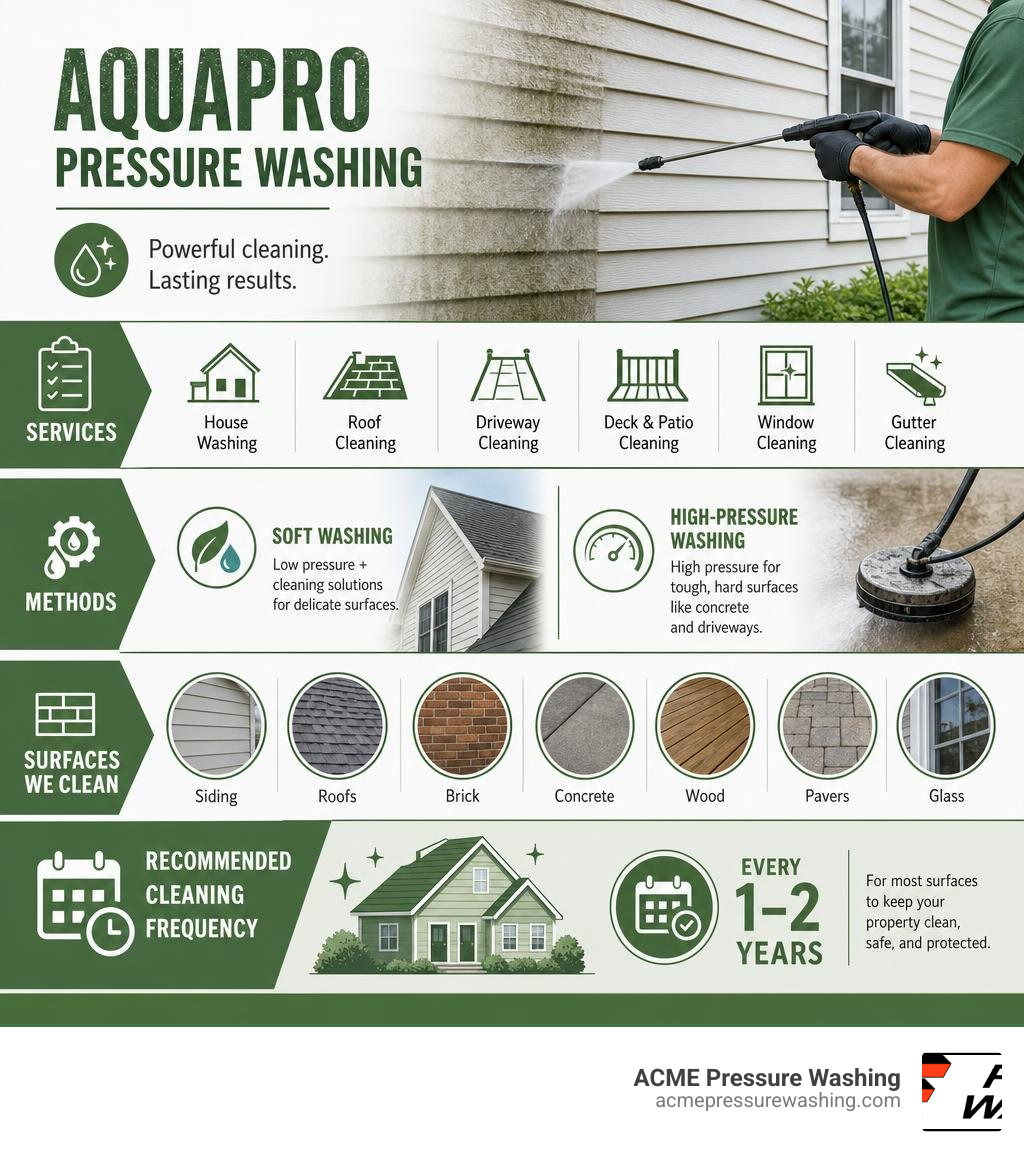
Learn more about aquapro pressure washing:
The Standards of Professional AquaPro Pressure Washing
When it comes to maintaining high-end commercial buildings, multi-family housing complexes, and sprawling residential estates in New Hampshire, utilizing professional-grade equipment and refined techniques is essential. True aquapro pressure washing is not a simple weekend DIY project with a retail-grade machine. It is a highly calibrated discipline that balances raw power with chemical science to achieve a deep, lasting clean without compromising structural integrity.
At ACME Pressure Washing, we approach every project with the highest standards of the industry. Professional exterior cleaning relies heavily on understanding the mechanics of water flow, measured in Gallons Per Minute (GPM), rather than just raw force, measured in Pounds per Square Inch (PSI). While a standard consumer-grade washer might force out water at a high PSI with very low GPM, our commercial-grade systems deliver high volume. This allows us to sweep away years of embedded grime, salt, and organic growth safely and efficiently.
Furthermore, protecting your surrounding landscaping, delicate masonry, and custom trim is a core priority of any high-level service. When executing Power Washing on hardscapes, we use professional rotary surface cleaners. These specialized tools prevent the “tiger striping” scars often left behind by inexperienced operators using standard spray wands. By distributing water flow evenly across the surface, we ensure a uniform, restored appearance for walkways, patios, and expansive concrete plazas.
Core Techniques of AquaPro Pressure Washing
To deliver a comprehensive clean, professional technicians must master two primary cleaning methodologies: high-pressure washing and low-pressure soft washing.
For resilient surfaces like concrete sidewalks, brick retaining walls, and commercial dumpster pads, high-pressure washing is the standard. This method physically blasts away tough, non-organic stains, tire marks, and deeply packed dirt. However, when we transition to delicate building envelopes, we utilize specialized low-pressure systems.
Our specialized House Pressure Washing services rely heavily on soft washing. Instead of using force to strip away dirt, soft washing utilizes custom-blended, biodegradable cleaning solutions to break down organic contaminants at their biological roots. These eco-friendly solutions are gently applied at low pressure—similar to the force of a garden hose—allowing them to kill mold, mildew, algae, and moss. Once the sanitizing agents have done the heavy lifting, the surface is thoroughly rinsed clean, leaving a spotless finish that stays clean up to three times longer than pressure washing alone.
Why Commercial Properties Choose AquaPro Pressure Washing
For businesses in bustling commercial hubs like Manchester and Bedford, maintaining an immaculate exterior is directly tied to brand reputation, customer trust, and property valuation. Dirt, grease, graffiti, and oil-stained walkways can deter clients and lower employee morale.
Commercial property managers routinely choose professional Commercial Pressure Washing to protect their real estate assets. Large-scale brick facades, metal siding, glass curtain walls, and concrete entryways require custom cleaning protocols. For example, high-traffic entryways often suffer from embedded chewing gum, soda spills, and heavy foot-traffic discoloration. Our team utilizes hot-water pressure washing units to melt away these stubborn contaminants quickly, restoring the welcoming look of your business.
Beyond buildings, commercial fleets, heavy machinery, and transport vehicles represent significant capital investments. Regular Fleet and Equipment Pressure Washing is vital to remove corrosive road salts, diesel soot, and grime. Keeping your fleet clean not only projects a professional image on New Hampshire highways but also allows mechanics to easily spot structural wear, fluid leaks, or damage during routine inspections.
Soft Washing vs. High-Pressure Washing
Choosing the wrong method for a specific surface can lead to thousands of dollars in property damage. Vinyl siding can crack, wood can splinter, and asphalt shingles can lose their protective UV granules if subjected to excessive water pressure.
To help you understand the clear distinctions between these two primary methods, we have broken down their applications, pressure levels, and ideal uses:
| Feature | Soft Washing | High-Pressure Washing |
|---|---|---|
| Typical Pressure | Low (under 500 PSI) | High (1,500 to 3,000+ PSI) |
| Primary Cleaning Action | Chemical sanitization & low-pressure rinse | Kinetic force & high-volume water flow |
| Ideal Surfaces | Vinyl siding, stucco, asphalt shingles, painted wood | Concrete, brick, stone walkways, metal |
| Target Contaminants | Mold, algae, mildew, moss, lichen, bacteria | Dirt, mud, tire marks, grease, chewing gum |
| Risk of Surface Damage | Extremely low | Moderate to high (if performed by amateurs) |
When we perform Pressure Washing Roofs, for example, high pressure is strictly avoided. Shingle manufacturers explicitly warn that high pressure will void warranties. Instead, we apply a gentle soft-wash treatment that eliminates Gloeocapsa magma—the hardy black algae responsible for those unsightly dark streaks on New Hampshire roofs. This preservation-first mindset is what separates true professional care from amateur attempts.
Key Benefits of Professional Exterior Cleaning in New Hampshire
The unique, four-season climate of New Hampshire presents distinct challenges for property maintenance. From the coastal air near the seacoast to the dense, wooded regions surrounding Amherst and Derry, our properties are constantly subjected to extreme weather patterns.
In the spring, heavy pollen coats siding and windows, while humid summers foster rapid mold, mildew, and algae growth on shaded northern walls. Autumn brings falling leaves and organic debris that clog gutters, and winter introduces harsh road salts, soot, and freezing moisture that can penetrate porous stone and concrete.
Investing in professional exterior maintenance offers several key advantages:
- Preventive Damage Control: Mold, mildew, and moss are not just cosmetic issues. Moss and lichen can dig roots into roof shingles, causing premature leaks. Left untreated on wood surfaces, organic growth traps moisture, accelerating wood rot and structural decay.
- Preserving Property Value: Regular cleaning prevents permanent staining and oxidation on vinyl siding, metal panels, and concrete. A clean, well-maintained building retains its market value and attracts high-quality tenants or buyers.
- Boosting Curb Appeal: First impressions are immediate. A pristine, freshly washed facade, clean walkways, and bright fences instantly elevate the aesthetic profile of any residential neighborhood or commercial district.
- Health and Safety: Algae, moss, and wet leaves on walkways, stairs, and pool decks create dangerous slip-and-fall hazards. Removing these slick layers ensures safe foot traffic for family members, employees, and customers alike.
To explore the deeper technical aspects of these benefits, check out The Ultimate Guide to Local Power Washing Services.
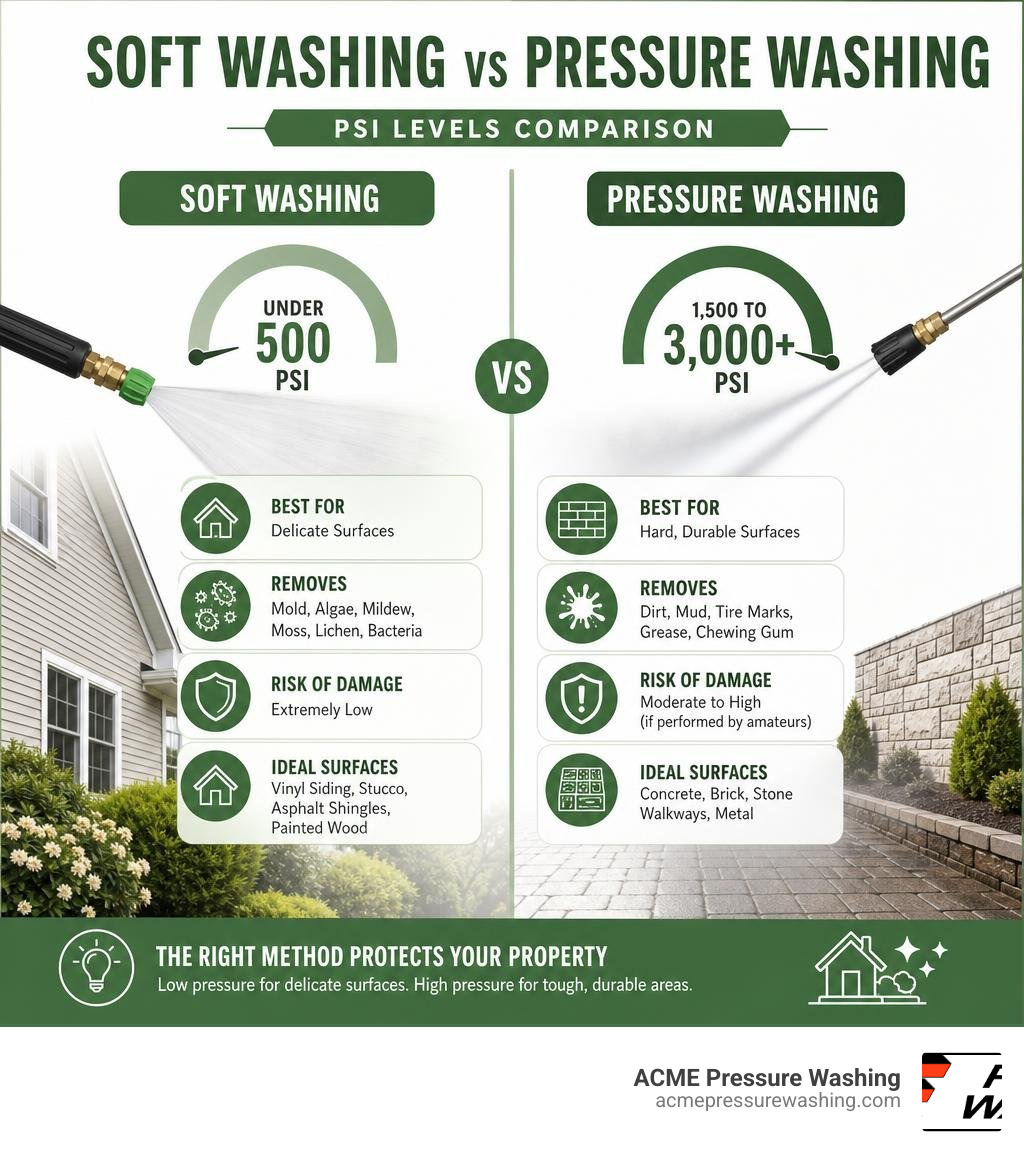
Preparing Your Property and Understanding the Costs
To ensure a seamless, highly effective cleaning appointment, proper preparation of the property is essential. When you schedule a professional cleaning service with us, we recommend a few simple steps to protect your belongings and allow our technicians to work safely:
- Close and Lock All Windows and Doors: This ensures a tight seal against water intrusion and prevents accidental overspray from entering your home or business.
- Clear the Driveway and Work Areas: Please move all vehicles, patio furniture, potted plants, and outdoor toys away from the surfaces being cleaned.
- Turn Off Outdoor Electrical Outlets: While professional crews use waterproof outlet covers, turning off outdoor breakers adds an extra layer of safety.
- Keep Pets and Family Members Indoors: For safety, children and pets should remain inside while high-pressure equipment and cleaning solutions are in use.
- Pre-Water Surrounding Landscaping: Running your outdoor lawn sprinklers or thoroughly watering sensitive plants for an hour before our arrival helps protect them from any accidental overspray of cleaning solutions.
For localized information on finding trusted service providers, you can consult resources like the Top 10 Best Pressure washers in Derry, NH – Angi.
Understanding the Cost of Professional Services
When budgeting for professional exterior cleaning, it is helpful to understand how pricing is structured across the industry. Exterior cleaning costs vary widely based on the overall square footage, the complexity of the architectural design, the level of organic buildup, and the specific surfaces involved.
To provide a realistic expectation of investment based on general internet data and industry averages, consider the following guidelines:
- Basic Walkway or Patio Cleaning: Online data indicates that a standard walkway or patio wash averages around $150 to $250. However, due to extreme variations in size, surface material, and level of contamination, professional service ranges typically span from $400 for basic, straightforward setups up to $1,250 or more for highly complex, multi-tiered stone patios or expansive commercial plazas.
- Full House or Building Envelope Washing: Standard residential house washes average around $300 to $500 in online databases. To account for multi-story challenges, delicate siding materials, and extensive architectural details, a realistic professional range spans from $800 on the lower end to $2,500 or more for estate-sized homes or commercial facilities.
Note: These ranges are based on broad internet data and industry averages to show the wide variability in the market; they do not represent the exact pricing of ACME Pressure Washing. Every property is unique, and we provide custom, detailed quotes tailored to your specific needs.
For a precise, tailored estimate for your home, business, or fleet, please visit our Contact ACME Pressure Washing page.
Frequently Asked Questions About Exterior Cleaning
How often should commercial properties be pressure washed?
In most cases, we recommend scheduling professional exterior cleaning at least once a year. However, high-traffic retail storefronts, restaurants, and buildings situated near busy roads or under dense tree canopies often require semi-annual cleanings to combat heavy soot, grease, and leaf debris.
Regular maintenance prevents contaminants from permanently staining concrete or etching into building facades. Keeping your walkways, entryways, and outdoor dining areas clean is simplified with scheduled Walkway and Patio Cleaning services.
Can pressure washing damage vinyl siding or wood decks?
Yes, if performed by untrained individuals using improper equipment. High pressure can easily blast water behind vinyl siding—leading to hidden mold growth—or splinter expensive wood decking.
This is why we prioritize soft washing for delicate building siding and apply carefully adjusted, low-pressure techniques with specialized wood restorers for decks and fences. Our professional training ensures your property is cleaned thoroughly and safely. To learn more about restoring wood surfaces, read about our Deck Pressure Washing Restoration and Fence Pressure Washing services.
What types of stains can professional power washing remove?
Professional-grade hot-water pressure washers and specialized detergents can remove a wide variety of stubborn stains, including:
- Deeply embedded oil, grease, and transmission fluid stains on concrete driveways and garage floors.
- Dark rust stains caused by irrigation systems, metal patio furniture, or fertilizer runoff.
- Thick layers of green mold, black algae, lichen, and moss.
- Spray paint and graffiti from brick, concrete, and metal surfaces.
- Heavy road salt, diesel soot, and road grime from shipping fleets and commercial vehicles.
For commercial fleets, maintaining a clean appearance is easy with our professional Fleet and Equipment Pressure Washing services.
Conclusion
Investing in professional aquapro pressure washing is one of the most effective ways to protect your property, enhance its curb appeal, and prevent costly structural repairs. Whether you need to restore a historic home in Amherst, clean a commercial facility in Manchester, wash a multi-family complex in Derry, or maintain a pristine estate in Bedford, using the right techniques is essential for safe, beautiful, and long-lasting results.
At ACME Pressure Washing, we have spent over 38 years perfecting our craft. We combine state-of-the-art commercial equipment with safe, highly customized, and eco-friendly techniques to clean your property thoroughly without risking damage to your surfaces or the surrounding environment.
We serve homes, businesses, and commercial fleets across our New Hampshire service areas with dedication, experience, and unmatched attention to detail.
Ready to see your property transformed? Contact our expert team today at +1603-883-6900 or fill out our online form to request a fast, free, and customized quote:
Get Your Free Custom Quote Today
Oil Stains on Your Driveway? Here’s What Actually Works
Finding the right degreaser for concrete driveway stains is one of the most common headaches homeowners in Manchester, Merrimack, and across New Hampshire face every spring and fall.
Quick Answer: Best Degreasers for Concrete Driveways
| Product Type | Best For | Working Time |
|---|---|---|
| Alkaline/surfactant-based (e.g., Zep Concentrated) | Fresh to moderate oil and grease stains | 5-10 minutes |
| Peroxide-based (e.g., Simple Green Oxy Solve) | General cleaning, eco-conscious users | 3-5 minutes |
| Enzyme/bioremediation (e.g., ACT Concrete Cleaner) | Deep, set-in hydrocarbon stains | 3-4 weeks |
| Ready-to-use spray degreasers | Small spot stains, quick jobs | 5-10 minutes |
Top picks at a glance:
- Best overall – Simple Green Oxy Solve Concrete and Driveway Cleaner (EPA Safer Choice certified)
- Best for heavy-duty stains – Zep Concentrated Driveway and Concrete Cleaner
- Best eco-friendly – ACT Concrete Cleaner (bioremediation formula)
- Best value concentrate – Oil Eater Cleaner & Degreaser (USDA approved, non-hazardous)
Here’s the problem most people don’t realize: concrete is porous. Oil doesn’t just sit on the surface — it soaks in fast and binds to the material at a chemical level. That’s why a quick rinse with a garden hose never works. And it’s why a driveway in Manchester or Merrimack that looks stained after one winter can be genuinely difficult to restore without the right product and technique.
The good news? The right degreaser, applied correctly, can pull a significant amount of that embedded oil back out. The bad news? Most homeowners pick the wrong product, use the wrong dilution, or skip key steps — and end up with a driveway that still looks dirty, or worse, gets damaged in the process.
This guide cuts through the noise. We’ll cover which products work, how to use them, and when it makes more sense to call in a professional.
I’m Lionel Greenwood, owner of ACME Pressure Washing, and I’ve been removing oil stains from concrete driveways across New Hampshire for over 38 years — which means I’ve tested more formulas and seen more degreaser for concrete driveway disasters than I can count. In the sections ahead, I’ll share what actually works in the field, not just what looks good on a label.
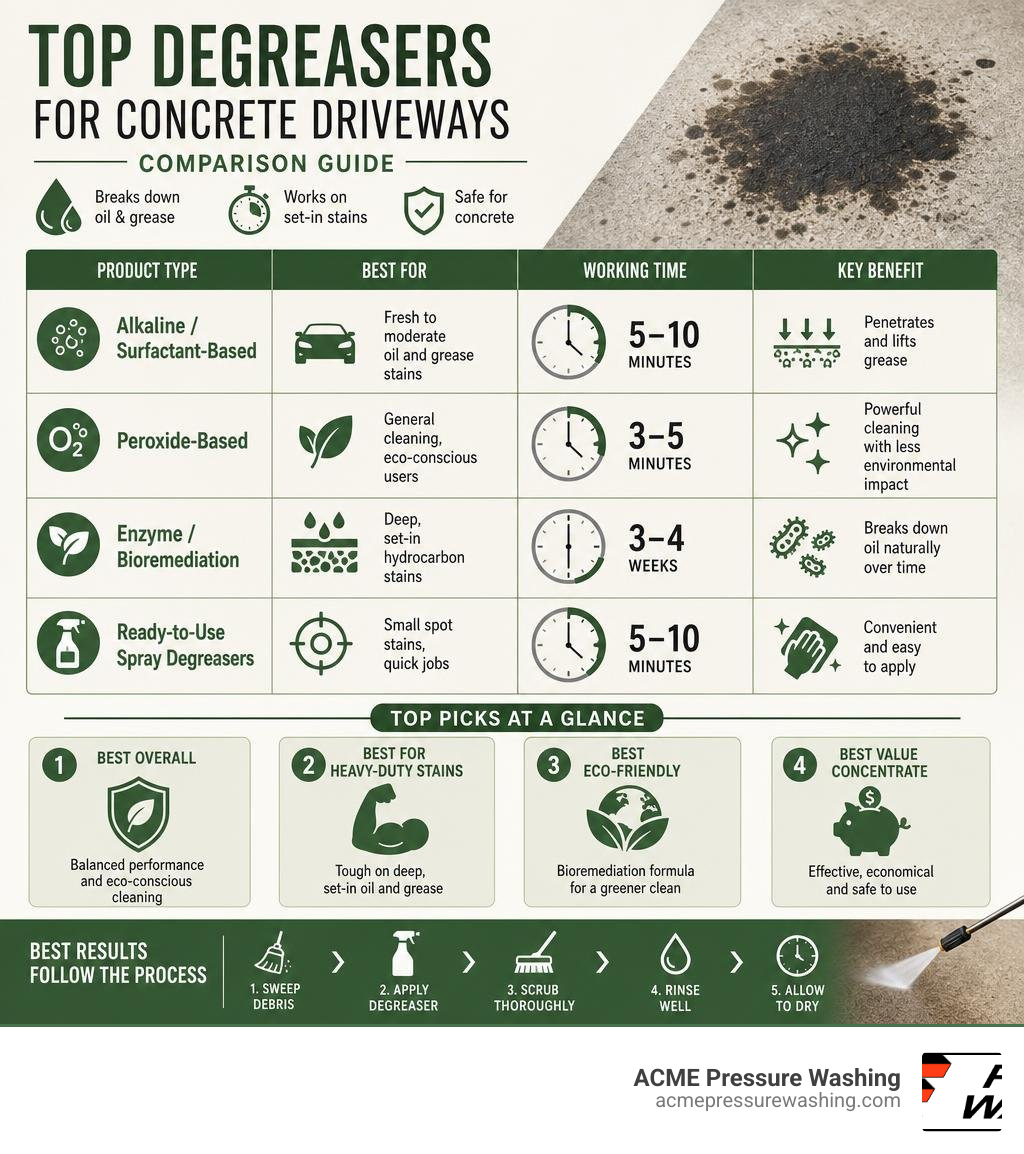
Understanding the Chemistry of a Degreaser for Concrete Driveway
To understand why a degreaser for concrete driveway works, you have to understand what you are fighting. Concrete is highly alkaline due to its lime content. It is also packed with microscopic pores, acting like a giant, hard sponge. When motor oil, transmission fluid, or grease drips onto your driveway, gravity pulls these hydrocarbons deep into those pores.
Standard water-based rinsing cannot touch these embedded hydrocarbons because oil and water do not mix. To break that bond, you need a chemical agent that can penetrate the pores, emulsify the oil, and lift it to the surface. This is where different chemical formulations come into play:
- Alkaline Cleaners & Surfactants: Most high-performing driveway cleaners, such as Zep Concentrated Driveway and Concrete Cleaner and Degreaser – 1 Gallon – Zep Inc. , rely on a high pH (alkaline) formula combined with advanced surfactants. The alkaline chemistry cuts through the acidic properties of oil, while surfactants reduce the surface tension of water, allowing the cleaner to seep deep into the concrete’s pores to break down the grease.
- Bioremediation (Enzyme) Cleaners: These products represent a massive leap in green technology. Instead of using harsh acids or solvents to strip the oil, they introduce specialized microbes that literally eat the oil and grease, converting them into harmless water and carbon dioxide. While highly effective, this biological process is slow, often taking 3 to 4 weeks to fully lift the stain.
- Acidic Cleaners: Generally, acids are used for etching concrete or removing rust and mineral deposits rather than degreasing. Using harsh acids on an oil stain can actually damage the concrete surface without effectively breaking down the hydrocarbons.
When selecting a chemical helper, matching the cleaner to your equipment is vital. Applying a heavy-duty degreaser requires careful application. If you plan on rinsing the surface, you must understand how to protect your concrete by reading The Ultimate Guide to Finding the Perfect PSI for Concrete Driveways to avoid damaging the cream coat of your concrete.
Furthermore, environmental safety is a major concern here in Southern New Hampshire. When you wash away a heavy chemical degreaser on a sloped driveway in Bedford, NH, that runoff flows directly into the soil, local storm drains, and eventually our groundwater. Choosing biodegradable, non-corrosive formulas helps protect our local ecosystems from toxic chemical accumulation.
Concentrated vs. Ready-to-Use Formulas: Performance and Value
When shopping for a degreaser for concrete driveway cleaning, you will face a choice between concentrated formulas and ready-to-use (RTU) products. Choosing the right format depends heavily on the scale of your project, your budget, and the severity of the oil stains.
Concentrated Degreasers
Concentrates offer the best overall value and versatility. For example, one gallon of Zep Concentrated Driveway & Concrete Cleaner can make up to 20 gallons of active cleaning solution when diluted for light soils. Similarly, products like Simple Green | US | Professional | Oxy Solve Concrete Driveway Cleaner can be mixed at a 1:20 ratio for manual cleaning, making up to 21 gallons of usable cleaner from a single container.
This flexibility allows you to customize the chemical strength. For light, seasonal maintenance cleaning across a large parking area, a highly diluted mix saves money and prevents waste. For deep, set-in oil pools, you can apply the concentrate at full strength or with a minimal dilution (such as 1:1 or 1:5) to maximize chemical power.
Ready-to-Use (RTU) Formulas
RTU formulas require no mixing or measuring. They are highly convenient for quick spot-treatments right after an engine leak. However, they are far more expensive per square foot and lack the customizability of concentrates. If you have a large driveway or a commercial property in Merrimack, NH, relying on RTU bottles will quickly become cost-prohibitive.
| Feature | Concentrated Degreasers | Ready-to-Use (RTU) Degreasers |
|---|---|---|
| Average Cost per Gallon | Low (highly economical when diluted) | High (paying for pre-mixed water) |
| Strength Control | Fully adjustable (from 1:1 up to 1:20) | Fixed strength |
| Best For | Large driveways, heavy staining, fleet areas | Small spot stains, instant convenience |
| Storage Space | Low (one jug makes multiple gallons) | High (requires storing multiple bottles) |
| Application Method | Pump sprayers, buckets, stiff brushes | Direct spray bottles |
For commercial applications where vast concrete pads must be cleaned regularly, concentrates are the undisputed industry standard. They allow cleaning crews to adjust their chemical ratios on the fly depending on whether they are tackling light exhaust soot or heavy transmission fluid pools.
Professional Application Techniques for Maximum Stain Removal
Simply pouring a degreaser onto a stain and rinsing it off immediately will yield disappointing results. To successfully extract oil from porous concrete, you must follow a disciplined, professional application process.
Step 1: Pre-Treat and Absorb Excess Oil
If the oil stain is fresh and wet, do not apply liquid degreaser immediately. Doing so will only liquefy the oil and cause it to spread, staining a larger surface area. Instead, cover the wet spill with an absorbent material like clay cat litter, baking soda, or a specialized oil-absorbent powder. Let it sit for at least an hour to draw out the standing pool, then sweep it up and dispose of it safely.
Step 2: Pre-Wet Surrounding Landscaping
Before applying any chemical cleaner, thoroughly saturate all surrounding grass, plants, and shrubs with clean water. This creates a moisture barrier on the leaves and in the soil, preventing the vegetation from absorbing the chemical runoff.
Step 3: Apply and Manage Dwell Time
Apply your diluted degreaser for concrete driveway solution using a low-pressure pump sprayer or a heavy-duty mop. The secret to chemical cleaning is dwell time—the period the chemical sits on the concrete to break down the oil.
According to professional standards, most high-quality alkaline degreasers require 5 to 10 minutes of dwell time to emulsify the grease. However, you must never allow the degreaser to dry on the concrete. If the cleaner dries, the emulsified oil will settle back down into the pores, making it twice as hard to remove. If you notice the surface drying under the summer sun, mist it lightly with water or apply a small amount of fresh cleaning solution to keep it wet.
For step-by-step guidance on how to manage these application steps safely, you can consult the instructional resource on How to Clean Concrete Driveways, Sidewalks and Patios | Oil Eater .
Step 4: Agitation
Chemicals do the heavy lifting, but physical agitation breaks the surface bond. Scrub the treated area vigorously using a stiff-bristle deck brush or a commercial floor scrubbing machine. Avoid wire-bristle brushes, as metal bristles can snap off, rust, and leave permanent orange rust stains on your concrete.
Step 5: Rinsing and Extraction
Once the oil is emulsified, rinse the surface thoroughly. While a garden hose with a high-pressure nozzle can work for very light stains, thorough rinsing is required to flush the pores completely. To avoid common pitfalls during the cleaning phase, make sure to read Stop Making These Noob Mistakes During Concrete Power Washing.
For tough jobs, such as driveway cleaning in Goffstown, NH, executing this multi-step process with professional-grade agitation and thermal pressure washing is often the only way to completely erase shadow stains.
Why DIY Concrete Degreasing Often Falls Short
While the local hardware store shelves are packed with DIY cleaning products, many homeowners find that their weekend cleaning projects yield disappointing results. Cleaning concrete is a science, and DIY attempts frequently run into several major roadblocks:
- Surface Etching and Damage: Many retail concrete cleaners contain highly corrosive acids or aggressive solvents. If left on the surface too long, or if applied to unsealed concrete, these chemicals can chemically dissolve the top layer of the concrete (the paste or cream coat). This leaves behind a rough, permanently etched texture that attracts dirt even faster.
- The “Shadow Stain” Phenomenon: You might succeed in removing the dark surface oil, only to find a light, ghostly outline of the stain remains. This “shadow” occurs because the degreaser did not penetrate deeply enough to extract the hydrocarbons trapped deep within the concrete’s capillary network. As the concrete dries, the remaining subsurface oil slowly migrates back to the surface via capillary action.
- Inadequate Equipment: Standard garden hoses and household sprayers rarely produce the hot water or the rinsing volume required to lift emulsified oil out of porous concrete. Standard cold-water rinsing simply pushes the loosened grease deeper into the pores or spreads it around, creating a larger, hazy stain.
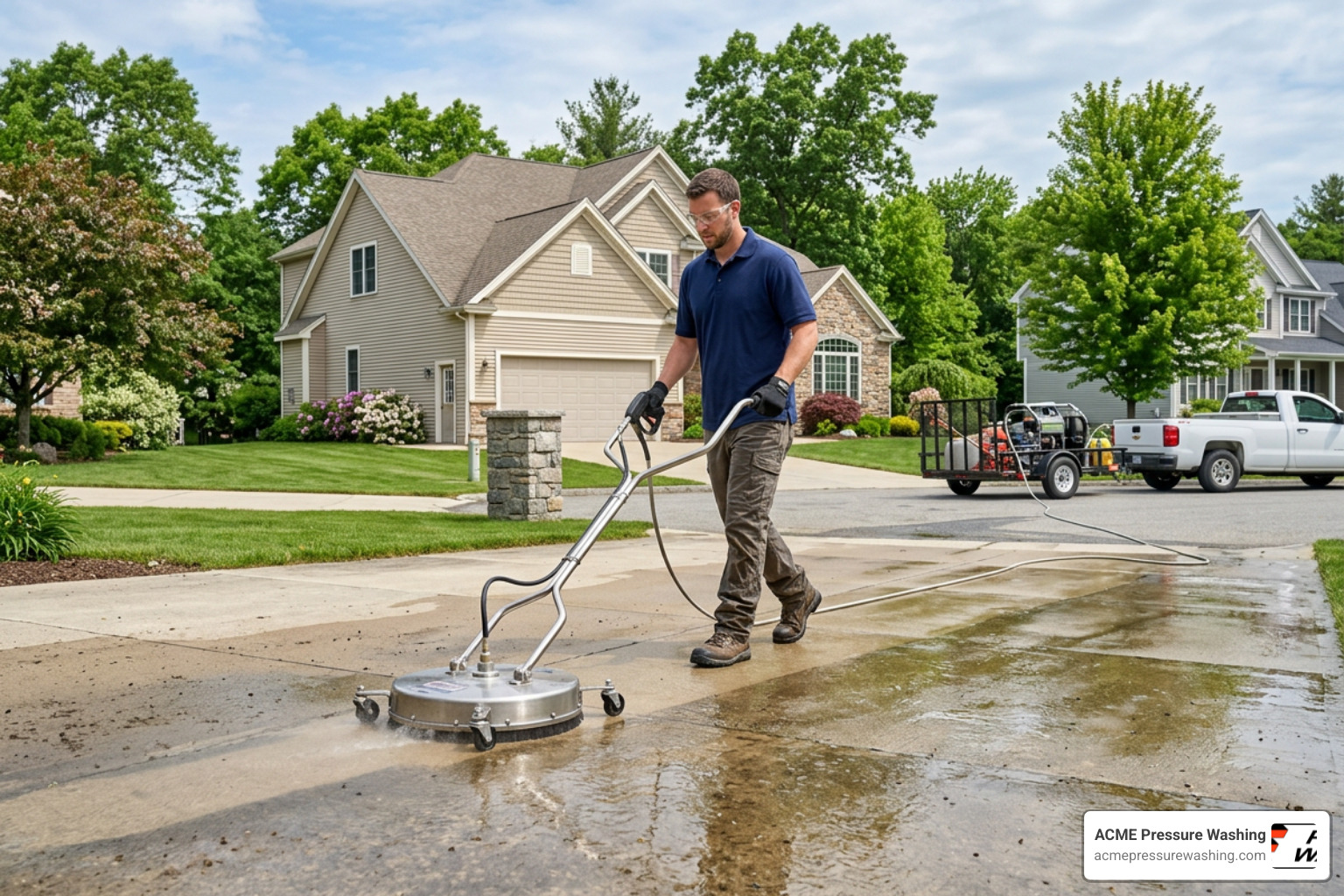
Furthermore, handling heavy chemical runoff presents significant safety and regulatory challenges. In cities like Manchester, NH, local environmental regulations strictly govern what can enter storm drains. Discharging toxic chemical degreasers and emulsified motor oil into public storm systems can result in steep municipal fines.
Professional exterior cleaning companies use specialized reclamation equipment or eco-friendly, biodegradable solutions that comply with local guidelines. If you want to understand the different professional service levels available, check out Don’t Let Grime Win: Your Guide to Driveway Pressure Washing Service Options.
If you are considering hiring a professional, it helps to understand the typical market rates. Based on publicly available internet data, the average cost of professional concrete cleaning across New Hampshire is around $400. However, actual custom rates vary based on the size of the driveway and the severity of the staining. A typical professional service range can run from $800 on the lower end for small, basic driveways up to $2,000 or more for heavily stained, large commercial-scale properties. These are general industry averages and do not represent the specific rates of ACME Pressure Washing.
Frequently Asked Questions About Concrete Driveway Degreasers
What is the best degreaser for concrete driveway oil stains?
The absolute best degreaser for concrete driveway stains depends on the age of the stain and your environmental goals. For general, highly effective oil and grime removal with a focus on safety, we recommend Simple Green | US | Professional | Pressure Washer Concrete Driveway . This formula is designed to meet strict eco-friendly standards, which is highly valued in environmentally conscious communities like Merrimack, NH. For ancient, deeply saturated stains, a biological enzyme cleaner that breaks down hydrocarbons over several weeks is often the most effective option.
How long does a degreaser for concrete driveway take to work?
Working times vary wildly by product type. Standard chemical degreasers typically require a dwell time of 5 to 10 minutes to break down grease before they must be scrubbed and rinsed. Conversely, specialized biodegradable concrete removers and dissolvers like MudBreaker | Biodegradable Concrete Dissolver & Remover – MudMixer require at least 30 minutes (or even overnight for heavy buildup) to soften hardened materials into a rinseable mud. If you are using a bioremediation cleaner, the microbes can take 3 to 4 weeks to fully digest deep oil stains.
Climate also plays a major role; during seasonal cleaning in Goffstown, NH, moderate spring and autumn temperatures are ideal. Applying these chemicals in freezing winter weather or under the direct, scorching summer sun will prevent them from working properly or cause them to dry out too quickly.
Will chemical degreasers damage my surrounding landscaping?
They can if used improperly. Highly acidic or caustic chemical cleaners will easily burn grass and kill ornamental plants. However, you can prevent this damage by choosing non-caustic, non-acidic, and biodegradable formulas.
Regardless of the product you choose, always pre-saturate the surrounding grass and soil with clean water before applying any cleaner, and rinse the landscaping thoroughly again once the job is complete. To learn more about how professional cleaning processes protect your home’s exterior investment, read our comprehensive Driveway Cleaning Cost Guide for a Sparkling Entrance.
Conclusion
Removing stubborn oil stains from your driveway doesn’t have to be an endless battle. By choosing the right degreaser for concrete driveway surfaces, understanding the chemistry of porous concrete, and utilizing proper dwell times and agitation techniques, you can dramatically improve your home’s curb appeal.
However, if you are dealing with ancient, set-in oil pools, or if you simply want to avoid the physical labor, chemical hazards, and runoff risks of a DIY project, calling in the experts is always the safest and most effective path.
At ACME Pressure Washing, we bring over 38 years of hands-on exterior cleaning experience to every job. Based in Merrimack, NH, we use safe, customized, and eco-friendly techniques to completely restore concrete driveways, walkways, and patios without damaging your property or the local New Hampshire environment.
Let us handle the dirty work and restore your driveway to its original beauty. For a professional concrete restoration that lasts, read more about our specialized driveway pressure washing service options.
Ready to get rid of those ugly oil stains for good?
- Call us today: +1603-883-6900
- Get a free, no-obligation quote online: Request a Quote from ACME Pressure Washing
Why Your Driveway Needs More Than a Garden Hose
Pressure washing driveway services give you the fastest, most effective way to remove oil stains, mold, algae, tire marks, and ground-in grime from concrete, pavers, and asphalt — restoring curb appeal and extending surface life.
Quick answer: What do professional driveway pressure washing services include?
| Service Component | What It Does |
|---|---|
| Surface assessment | Identifies stain types and driveway material to calibrate equipment |
| Chemical pre-treatment | Breaks down oil, rust, algae, and mineral deposits before washing |
| Commercial pressure washing | Removes embedded grime at 2,500–4,000 PSI with a rotary surface cleaner |
| Post-clean sealing | Protects pores from moisture, mold, and future staining |
| Final walkthrough | Documents results and provides maintenance recommendations |
How much does it cost? Based on publicly available internet data, professional driveway cleaning averages between $300 and $1,500+ depending on driveway size, surface type, and stain severity. These are industry averages — not ACME Pressure Washing’s actual rates.
Your driveway takes more punishment than almost any other surface on your property. In towns like Merrimack and Nashua, driveways face road salt, freeze-thaw cycles, heavy vehicle traffic, and New Hampshire’s humid summers — all of which grind dirt and organic growth deep into porous concrete and pavers.
Most homeowners don’t realize how much buildup has accumulated until after a professional cleaning. One common reaction: “I didn’t know my driveway was that color.” That’s how dramatic the difference can be.
A dirty driveway isn’t just an eyesore. Algae and mold create genuine slip hazards. Oil and moisture accelerate surface breakdown. And stains left untreated long enough can become permanent.
The good news? A single professional service — done right — can restore your driveway and keep it protected for 12 to 18 months.
I’m Lionel Greenwood, owner of ACME Pressure Washing, and I’ve been delivering pressure washing driveway services across New Hampshire and Southern New England since 1988. In 38+ years, I’ve cleaned everything from basic concrete driveways in Bedford to complex paver and specialty stone installations throughout the region. This guide covers everything you need to know to make a smart, informed decision about your driveway cleaning.
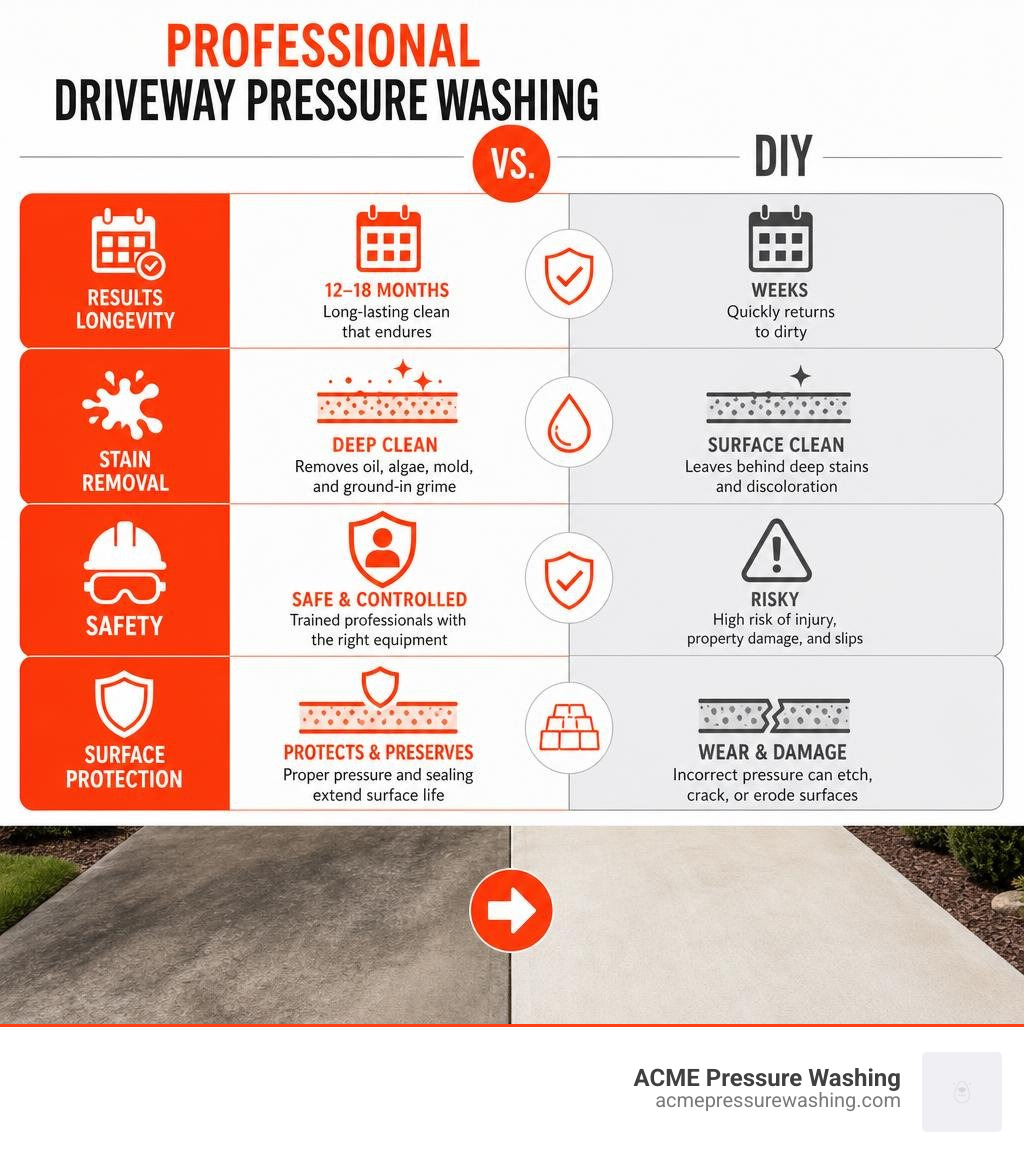
Explore more about pressure washing driveway services:
Professional Driveway Cleaning and Material-Specific Protocols
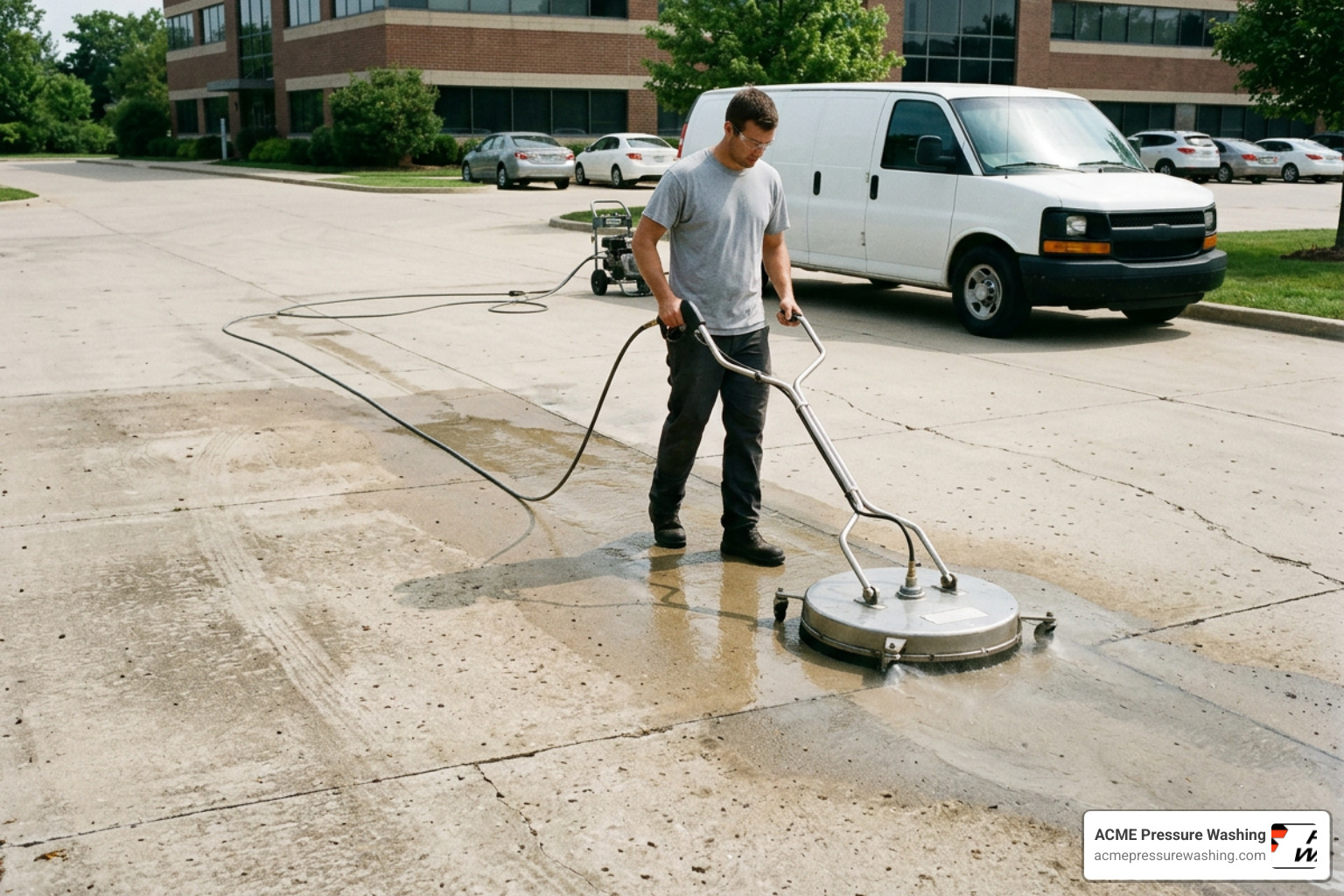
When it comes to cleaning highly trafficked exterior surfaces, a one-size-fits-all approach is a recipe for disaster. Different hardscape materials require custom configurations of water temperature, pressure levels, and specialized cleaning agents to achieve a deep clean without causing structural damage.
At ACME Pressure Washing, we utilize commercial-grade, truck-mounted equipment capable of producing hot water and outputting calibrated water flow rates. While standard consumer units rely on cold water and sheer force, our professional systems use heated water to melt away grease, oil, and synthetic rubber tire marks.
Different materials demand highly specific protocols:
- Concrete: Concrete is naturally porous, allowing motor oil, mold spores, and grime to settle deep beneath the surface. To thoroughly clean concrete, we use professional rotary surface cleaners operating at a calibrated PSI. This ensures an even, streak-free clean across the entire slab. To understand the exact pressure requirements for these surfaces, check out The Ultimate Guide to Finding the Perfect PSI for Concrete Driveways.
- Pavers: Cleaning interlocking paving stones requires a delicate balance. High-pressure streams can easily wash away the joint sand holding the pavers in place. We adjust our pressure settings and use specialized nozzles to clean the stone faces while preserving the joint integrity. Learn more about this delicate process by reading Pressure Washing Paving Stones Like a Pro and Clean Your Patio Pavers Like a Pro This Weekend.
- Asphalt: Asphalt is bound together by petroleum-based binders. Applying excessive pressure or harsh solvents can strip these binders, leading to loose aggregate and premature crumbling. We utilize low-pressure soft washing techniques combined with eco-friendly detergents to clean asphalt safely.
Why DIY Methods Fall Short of Professional Pressure Washing Driveway Services
Many property owners attempt to clean their own driveways using rented or light-duty consumer pressure washers. Unfortunately, these DIY attempts often lead to disappointing results or permanent property damage.
Consumer pressure washers typically utilize a single high-pressure wand. Operating this wand by hand makes it nearly impossible to maintain a consistent distance from the surface. The result is “striping” or permanent wand marks—unsightly, uneven clean lines etched into the concrete.
Even worse, excessive pressure can cause surface etching and spalling, blasting away the top cream layer of concrete and exposing the rough aggregate underneath. Once concrete is etched, it cannot be reversed; the rough surface will trap dirt and organic matter even faster than before. To avoid these costly errors, read about how to Stop Making These Noob Mistakes During Concrete Power Washing.
Restoring Pavers and Specialty Stone with Pressure Washing Driveway Services
Specialty driveways constructed from pavers, Chicago brick, or travertine add incredible aesthetic value to New Hampshire properties, but they require expert maintenance. Over time, weed seeds, moss, and black algae colonize the joint spaces between the stones, breaking down the underlying sand bed.
Our technical restoration process for these surfaces involves a careful wash to remove organic growth, followed by the installation of dry polymeric sand. Polymeric sand contains special chemical binders that activate when misted with water, locking the joints in place and preventing future weed growth. Finally, we apply a breathable, protective penetrating sealer to shield the stones from weather damage and chemical stains. For alternative cleaning methods and insights on block paving maintenance, see Does Washing Powder Clean Block Paving The Ultimate Guide.
The Impact of New England Climate on Driveway Surfaces
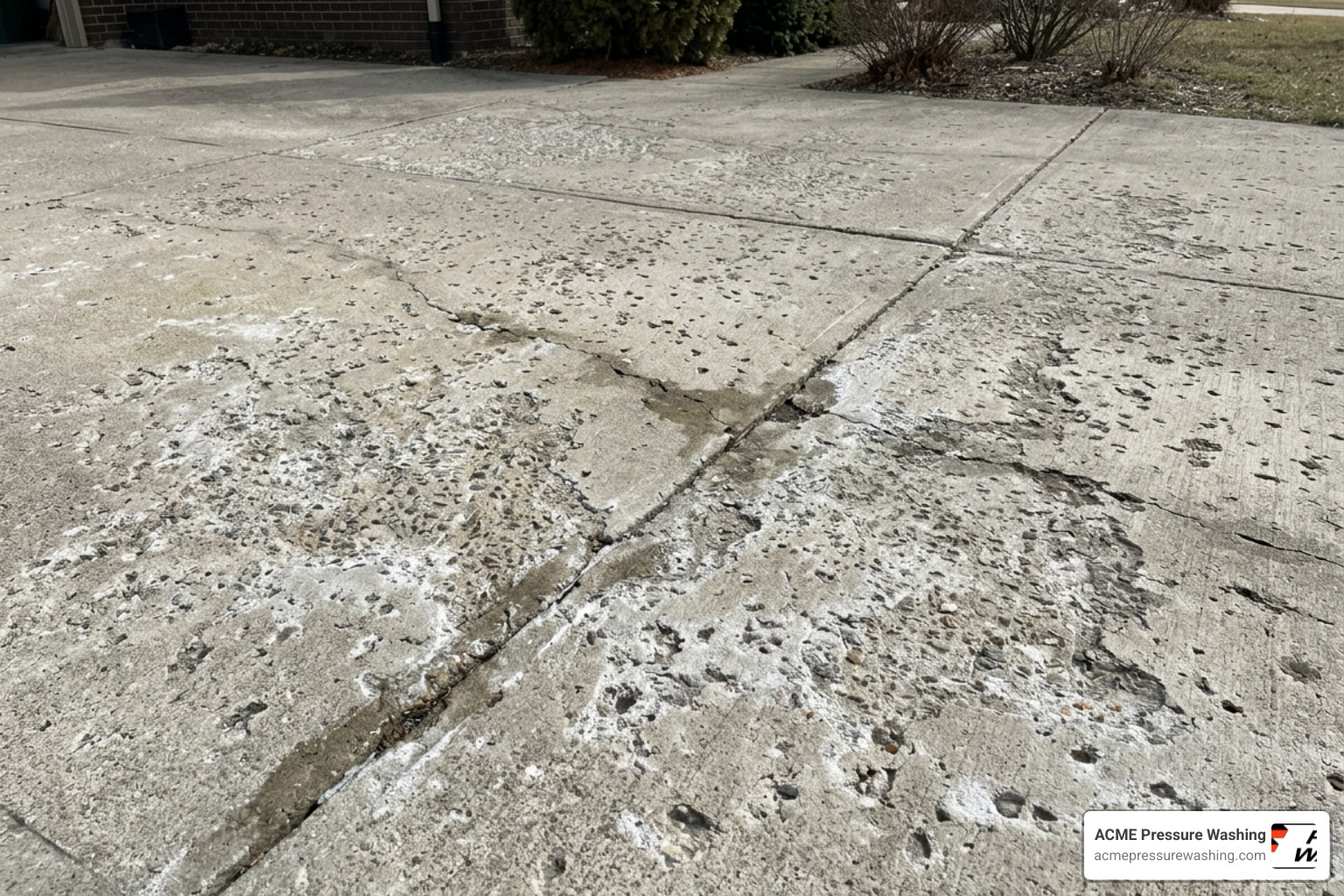
The climate in Southern New Hampshire is exceptionally harsh on outdoor hardscapes. From freezing winters in Amherst to humid summers in Bedford, our local weather creates a continuous cycle of physical and biological stress on driveways.
During the winter months, road salt and liquid de-icers are tracked onto residential and commercial driveways. This salt penetrates the porous concrete. When temperatures drop, water trapped inside the concrete pores freezes and expands by roughly 9%. This expansion pressure causes micro-fractures, chipping, and spalling.
In the spring and summer, New Hampshire’s high humidity and rainfall trigger rapid biological growth. Mold, mildew, and black algae thrive in shaded driveways, creating slick, dark films that ruin your curb appeal and turn wet driveways into major slip hazards. This constant environmental onslaught makes regular professional cleaning a necessity rather than a luxury. For residents in the area, utilizing professional Soft & Pressure Washing Services in Bedford New Hampshire is the most effective way to combat this wear.
Pressure Washing vs. Soft Washing for Driveways
Understanding the difference between high-pressure washing and low-pressure soft washing is critical to protecting your property.
- Pressure Washing: Utilizes high-velocity water (typically 2,500 to 4,000 PSI) to mechanically blast away stubborn, non-living contaminants like clay, dried mud, and tire rubber from durable surfaces like solid concrete.
- Soft Washing: Relies on low-pressure water streams combined with specialized, biodegradable chemical pre-treatments. This method is designed to target and eliminate organic growth (algae, mold, and moss) at the root level without damaging delicate materials like wood, asphalt, or soft stone.
By choosing soft washing for delicate hardscapes, we eliminate the risk of structural damage while ensuring that mold and algae spores are completely neutralized. To learn more about how these techniques are applied locally, check out the Soft & Pressure Washing Services in Hollis New Hampshire guidelines.
Understanding the Cost of Pressure Washing Driveway Services
When budgeting for professional driveway maintenance, it is helpful to understand how pricing is determined. Several key variables influence the final cost of a professional cleaning and sealing service:
- Square Footage: The overall physical footprint of your driveway and connected walkways is the primary factor.
- Surface Material: Standard concrete is typically more straightforward to clean than intricate interlocking pavers that require sand replacement.
- Stain Severity: Heavy oil leaks, deep rust stains from well water, and severe efflorescence require specialty chemical treatments and extended dwell times.
- Sealing Options: Applying a high-grade penetrating sealer after cleaning adds material costs but dramatically extends the life of the clean.
To help you plan, we have compiled a comparison of costs and long-term value based on general industry data. That all prices mentioned below are average costs sourced from publicly available internet data and are not the actual prices of ACME Pressure Washing.
For a comprehensive breakdown of pricing dynamics, refer to the Driveway Cleaning Cost Guide for a Sparkling Entrance.
Professional vs. DIY Cost and Longevity Comparison Table
| Cleaning Method | Sourced Average Cost Range | Results Longevity | Risk of Surface Damage |
|---|---|---|---|
| DIY Rental & Cleaning | $150 – $300 (Equipment & chemicals) | 4 to 8 weeks | High (Etching, striping, erosion) |
| Professional Cleaning & Sealing | $500 – $2,500+ (Industry average range) | 12 to 18 months | Negligible (Calibrated equipment) |
Note: The professional price range represents industry-wide averages where the low end of the range is set at twice the national average cost to account for variable factors, and the high end extends to over five times the average for large estate properties, paver re-sanding, and premium sealing applications.
Frequently Asked Questions About Driveway Cleaning
How often should New Hampshire driveways be professionally cleaned and sealed?
Given the intense freeze-thaw cycles and humid summers in towns like Nashua and Merrimack, we recommend having your driveway professionally cleaned at least once a year. Annual maintenance prevents organic growth from taking deep root and stops road salt from accumulating in the concrete pores. Applying a high-quality sealer every 12 to 18 months will dramatically reduce water absorption, protecting your hardscape from winter cracking.
Can professional pressure washing remove deep oil and rust stains?
Yes, but water pressure alone is never enough. Petroleum-based oil stains bond with concrete at a molecular level. We treat these stains using professional-grade enzymatic cleaners and degreasers, allowing them sufficient dwell time to break down the hydrocarbons before washing. Similarly, stubborn rust stains caused by iron-rich sprinkler water require specialized acid-based treatments to dissolve the iron oxide bonds without etching the concrete.
Why is choosing a licensed and insured pressure washing company critical?
Operating high-pressure machinery carries inherent risks. An unlicensed operator using improper PSI settings can easily destroy your concrete, ruin your landscaping, or cause severe personal injury. Working with a fully licensed and insured company ensures you are completely protected against liability for property damage or personal injury. Furthermore, professional companies comply with local environmental regulations regarding wastewater runoff, keeping your property safe and legally compliant.
Conclusion
Your driveway is one of the most visible parts of your property. Keeping it clean and structurally sound preserves your curb appeal and prevents expensive concrete replacement or paver repairs down the road.
Since 1988, ACME Pressure Washing has provided premier exterior cleaning services throughout Southern New Hampshire, including Merrimack, Nashua, Bedford, and Amherst. With over 38 years of experience, we bring the perfect blend of hot-water commercial equipment, eco-friendly cleaning agents, and material-specific expertise to every job.
Beyond driveways, we specialize in a comprehensive suite of professional pressure washing services designed to keep your entire property looking immaculate. Explore our primary service options:
- Protect your home’s exterior walls with our safe, low-pressure house pressure washing services.
- Maintain a clean, welcoming storefront and safe walkways with our commercial pressure washing solutions.
- Keep your business assets looking professional on the road with our specialized fleet and equipment pressure washing services.
Don’t let winter salt and summer grime degrade your property’s value. Contact our expert team today to schedule your professional driveway restoration.
Fill out our quick online form to Contact ACME Pressure Washing and request your free, no-obligation estimate!
