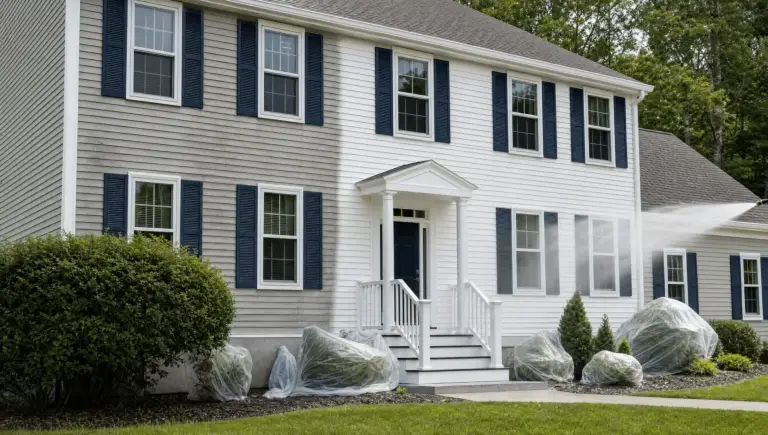
Pressure Wash Exterior Surfaces Without Damaging Your Home
Why the Wrong Technique Can Ruin Your Home When You Pressure Wash Exterior Surfaces
How to pressure wash exterior surfaces safely comes down to three things: the right pressure, the right method, and knowing which surfaces need a gentler approach.
Here’s a quick-reference guide to get you started:
| Surface | Recommended Method | PSI Range |
|---|---|---|
| Concrete driveway | Pressure washing | 1,500 – 3,000 PSI |
| Vinyl siding | Soft washing | 150 – 1,500 PSI |
| Wood deck | Low-pressure washing | 800 – 1,000 PSI |
| Asphalt roof shingles | Soft washing only | 150 – 300 PSI |
| Brick and stone | Pressure washing | 1,500 – 2,500 PSI |
| Stucco | Low-pressure washing | 1,200 – 1,500 PSI |
New Hampshire’s climate is hard on exterior surfaces. Humid summers breed mold and algae. Harsh winters leave salt, grit, and moisture behind. By spring, most homes in areas like Merrimack, Manchester, and Nashua are showing the damage.
The fix seems simple: grab a pressure washer and blast it clean.
But that’s where many homeowners go wrong.
Too much pressure — or the wrong technique — can crack vinyl siding, strip paint, etch wood, and force water behind your walls. That hidden moisture then feeds mold and rot for months before you ever notice it.
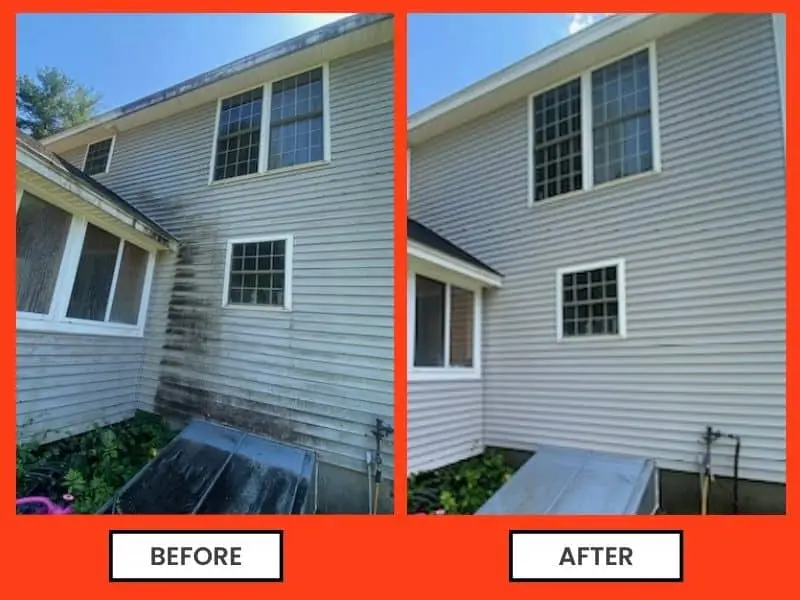
The good news? When done correctly, exterior pressure washing is one of the most effective ways to restore your home’s appearance, protect its surfaces, and maintain its value.
I’m Lionel Greenwood, owner of ACME Pressure Washing, and I’ve spent 38 years pressure washing exterior surfaces across New Hampshire — from residential homes in Merrimack and Nashua to commercial properties throughout Southern New England. In this guide, I’ll walk you through exactly how to clean your home’s exterior safely, what methods work for which surfaces, and when it’s smarter to call a professional.
Pressure wash exterior vocabulary:
Understanding the Methods: Pressure Washing vs. Soft Washing

To safely pressure wash exterior surfaces, we must first understand that “one size does not fit all.” Many people use the terms “pressure washing” and “soft washing” interchangeably, but they represent completely different philosophies in the exterior cleaning industry.
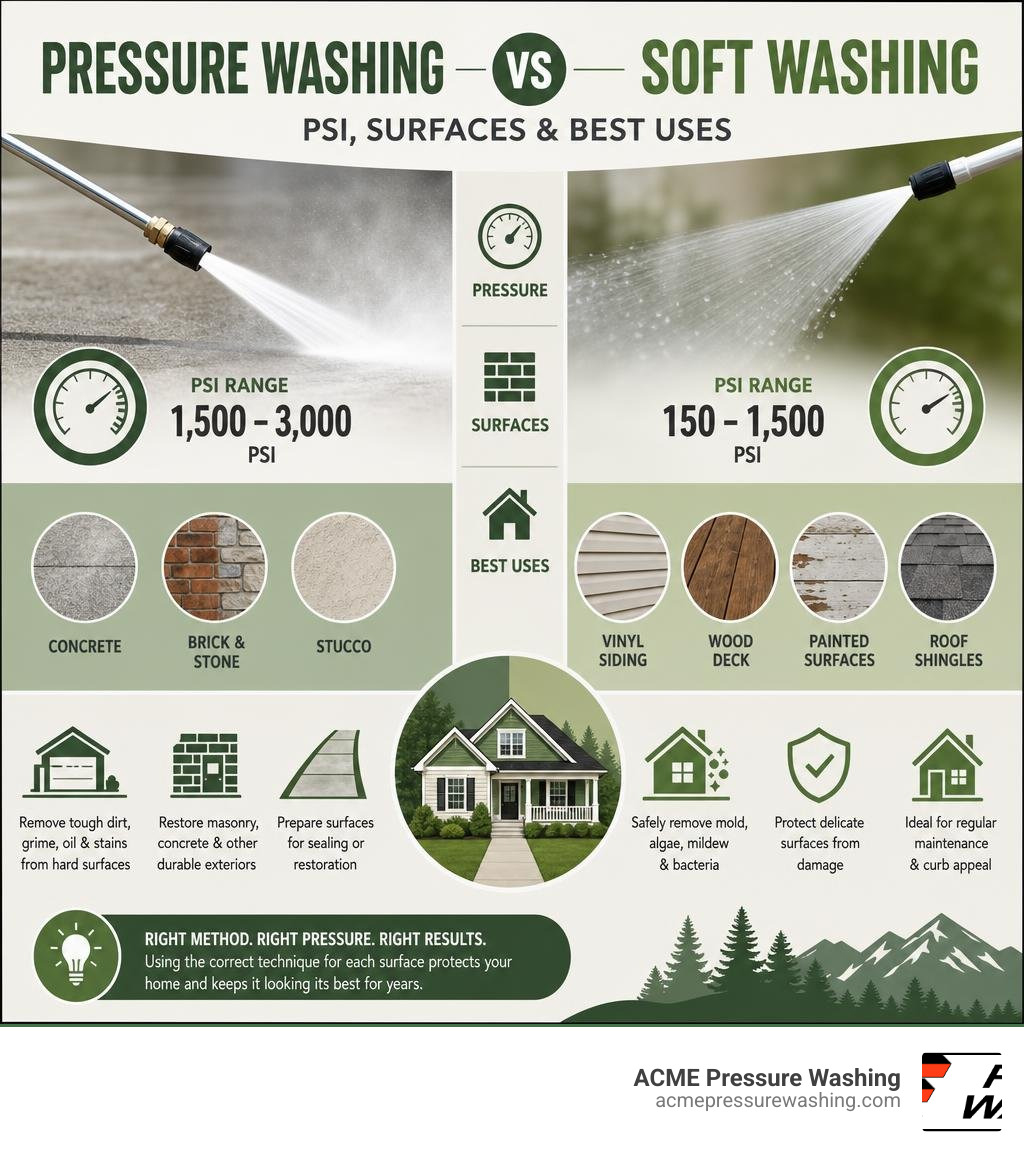
Traditional pressure washing relies on sheer mechanical force to rip away dirt, grime, moss, and grease. Operating anywhere from 1,300 to over 3,000 PSI (pounds per square inch), it is highly effective for hard, dense surfaces. However, utilizing this level of force on delicate home materials is a recipe for disaster.
In contrast, soft washing relies on safe, customized chemical solutions to do the heavy lifting, using very low pressure — typically between 150 and 300 PSI. This is roughly the same pressure you would get from a standard garden hose with a spray nozzle. Instead of blasting the surface, a soft wash pump system (ideally outputting about 6.5 GPM at 150 PSI) applies a specialized cleaning mixture to the surface. After a designated dwell time, during which the solution breaks down organic matter, we gently rinse everything away.
To learn more about the technical details of this approach, read our comprehensive guide, The A-Z of Soft Washing Your Exterior.
The primary active ingredient in professional soft washing is sodium hypochlorite (a highly diluted, commercial-grade bleach), which is combined with specialized surfactants. The surfactants act as wetting agents, helping the solution cling to vertical surfaces rather than immediately running off. This combination kills mold, mildew, algae, and moss at the root, preventing rapid regrowth.
| Feature | Traditional Pressure Washing | Professional Soft Washing |
|---|---|---|
| Primary Cleaning Force | High-pressure water stream | Eco-friendly chemical solutions |
| Pressure Range | 1,300 to 3,000+ PSI | 150 to 300 PSI |
| Water Flow Rate (GPM) | 2.0 to 4.0 GPM | 5.0 to 10.0 GPM (Typically 6.5 GPM) |
| Best For | Concrete, brick, stone walkways, driveways | Siding, roofs, wood decks, stucco |
| Risk of Surface Damage | High (if used improperly) | Extremely Low |
How to Soft Wash vs. Pressure Wash Exterior Siding
When we clean siding in towns like Amherst and Londonderry, we almost always choose soft washing over high-pressure washing. High pressure can easily jeopardize the physical integrity of vinyl siding, wood clapboard, and stucco.
Vinyl siding, while durable, is designed to hang loosely on your home’s exterior to allow for natural thermal expansion and contraction. It is not a watertight seal. If you target vinyl siding with high pressure, you risk cracking the panels or forcing water upward under the overlapping seams. Once water gets trapped behind the vinyl siding in the sheathing, it creates a dark, damp environment that promotes hidden mold growth and wood rot.
Wood clapboard siding presents its own challenges. High-pressure water can easily etch the wood, raising the grain and splintering the surface. It can also strip away protective paint or stain, leaving the raw wood vulnerable to the elements. Stucco is even more fragile; high pressure can easily gouge the textured finish or blast away bottle-dash and rock-dash stucco aggregates.
By using a soft wash approach, we eliminate these risks entirely. The low-pressure application ensures that water does not penetrate behind the lap joints of your siding, while our eco-friendly solutions gently dissolve the dirt, pollen, and green algae. For a deeper dive into protecting your home’s siding, read our advice on why you should Don’t Blast Your Siding Away and Other Soft Washing Benefits.
Best Practices to Pressure Wash Exterior Surfaces

If you are going to clean your home’s exterior, you must match your technique to the specific material you are washing. Different surfaces require different levels of water volume, pressure, and chemical assistance.
For concrete driveways, walkways, and patios, traditional pressure washing is highly effective. These hard, porous surfaces easily trap grease, oil, rust, and deeply embedded dirt. High-pressure water can safely penetrate the pores of the concrete to lift these stubborn stains. However, care must still be taken around concrete joints and expansion lines, as high pressure can wash away the sand or mortar holding them together.
For brick and stone, the age and condition of the mortar are critical. While the brick itself can handle moderate to high pressure, old or weathered mortar joints can easily disintegrate under a high-pressure stream. We recommend using a wider spray pattern and maintaining a safe distance to avoid damaging the joints.
When it comes to wood decks and fences, the wood species dictates the approach. Soft woods like Southern yellow pine require very low pressure (800 to 1,000 PSI) and a wide fan nozzle to prevent etching. Hardwoods like ipe can handle slightly more pressure, but consistent distance and motion are still required to avoid leaving visible wand marks or “lap lines.”
For a step-by-step breakdown of safe cleaning techniques, check out How to Pressure Wash House Exterior: 5 Guaranteed Methods. Additionally, you can review professional tips in the Popular Mechanics House Washing Guide.
Recommended PSI Settings to Pressure Wash Exterior Materials
Adjusting the PSI is your first line of defense against property damage. Here is a breakdown of the industry-standard pressure ranges we recommend for various exterior materials:
- Concrete Driveways and Walkways: 1,500 to 3,000 PSI. This range is powerful enough to strip away years of tire marks, oil leaks, and moss buildup.
- Brick and Mortar: 1,500 to 2,000 PSI. Always test an inconspicuous area first to ensure the mortar is stable enough to handle the pressure.
- Vinyl Siding: 1,200 to 1,500 PSI (if pressure washing) or 150 to 300 PSI (if soft washing). Soft washing is always our preferred method for vinyl.
- Wood Decks and Fences: 800 to 1,000 PSI. Using a wider fan pattern is essential here to distribute the force evenly across the wood grain.
- Stucco: 1,200 to 1,500 PSI with a wide spray pattern, keeping the nozzle at least 24 inches away from the surface.
- Asphalt Shingle Roofs: 150 to 300 PSI (Soft washing only). High pressure should never touch an asphalt shingle roof.
To learn more about adjusting your equipment settings for different siding types, see our Siding Pressure Washing Guide 2026.
Essential Equipment, Safety Gear, and Preparation Steps
To pressure wash exterior surfaces safely, you must have the right gear and prepare the work area meticulously.
First, let’s talk about nozzles. Pressure washers use color-coded spray tips that determine the angle of the water stream:
- 0-degree (Red): A concentrated, pencil-point jet. This tip is incredibly dangerous and should be avoided entirely for home cleaning, as it can easily slice through wood, siding, and boots.
- 15-degree (Yellow): A narrow fan used for heavy-duty stripping on concrete or metal.
- 25-degree (Green): A wider fan optimal for general washing of concrete, brick, and durable siding.
- 40-degree (White): A very wide, gentle fan best suited for wood decks, stucco, and delicate painted surfaces.
- 65-degree (Black): A low-pressure soap application nozzle.
Personal Protective Equipment (PPE) is non-negotiable. Always wear safety goggles to protect your eyes from flying debris and chemical overspray. Wear heavy-duty gloves and closed-toe, non-slip shoes or rubber boots. Never operate a pressure washer while wearing sandals or sneakers. Because gasoline-powered pressure washers are loud, hearing protection is also highly recommended.
Before starting, prep your work area:
- Protect Landscaping: Thoroughly wet all nearby grass, shrubs, and flowerbeds with fresh water before, during, and after applying any cleaning solutions. This dilutes any chemical overspray and prevents the plants from absorbing the soap. You can also cover delicate plants with lightweight tarps.
- Seal the House: Close all windows and doors tightly. Tape plastic sheeting over outdoor electrical outlets, light fixtures, and air conditioning units.
- Inspect the Surfaces: Look for loose siding, cracked mortar, or damaged wood. Repair these areas before washing to prevent water intrusion.
For a detailed list of prep steps, you can refer to Bob Vila’s House Pressure Washing Steps.
The Real Cost of DIY vs. Professional Exterior Cleaning
Many property owners in Bedford and Nashua consider renting a pressure washer from a local hardware store to tackle the job themselves. While a DIY project can seem appealing, the hidden costs, safety hazards, and risk of property damage often outweigh any potential savings.
A typical hardware store rental costs between $80 and $120 per day. When you add the cost of professional-grade cleaning solutions, safety gear, and gas, the upfront DIY cost can quickly climb. Furthermore, home-use pressure washers often lack the water volume (measured in GPM) of commercial machines. While a consumer-grade unit might output 1.5 to 2.0 GPM, our professional truck-mounted systems deliver 6.0 to 10.0 GPM. This higher water volume allows us to clean surfaces faster and more evenly, preventing the “tiger striping” marks commonly left by low-volume DIY machines.
The biggest risk of DIY cleaning is accidental damage. A single slip of a high-pressure nozzle can gouge a wood deck, shatter a window pane, or strip the paint off your siding. Even worse, forcing water behind your siding or under your roof shingles can lead to structural rot and mold issues that cost thousands of dollars to remediate. There is also a significant physical safety risk; high-pressure water streams can easily cause severe skin lacerations and deep-tissue infections if they make contact with your body.
If you are looking at professional services, it helps to understand how pricing works in our industry. Based on publicly available internet data, the national average cost to wash a house ranges from $300 to $600. However, because every property has unique cleaning requirements, siding materials, and architectural challenges, actual professional rates vary widely. For a small, straightforward job, professional rates can start around $600 to $1,200. For larger, multi-story estates, complex commercial buildings, or properties requiring specialized heavy equipment, professional cleaning packages can range from $3,000 to over $5,000.
To learn how to evaluate service quotes and ensure you are getting a fair price, read our guide: Don’t Get Washed Out: How to Spot a Fair Exterior Power Washing Quote.
Frequently Asked Questions About Exterior Pressure Washing
Can you pressure wash a roof?
No, you should never use traditional high-pressure washing on an asphalt shingle roof. Doing so will instantly strip away the protective ceramic granules embedded in the shingles. These granules are your roof’s primary defense against UV radiation and weathering. Losing them will significantly shorten the lifespan of your roof, void your manufacturer’s warranty, and likely cause leaks.
Instead, roofs must be cleaned using a dedicated soft washing system. We apply a specialized, low-pressure chemical solution that kills moss, algae, and lichens at the root, allowing them to wash away naturally with the rain. To learn more about our safe roof cleaning methods, visit our Pressure Washing Services page.
How often should you wash your home’s exterior in New Hampshire?
In Southern New Hampshire towns like Bedford, Nashua, Amherst, and Londonderry, we highly recommend washing your home’s exterior once a year. The New England climate brings a rapid succession of pollen in the spring, high humidity in the summer, organic staining from falling leaves in autumn, and road salt and moisture in the winter.
An annual maintenance wash prevents mold, mildew, and algae from permanently staining your siding, deck, or walkways. It also gives you a clear view of your property’s exterior, making it easier to spot minor maintenance issues—like cracked caulking or loose siding—before they turn into expensive repairs. For more details on seasonal maintenance, check out our Power Washing overview.
What are the risks of using too much pressure on siding?
Using excessive water pressure on siding can cause immediate and long-term damage, including:
- Cracked or Broken Siding: High pressure can easily shatter brittle vinyl panels or crack wood clapboards, especially in cooler weather.
- Wood Etching: Too much pressure raises the wood grain, leaving a fuzzy, splintered texture that requires extensive sanding to fix.
- Water Intrusion: Pressurized water can easily bypass the overlapping seams of your siding, soaking the wooden sheathing and insulation underneath. This trapped moisture leads to structural rot, ruined drywall, and hidden mold growth.
- Paint Peeling: High pressure can lift the edges of stable paint, causing premature peeling and forcing you to repaint years ahead of schedule.
Read more about safe siding maintenance on our House Pressure Washing page.
Conclusion
When you decide to pressure wash exterior surfaces around your property, taking the time to understand the correct methods, PSI settings, and safety protocols is the key to achieving beautiful, damage-free results. While DIY cleaning is an option for minor projects, the risks of personal injury, equipment damage, and hidden water intrusion are substantial.
At ACME Pressure Washing, we have spent over 38 years perfecting our safe, customized, and eco-friendly exterior cleaning techniques. Based in Merrimack, NH, we proudly serve homeowners and businesses throughout Southern New Hampshire, including Amherst, Auburn, Bedford, Brookline, Derry, Goffstown, Hollis, Londonderry, Manchester, Milford, Mont Vernon, Nashua, New Boston, Wilton, and Windham.
Whether you need professional house washing, commercial pressure washing, or fleet and equipment pressure washing, our experienced team has the specialized equipment and knowledge to get the job done right. We take pride in protecting your investment and restoring your property’s curb appeal safely.
For more information on selecting the right service provider in our area, read The Ultimate Guide to Local Power Washing Services.
Ready to give your home or business a professional refresh? Contact our team today at +1603-883-6900 or fill out our online form to request your free service quote.