




How to Find and Hire the Right Roof Moss Removal Company in New Hampshire
If you’re looking for moss removal from roof companies in New Hampshire, here’s a quick overview of what to look for before you hire anyone:
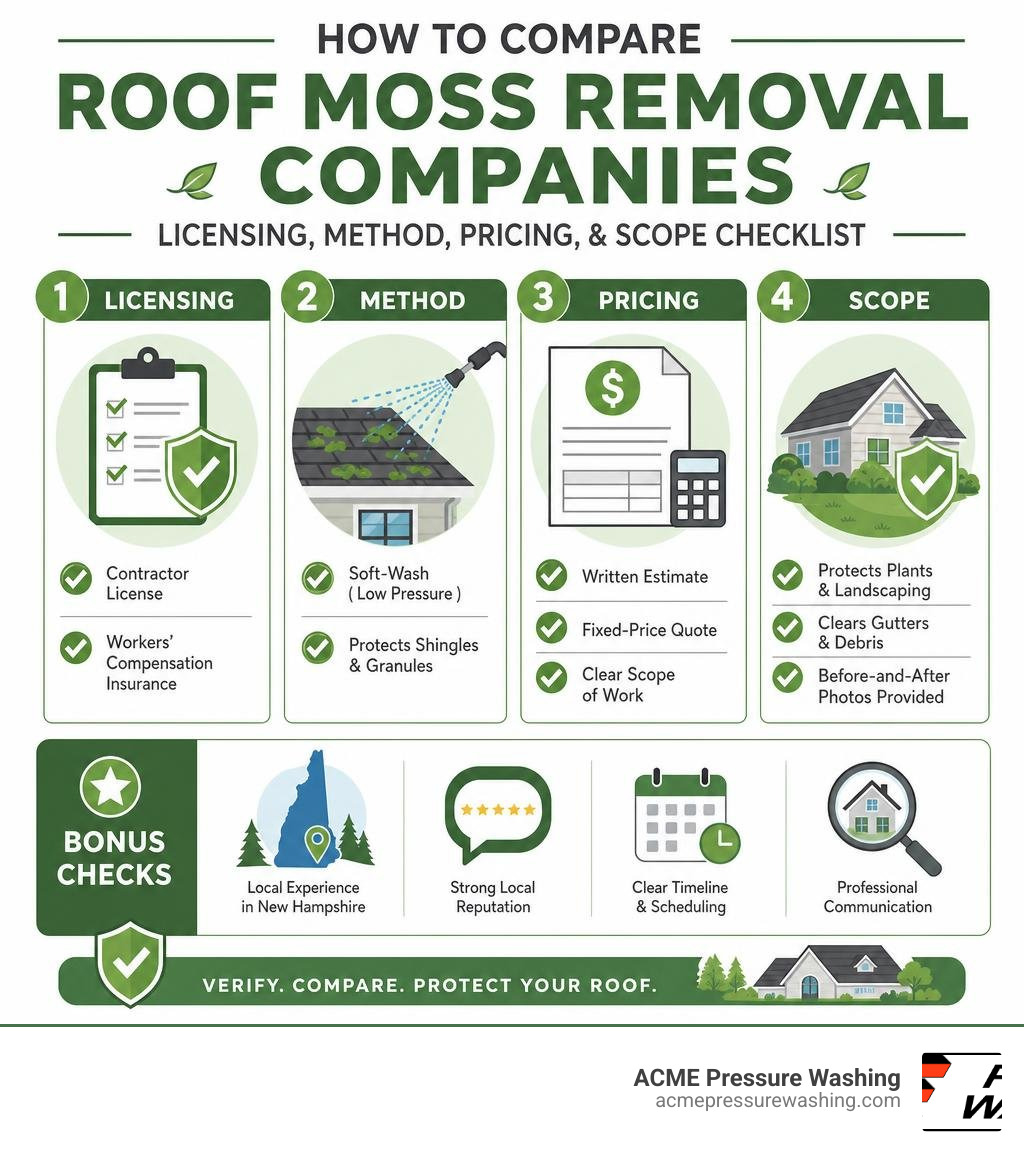
Quick Answer: What to Look for in a Roof Moss Removal Company
- Licensed and insured — verify contractor license and workers’ compensation coverage
- Soft-wash method — low-pressure cleaning protects shingles and granules
- Written estimate — get a fixed-price quote with a clear scope of work
- Plant and gutter protection — a reputable company protects your landscaping and clears debris
- Local experience — choose a company that knows New Hampshire roofs and weather
- Before-and-after photos — proof of work and condition documentation
That green, fuzzy growth creeping across your shingles isn’t just ugly. It’s actively working against your roof.
Moss holds up to 20–30 times its own weight in water. Left unchecked, it can shorten a roof’s lifespan by 5 to 10 years — turning what should be a decades-long investment into an expensive early replacement. For homeowners in Merrimack, Nashua, Bedford, and Amherst, where tree cover and seasonal humidity create near-perfect moss conditions, the problem is especially common.
The bigger frustration? Finding a company you can actually trust. Some contractors show up with high-pressure washers that strip protective granules right off your shingles. Others give low verbal quotes and disappear after a mediocre job. The industry has no shortage of ways to get burned.
This guide cuts through the noise. It covers how moss damages roofs, what methods actually work, what you should expect to pay (based on publicly available internet data, not ACME’s rates), and exactly how to vet a company before they set foot on your property.
I’m Lionel Greenwood, owner of ACME Pressure Washing, and I’ve been in the exterior cleaning business in New Hampshire since 1988 — with well over three decades of hands-on experience working with moss removal from roof companies and handling roof cleaning jobs across the region. That experience shapes everything in this guide, so you can hire with confidence.
What Roof Moss Is, Why It Grows, and When It Becomes a Roof Problem
Roof moss is a small, non-flowering plant that grows in damp, shaded places. Unlike algae, which often appears as black streaking, moss has a thicker, cushion-like texture. On asphalt shingles, it may start as a soft green patch and slowly spread across shaded roof planes, valleys, and areas under trees.
In New Hampshire, moss is especially common because our roofs deal with:
- Spring moisture
- Fall leaf buildup
- Snow melt
- shaded tree cover
- humid summer stretches
- north-facing roof sections that dry slowly
A little green fuzz may look harmless at first. The problem is that moss does not just sit politely on top of the roof like a decorative throw pillow. It traps moisture, works under shingle edges, and creates conditions that can lead to leaks, rot, and premature aging.
For a deeper New Hampshire-specific breakdown, see our guide on How to Remove Moss from Roof in New Hampshire.
Why Moss Grows on Shingles in New Hampshire
Moss grows where three things come together: moisture, shade, and organic material.
On roofs in Merrimack, Nashua, Bedford, and Amherst, we commonly see moss develop in areas with:
- Overhanging branches
- Clogged gutters
- Shaded roof valleys
- North-facing slopes
- Pine needles or leaves sitting on shingles
- Poor drainage around dormers, skylights, or roof intersections
Moss spreads by spores carried by wind, animals, and debris. Once spores land on a damp, shaded surface, they can take hold. Asphalt shingles with granule wear or accumulated organic matter give moss an even easier place to grow.
Commercial properties can have the same issue, especially buildings with shaded loading areas, flat transitions, tree-lined parking lots, or roof sections that do not dry evenly.
How Moss Damages Shingles Over Time
Moss damage is mostly about moisture and movement.
Moss can hold 20 to 30 times its weight in water. That means a moss-covered section of roof may stay damp long after the rest of the shingles have dried. Over time, that moisture can contribute to:
- Shingle edge lifting
- Protective granule loss
- Faster UV damage
- Lateral water movement under shingles
- Soft or weakened roof decking
- Attic mold or mildew
- Interior ceiling stains
- Leaks during wind-driven rain
- Shortened roof life by 5 to 10 years in severe cases
The roots or anchoring structures of moss can also grip into the surface texture of shingles. When moss thickens, it can physically lift shingle tabs. Once shingle edges lift, water and wind have more opportunity to get underneath.
This is why aggressive cleaning is so risky. The goal is not just to make the roof look better; it is to remove moss without damaging the roof’s protective surface. We explain this in more detail in Roof Shingle Moss Cleaning: How to Avoid Damage.
Signs You Need Professional Moss Removal From Roof Companies
You should consider calling a professional if you notice any of these warning signs:
- Green moss patches on shingles
- Thick moss mats along roof edges or valleys
- Black streaks mixed with green growth
- Gray-green lichen patches
- Lifted or curled shingle edges
- Loose granules in gutters or at downspouts
- Gutters clogged with moss, grit, leaves, or roof debris
- Musty attic smells
- Water stains on ceilings or upper walls
- Soft-looking roof areas
- Moss that returns quickly after previous cleaning
Recurring moss is a big sign that the underlying conditions were never addressed. Cleaning alone may not be enough if gutters remain clogged, branches block sunlight, or the roof stays damp for days after rain.
Methods Reputable Moss Removal From Roof Companies Use Safely
Good moss removal from roof companies do not treat every roof the same way. Asphalt shingles, composite roofs, and metal roofs all need different handling. A responsible company should inspect the roof, identify the growth, protect the property, choose the right cleaning method, and document the work.
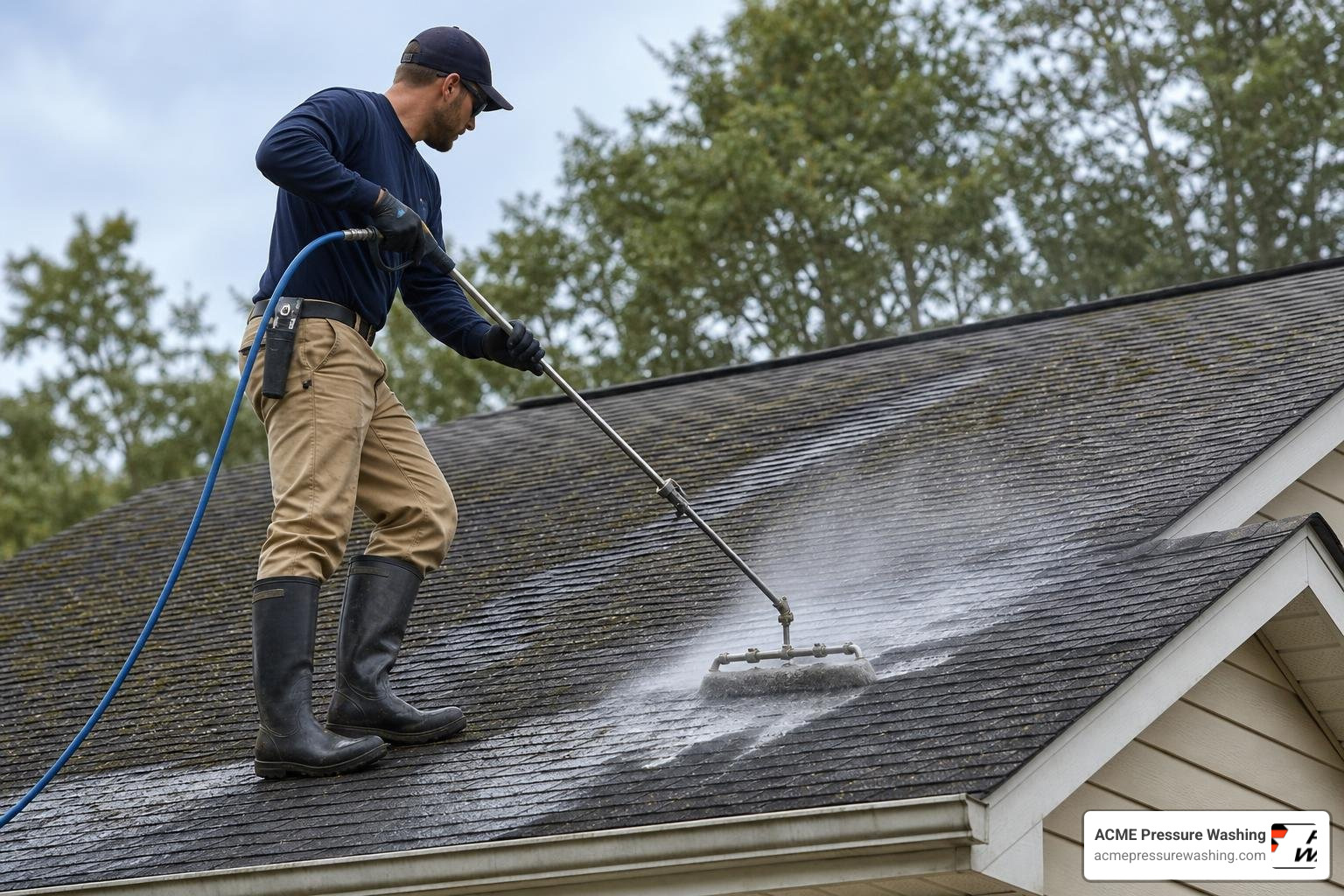
A safe professional process often includes:
- Roof and gutter inspection
- Identification of moss, algae, and lichen
- Landscaping protection
- Controlled soft-wash treatment
- Gentle manual moss removal where needed
- Low-pressure rinsing when appropriate
- Gutter clearing
- Runoff management
- Final cleanup
- Before-and-after photos
- Prevention recommendations
The best result is not the fastest-looking result. Some roof treatments continue working after application, meaning moss may lighten, dry out, and release gradually. That is normal with many soft-wash and treatment-based systems.
Professional Soft-Wash Treatment
Soft washing uses low pressure and carefully selected cleaning solutions to treat organic growth. For roof moss, the point is to kill the moss at the root-like structure without blasting the shingles.
A professional soft-wash process may involve:
- Pre-wetting or protecting landscaping
- Applying a roof-safe treatment
- Allowing dwell time so the treatment can work
- Light rinsing or weather-assisted release, depending on the roof
- Follow-up inspection or photos
This method is especially useful for asphalt shingles because it avoids high-pressure damage. It can also be adapted for composite and metal roofs when the technician understands the surface.
For more on proper technique, read How to Clean Roof Moss the Right Way.
Gentle Manual Moss Removal
Heavy moss sometimes needs more than treatment alone. Thick clumps may be loosened with soft brushes or non-aggressive hand tools before or after treatment.
The key word is gentle.
A professional should avoid:
- Digging into shingles
- Using stiff wire brushes on asphalt shingles
- Scraping aggressively against the granules
- Pulling up shingle edges
- Walking unnecessarily on fragile roof areas
Manual removal is often used around valleys, ridge lines, gutters, and heavy buildup areas. Dead or dried moss is usually easier to remove than wet, living moss. After removal, debris should be cleaned from the roof, gutters, downspouts, walkways, decks, and landscaping.
Why High-Pressure Washing Should Usually Be Avoided
High-pressure washing is usually not appropriate for asphalt shingle roof moss removal.
Why? Because pressure can:
- Strip protective granules
- Lift shingles
- Push water under the roof system
- Damage underlayment
- Increase leak risk
- Cause premature aging
- Create warranty concerns
- Make a slippery roof even more dangerous
This is where the word “pressure washing” can confuse people. We are ACME Pressure Washing, but that does not mean we blast every surface with maximum force like we are trying to peel paint off a battleship. Roof cleaning requires controlled methods, not brute force.
To understand the difference, see Pressure Washing Roofs and Can You Power Wash Shingles? Risks and Safer Alternatives.
Cost, Timing, and Prevention: How Not to Overpay
Roof moss removal pricing varies widely. Roof size, slope, access, material, moss severity, gutter condition, and landscaping protection all affect the job.
Important note: Any prices mentioned here are average planning figures based on publicly available internet data and industry averages. They are not ACME Pressure Washing prices, quotes, guarantees, or rate sheets.
For general industry context, online data often shows average roof cleaning costs around the mid-hundreds, with wide variability. Following the pricing rule we use for planning purposes, a more cautious budgeting range would be about $910 to $2,275 or more, depending on the property and scope. Large, steep, complex, heavily mossed, or commercial roofs may fall outside that range.
You can also review industry roof cleaning cost averages for broader internet-based pricing context.
| Cost Driver | Why It Matters | Value Indicator |
|---|---|---|
| Roof size | More surface area requires more time, treatment, and setup | Estimate includes square footage or roof sections |
| Roof pitch | Steep roofs require more safety planning | Safety plan is clearly explained |
| Moss severity | Heavy moss may need treatment plus manual removal | Scope separates treatment, removal, and cleanup |
| Roof material | Asphalt, metal, and composite surfaces need different methods | Company explains pressure limits and chemistry |
| Access difficulty | Landscaping, height, and layout affect labor | Estimate accounts for access and protection |
| Gutters and debris | Moss often clogs drainage after cleaning | Gutter clearing is included or offered |
| Plant protection | Treatments require responsible runoff control | Pre-rinse, cover, and post-rinse steps are listed |
| Documentation | Photos help verify condition and completion | Before-and-after photos are provided |
Typical Roof Moss Removal Cost Ranges
Based on publicly available internet data, roof cleaning is often discussed around an average of $455. To account for real-world variability, we recommend homeowners and property managers think in a wider planning range of roughly $910 to $2,275 or more.
Again, this is not ACME’s pricing. It is a planning range based on internet averages and adjusted upward to reflect how much roof conditions can vary.
Factors that can move cost up or down include:
- One-story versus two-story access
- Roof pitch
- Amount of moss
- Whether moss is wet, thick, or deeply rooted
- Roof age and fragility
- Need for gutter cleaning
- Need for plant protection
- Multi-building properties
- Commercial building requirements
Many professional roof cleaning jobs take about 2 to 5 hours, though larger or more complex projects can take longer. Photo-based estimates can help, but an in-person inspection is often better for steep roofs, heavy moss, or properties with access challenges.
How Often to Schedule Roof Cleaning
For many New Hampshire properties, annual roof cleaning or inspection is a smart maintenance rhythm. A typical schedule looks like this:
- Spring: inspect for winter damage, moss growth, and clogged drainage
- Fall: remove leaves, pine needles, and organic debris before snow season
- Annually: schedule roof cleaning or treatment if growth is visible or recurring
In shaded neighborhoods around Merrimack and Nashua, moss can return faster if the conditions remain damp. Roofs under heavy tree cover may need more frequent monitoring than roofs with full sun exposure.
For broader maintenance questions, see 10 Common Questions About Roof Cleaning Service Answered.
Prevention That Helps Moss Stay Away
The best roof moss strategy is not “clean it once and forget it forever.” Moss spores come back. The goal is to make the roof less inviting.
Prevention options include:
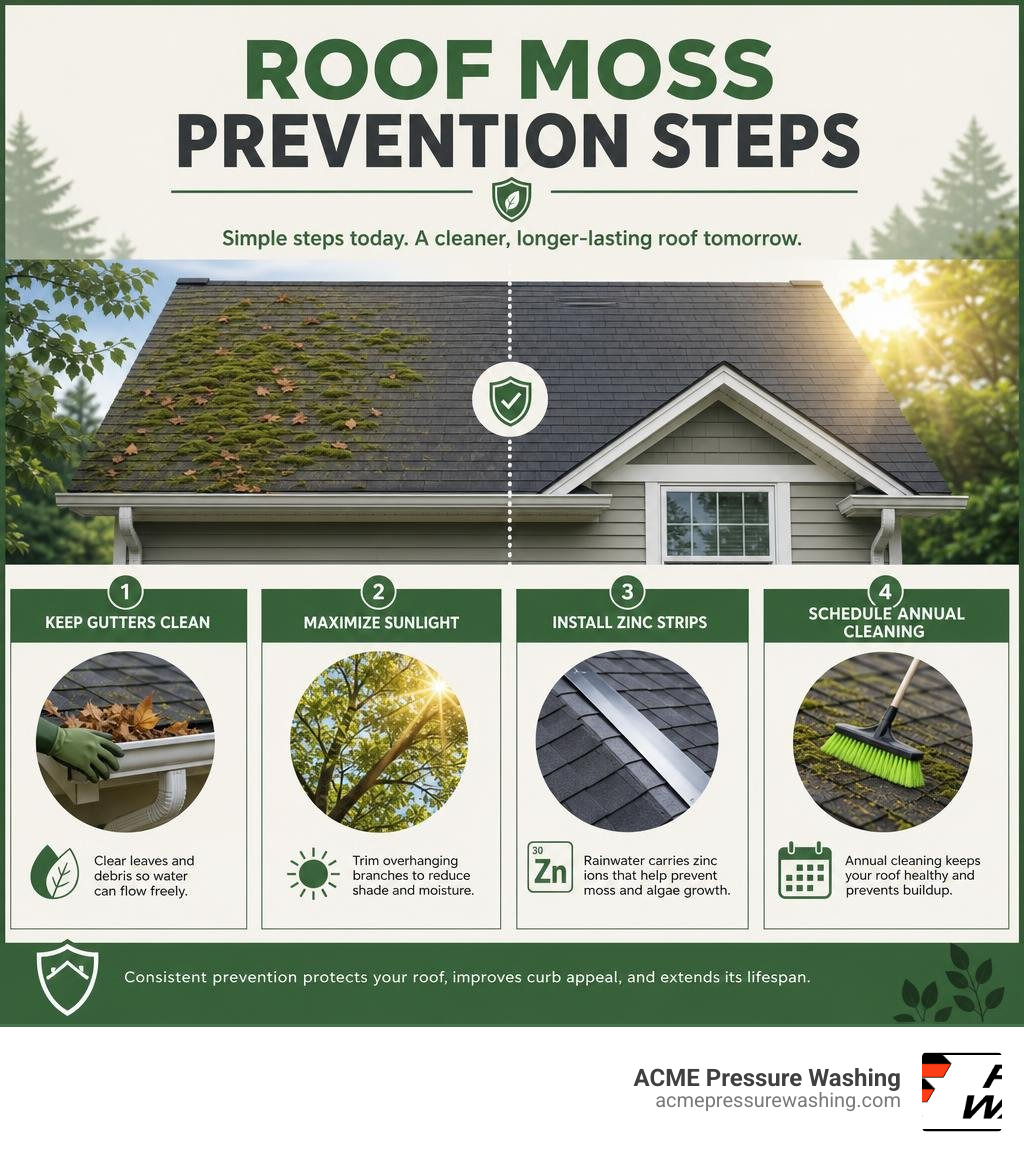
- Keeping gutters clean
- Removing leaves and pine needles
- Trimming branches to increase sunlight
- Improving roof drainage
- Keeping downspouts flowing properly
- Addressing ventilation issues
- Installing zinc or copper strips where appropriate
- Considering algae-resistant shingles during roof replacement
- Scheduling routine inspections
Zinc and copper strips can help because rainwater carries trace metal ions down the roof surface, discouraging moss and algae growth. They are typically installed near ridge areas. However, they must be installed correctly. Poor installation can create leak points, so this is not a “grab a ladder and wing it” project.
DIY vs Professional Roof Moss Removal: Where the Risk Starts
We understand the DIY temptation. Moss looks simple. Ladder goes up, brush comes out, problem solved, right?
Not quite.
Roof moss removal combines height, slippery surfaces, chemicals, fragile shingles, and drainage issues. That is a spicy little danger casserole.
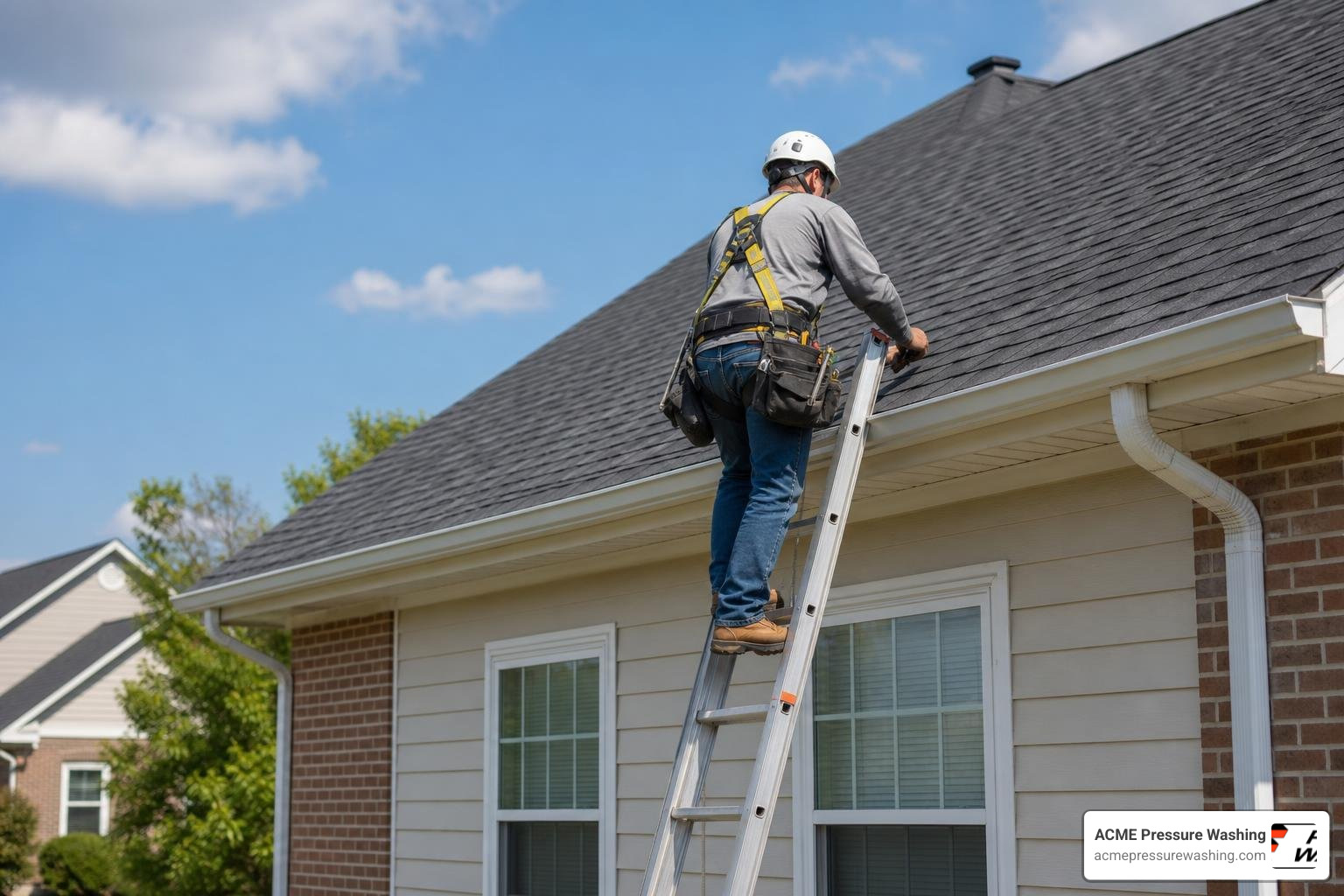
The biggest DIY risks are:
- Falls from ladders or roofs
- Slipping on wet moss
- Chemical burns or inhalation
- Plant and lawn damage
- Shingle granule loss
- Water intrusion from improper rinsing
- Gutter blockages from loosened moss
- Missed roof damage
- Insurance complications after injury or damage
This is especially important for two-story homes, steep roofs, older shingles, and commercial buildings in Bedford, Amherst, Merrimack, and Nashua.
What Homeowners Should Not Do
If you do attempt basic visual inspection from the ground, fine. But avoid these roof moss removal mistakes:
- Do not pressure wash asphalt shingles
- Do not use stiff scraping tools
- Do not walk on wet moss
- Do not use undiluted bleach
- Do not mix chemicals
- Do not rinse upward under shingles
- Do not treat from the ridge and walk backward downhill
- Do not ignore gutters after moss loosens
- Do not assume black streaks, moss, and lichen all need the same treatment
Also, never mix bleach with ammonia, acids, or mystery cleaning products. That is not roof cleaning. That is a chemistry lesson nobody asked for.
When DIY Is Too Risky
DIY roof moss removal is too risky when:
- The roof is steep
- The building is two stories or higher
- Moss mats are thick
- Shingles are old or brittle
- The roof is metal and slippery
- There are hidden leaks or soft spots
- Gutters are packed with debris
- The property is commercial
- Multiple surfaces need cleaning
- Moss keeps returning after previous attempts
For businesses, DIY is even less practical. Commercial buildings, fleet areas, sidewalks, concrete, loading zones, patios, and exterior walls often need coordinated cleaning so runoff, safety, and access are managed properly.
Safer Professional Alternatives
Professional roof moss removal uses controlled steps instead of guesswork.
Safer alternatives include:
- Soft-wash roof treatment
- Controlled dilution of cleaning solutions
- Pre-rinsing and post-rinsing plants
- Gutter clearing after moss removal
- Low-pressure application
- Roof-condition photos
- Follow-up maintenance recommendations
- Surface-specific methods for asphalt, composite, and metal roofs
If your property has a metal roof, read Metal Roof Cleaning: The Ultimate Guide to Solutions and Soft Washing.
How to Choose Licensed Moss Removal From Roof Companies Without Getting Scalped
Choosing the right company is about more than price. A cheap roof cleaning can get very expensive if it damages shingles, floods gutters, burns landscaping, or leaves moss roots behind.
Look for a company that offers:
- Proper licensing where applicable
- General liability insurance
- Workers’ compensation coverage
- A roof-safe cleaning process
- Written scope of work
- Clear pricing
- Plant protection steps
- Gutter and debris plan
- Local New Hampshire experience
- Before-and-after documentation
- No-pressure sales approach
At ACME Pressure Washing, we bring more than 38 years of exterior cleaning experience to homes, businesses, fleets, and specialty services across New Hampshire. Our approach is customized to the surface, the condition, and the property. That matters because the right method for a concrete walkway is not the right method for an asphalt shingle roof.
Questions to Ask Moss Removal From Roof Companies Before Hiring
Before hiring any roof moss removal company, ask:
- Are you insured, and do you carry workers’ compensation?
- What cleaning method will you use on my roof?
- What pressure level will be used?
- What type of treatment or cleaning solution do you use?
- Is your process safe for asphalt shingles?
- How do you protect plants, siding, decks, patios, and walkways?
- Will you clear gutters after moss removal?
- Do you provide before-and-after photos?
- Is the estimate written?
- What exactly is included in the scope?
- How long should the job take?
- Will moss disappear immediately, or die off over time?
- Do you offer prevention recommendations?
- What happens if rain is forecast?
- How do you handle runoff?
A reputable company should be able to answer these clearly. If the answer is “Don’t worry about it,” you should absolutely worry about it.
Red Flags That Lead to Roof Damage or Overcharging
Be careful if you notice:
- Very cheap verbal quotes
- No written scope
- No insurance documentation
- Promises to “blast it clean”
- High-pressure roof washing
- Vague chemical explanations
- No plant protection plan
- No gutter cleanup plan
- No inspection
- No photos
- Cash-only pricing
- Unrealistic guarantees
- Pressure to decide immediately
A good company will not scare you into signing. Moss is a real problem, but you should still have time to understand the process, compare the scope, and ask questions.
What a Complete Roof Moss Removal Scope Should Include
A complete roof moss removal scope should clearly state what is included. Ideally, it should cover:
- Roof inspection
- Moss, algae, and lichen identification
- Soft-wash or roof-safe treatment
- Gentle manual removal if needed
- Gutter clearing or debris management
- Landscaping protection
- Controlled rinse or weather-assisted release plan
- Cleanup of fallen debris
- Final photos
- Prevention options
- Suggested maintenance schedule
If you are in Merrimack or nearby towns, our article Merrimack Roof Cleaning: Why Soft Washing Wins explains why low-pressure methods are often the safest choice for New Hampshire roofs.
Frequently Asked Questions About Moss Removal From Roof Companies
Is Pressure Washing Safe for Roof Moss Removal?
Usually, no. High-pressure washing is not recommended for asphalt shingles because it can strip granules, lift shingles, force water under the roof system, and accelerate wear.
Low-pressure soft washing is usually the safer option. It treats the organic growth without relying on force. For metal, composite, or specialty roofs, the safest method depends on the material and condition, which is why inspection matters.
How Long Does Professional Roof Moss Removal Take?
Many professional roof cleaning jobs take about 2 to 5 hours, based on publicly available industry data. Actual timing depends on:
- Roof size
- Roof pitch
- Moss severity
- Access
- Weather
- Setup needs
- Plant protection
- Gutter conditions
- Whether manual removal is needed
Also, moss may not vanish instantly. Some treatments keep working after application. Moss can turn lighter, dry out, and release over time. A company should explain what results to expect immediately and what will happen over the following days or weeks.
Will Moss Come Back After Professional Cleaning?
Yes, moss can come back because spores are always present outdoors. Professional cleaning removes existing growth, but prevention controls the conditions that help moss return.
To reduce regrowth:
- Keep gutters clean
- Remove roof debris
- Trim branches
- Improve sunlight and airflow
- Consider zinc or copper strips
- Schedule annual inspections
- Treat shaded areas before moss becomes thick
Think of moss prevention like dental care. One cleaning helps, but if you never brush again, things get fuzzy. Roofs are the same, just with fewer toothbrushes.
Conclusion
Finding the right moss removal from roof companies in New Hampshire comes down to method, safety, experience, and transparency.
Avoid high-pressure roof washing on asphalt shingles. Be cautious with vague quotes. Ask about insurance, plant protection, gutter cleanup, photos, and prevention. A roof-safe company should explain the process in plain English and give you a written scope before work begins.
ACME Pressure Washing has served New Hampshire since 1988, bringing 38+ years of exterior cleaning experience to roof cleaning, house washing, commercial properties, fleets, equipment, and more. We use safe, customized, eco-friendly techniques for properties in Merrimack, Nashua, Bedford, Amherst, and surrounding New Hampshire communities.
Need help with roof moss, exterior buildup, siding stains, concrete, walkways, patios, commercial buildings, or fleet cleaning? Request service here:
Request a Quote From ACME Pressure Washing
Helpful service links:
