Can Pressure Washing Remove Efflorescence? What to Check First
Pressure washing can remove some loose efflorescence, but it does not correct the moisture that carried salts to the surface, and excessive pressure can damage brick or mortar. The right first step is to identify the deposit, trace the moisture pattern, and test the gentlest suitable cleaning method on a small area.
That distinction matters on Southern New Hampshire buildings and hardscapes. A white mark that appears after wet weather may be a removable salt deposit, a harder mineral deposit, residue from an earlier cleaning, or a sign that water is repeatedly moving through the assembly. Those conditions do not share one cleaning answer.
What efflorescence looks like
The Brick Industry Association describes efflorescence as a usually white, crystalline deposit left when water carries soluble salts through masonry and then evaporates. Its stain-identification guidance also warns that not every white mark is efflorescence.
Use appearance and location as clues, not as a final diagnosis:
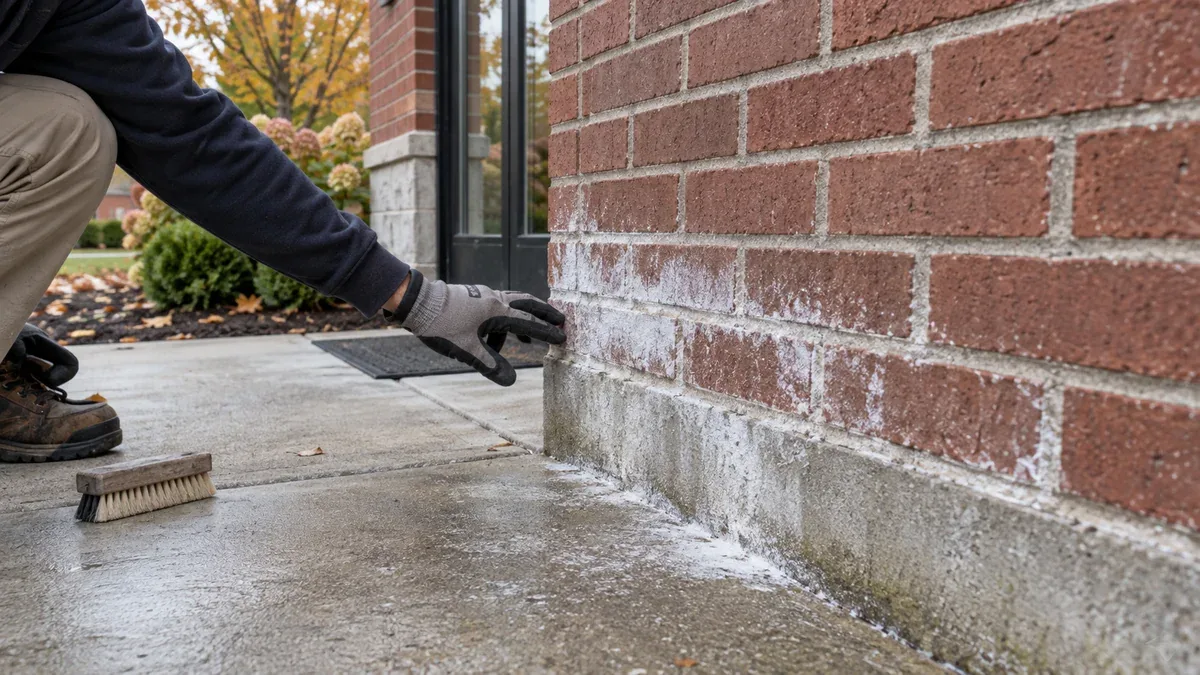
- Powdery or crystalline material: This is consistent with efflorescence, especially when it brushes away dry and returns after wet conditions.
- Hard white or gray crust below a crack or weep: This may be lime run, which is less water-soluble and can be harder to remove.
- Irregular white or gray film after an earlier acid cleaning: This may be white scum rather than efflorescence.
- Soft, dusty concrete: The surface itself may be deteriorating. Cleaning should pause until the material is assessed.
When the source or composition is uncertain, the association recommends verification by experienced brick or masonry personnel before cleaning. The wrong chemistry can leave a more difficult stain or damage the masonry.
Why the white deposit returns
Efflorescence needs three things: soluble salts, water, and a path that lets the salt solution move to an evaporation surface. The Brick Industry Association's efflorescence technical note recommends identifying and correcting the water source before attempting to remove recurring deposits.
Document the pattern before cleaning:
- Does it appear after rain, snowmelt, irrigation, or a freeze-thaw cycle?
- Is it concentrated at the base of a wall, beneath a cap, around a downspout, or along one mortar joint?
- Is the masonry less than a year old, or is this a new symptom on an older wall?
- Are there open joints, failed sealant, cracked units, blocked drainage paths, or soil held against the masonry?
- Does the deposit return in the same place after it is brushed away?
This record separates a surface-cleaning task from a moisture-control or masonry-repair task. A cleaner may improve the appearance, but a mason, building-envelope professional, roofer, or drainage specialist may need to correct the source.
A five-step decision before pressure washing efflorescence
1. Try a dry observation first
Photograph the dry surface and lightly brush a small inconspicuous area with a nonmetallic fiber brush. Do not turn the entire wall into a test. Loose new-building bloom or light efflorescence may respond to weathering or gentle brushing.
2. Check the material and finish
Identify whether the surface is fired clay brick, concrete brick, poured concrete, natural stone, stucco, painted masonry, or a sealed product. A method suitable for one material can discolor or damage another. Record any coating and, when possible, the brick or cleaner manufacturer's instructions.
3. Resolve recurring moisture clues
If the deposit keeps returning, do not treat repeated cleaning as the fix. Investigate the water path first. A recurring band at the base of a wall calls for a different owner and repair question than temporary bloom on new masonry.
4. Require a test area
The Brick Industry Association's brick-cleaning guidance calls for matching the solution and method to the brick, using the gentlest effective method, and evaluating a trial area after it dries. The sample should include mortar as well as brick because both can change during cleaning.
5. Set a weather gate
Water-based masonry cleaning should not be squeezed into a New Hampshire freeze window. The same guidance says not to clean during freezing weather or when freezing is expected. For water-only methods, it prefers air temperatures of at least 40°F that remain above freezing until the wall dries. The contractor should set the actual weather window for the material, method, and exposure.
Can more pressure solve stubborn efflorescence?
No. More pressure is not a substitute for correct identification or chemistry. On brickwork, the association recommends low-pressure rinsing and warns that excessive pressure can damage brick faces, erode mortar joints, or strip finishes. It also says not to use unbuffered muriatic or hydrofluoric acid.
Stubborn deposits may need a manufacturer-compatible proprietary cleaner, controlled application, thorough rinsing, and runoff management. That is a method-selection problem, not a reason to reach for the strongest nozzle or an improvised acid mix.
Choose the right next professional
- Exterior cleaner: The deposit has been identified, the surface is sound, the water source is not active or has been corrected, and you need a test-area cleaning plan.
- Mason or building-envelope specialist: Mortar is soft or missing, units are cracked or spalling, the wall has an unresolved leak pattern, or the deposit is hard and its identity is uncertain.
- Drainage, roofing, or waterproofing specialist: Water is entering from grade, a roof edge, flashing, irrigation, or another condition outside the cleaning scope.
For a sound exterior surface in Merrimack or Southern New Hampshire, ACME's commercial pressure washing service can help evaluate a surface-appropriate cleaning scope. Send photographs in dry and recently wet conditions, note when the deposit returns, identify the masonry or coating if known, and ask how the test area and runoff will be handled. If the surface is damaged or the moisture source is unresolved, address that condition before scheduling cleaning.