




Your Concrete Patio Can Look Brand New — Here’s How
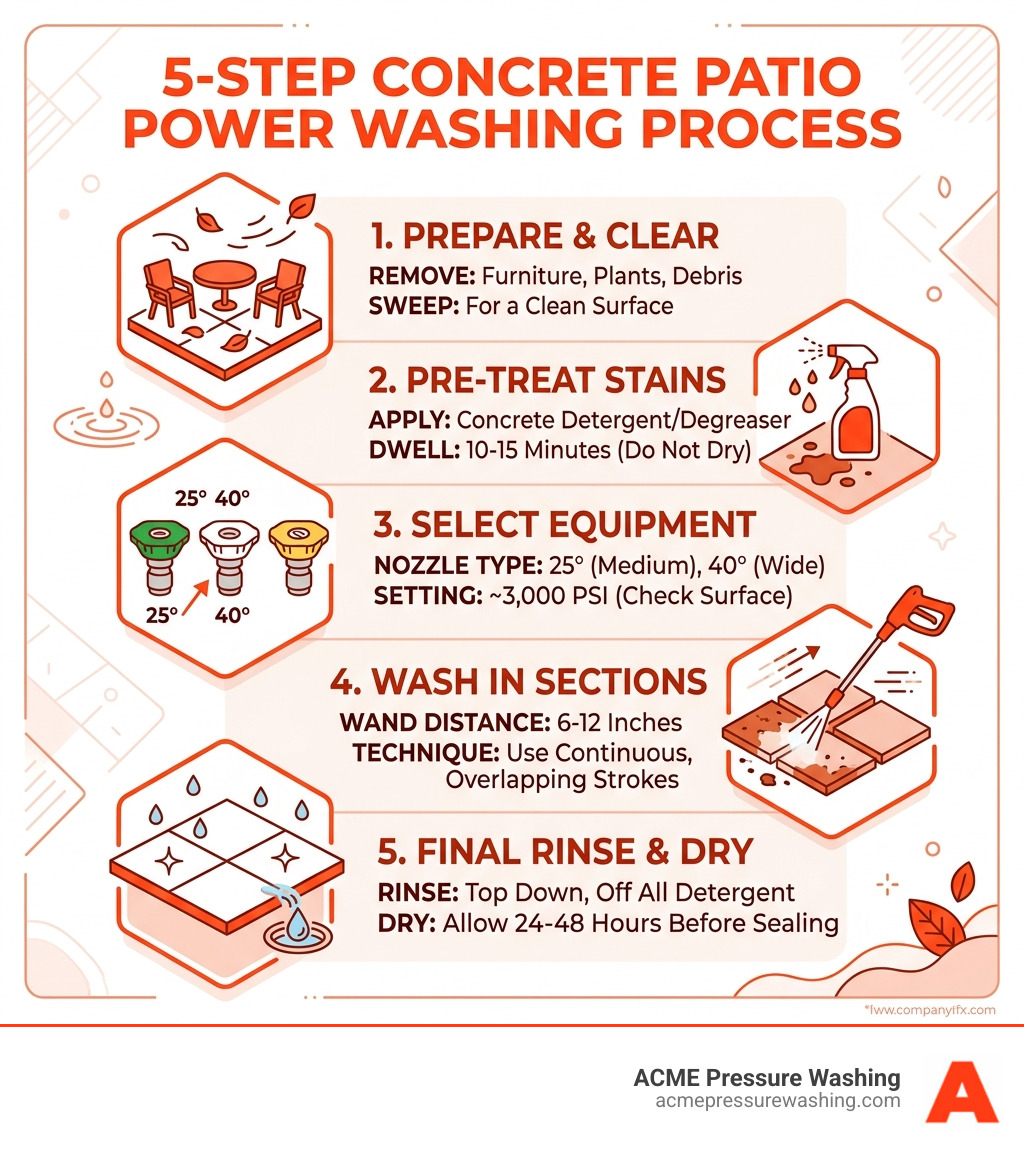
Power wash concrete patio surfaces the right way, and you can strip away years of grime, mold, and stains in just a few hours. Here’s a quick overview of the process:
- Clear the area — remove furniture, plants, and debris
- Pre-treat stains — apply detergent or degreaser and let it dwell 10-15 minutes
- Select the right nozzle — use a 25° or 40° tip at 3,000 PSI
- Wash in sections — hold the wand 6-12 inches from the surface, use overlapping strokes
- Rinse thoroughly — work from the highest point downward
- Seal the concrete — apply sealer after 24-48 hours of drying
Concrete patios look great when they’re new. But concrete is porous, which means dirt, oil, mold, and algae don’t just sit on the surface — they sink in. Regular sweeping and hosing simply can’t reach those embedded stains.
That’s where power washing makes a real difference.
A pressure washer forces water through a narrow nozzle at high speed, creating enough force to pull contaminants out of the concrete’s pores. Done correctly, it can restore a heavily stained patio to near-original condition — without damaging the surface.
This guide walks you through everything: the right equipment, the correct technique, how to handle stubborn stains, and when it makes sense to call in a professional like the team at ACME Pressure Washing instead of going the DIY route.
Why Power Washing is the Best Method for Concrete
If you’ve ever tried to scrub a concrete patio with a garden hose and a push broom, you know how back-breaking and ultimately disappointing that job can be. The reason is simple: concrete is a thirsty, porous material. Think of it like a very hard sponge. Over time, moisture carries dirt, mold spores, and algae deep into the “pores” of the slab.
According to experts at Pure Pressure, power washing is the most effective solution because it uses concentrated mechanical force to “lift” that embedded debris out. While a garden hose might provide 40-60 PSI (pounds per square inch), a professional-grade pressure washer delivers 3,000 PSI or more. This high-velocity water stream doesn’t just wet the dirt; it blasts it loose.
Furthermore, power washing is essential for health and safety. In our humid New Hampshire summers, algae and moss can create a slick film on your patio, turning a beautiful outdoor space into a slip hazard. By using the right Walkway and Patio Cleaning techniques, we can eliminate these organic growths at the root, ensuring your family stays safe on their feet.
Essential Equipment: Choosing the Right Power Wash Concrete Patio Tools
When you decide to power wash concrete patio areas, the machine you choose dictates your results. There are two main numbers to look at: PSI (Pressure) and GPM (Gallons Per Minute). While PSI provides the “punch” to break dirt loose, GPM provides the “flush” to wash it away.
For a standard concrete patio, you want a machine that balances both. Most professionals agree that 3,000 PSI is the “sweet spot” for residential concrete. It’s powerful enough to remove tire marks and deep grime but won’t immediately etch the surface if you’re careful.
Recommended PSI and GPM for Residential Concrete
To clean effectively without spending all day on the job, aim for a pressure washer with at least 3,000 PSI and a flow rate of 4 GPM. Some heavy-duty units go up to 5 or 6 GPM, which significantly speeds up the process for larger areas. If you’re dealing with decorative or stamped concrete, you’ll want to dial the pressure back to about 1,500–2,000 PSI to protect the finish.
Gas vs. Electric Pressure Washers
This is the classic DIY debate. Electric washers are quiet and easy to start, but they often max out around 2,000 PSI and 1.5 GPM. For a small, lightly soiled patio, they might suffice. However, for deep stains or large slabs, a gas-powered unit is almost always the better choice. Gas units provide the consistent high pressure and water volume needed to Deep Clean Patio Slabs Without Breaking a Sweat.
| Feature | Electric Pressure Washer | Gas Pressure Washer |
|---|---|---|
| Average PSI | 1,300 – 2,000 | 2,500 – 4,000+ |
| Average GPM | 1.2 – 1.5 | 2.5 – 5.0+ |
| Best For | Light cleaning, small patios | Deep stains, large driveways |
| Portability | Limited by cord length | High (no cords needed) |
Nozzle Types and Spray Patterns
The nozzle you snap onto the end of your wand determines the “fan” of the water.
- 25-Degree (Green): The workhorse for concrete. It provides a wide enough spray for efficiency but enough force for cleaning.
- 40-Degree (White): Best for rinsing or for more delicate, stamped concrete surfaces.
- Rotary/Turbo Nozzle: This nozzle spins a 0-degree stream in a circle. It’s incredibly effective for tough grime but can be aggressive, so use it with caution.
- 0-Degree (Red): Avoid this on concrete. It’s a pinpoint laser that can easily gouge or “etch” a permanent line into your patio.
Preparation and Safety: Protecting Your Property
Before you pull the trigger, you need to prepare the “battlefield.” High-pressure water is dangerous; it can cut through skin and boots just as easily as it cuts through grime.
Personal Protective Equipment (PPE)
Never wash your patio in flip-flops! Wear sturdy, closed-toe shoes or rubber boots. You also need safety goggles to protect your eyes from flying debris and long pants to shield your legs from “back-splash.”
How to Prepare a Concrete Patio for Power Washing
- Clear the Deck: Remove all furniture, grills, and potted plants. Even small items can become projectiles if hit by the spray.
- Sweep: Use a push broom to remove loose leaves, twigs, and pebbles. This prevents you from just blowing debris around once the water starts.
- Protect the Greens: High-pressure water and detergents can stress your landscaping. Thoroughly soak nearby grass and plants with a garden hose before you start. This dilutes any runoff that reaches them. You can also cover delicate plants with a tarp, but don’t leave it on too long in the sun.
- Identify Drainage: Check where the water will flow. You don’t want a lake forming in your basement or a muddy mess in your flower beds.
For more on site prep, check out this Step-by-step guide for power washing concrete patio.
Step-by-Step Execution and Technique
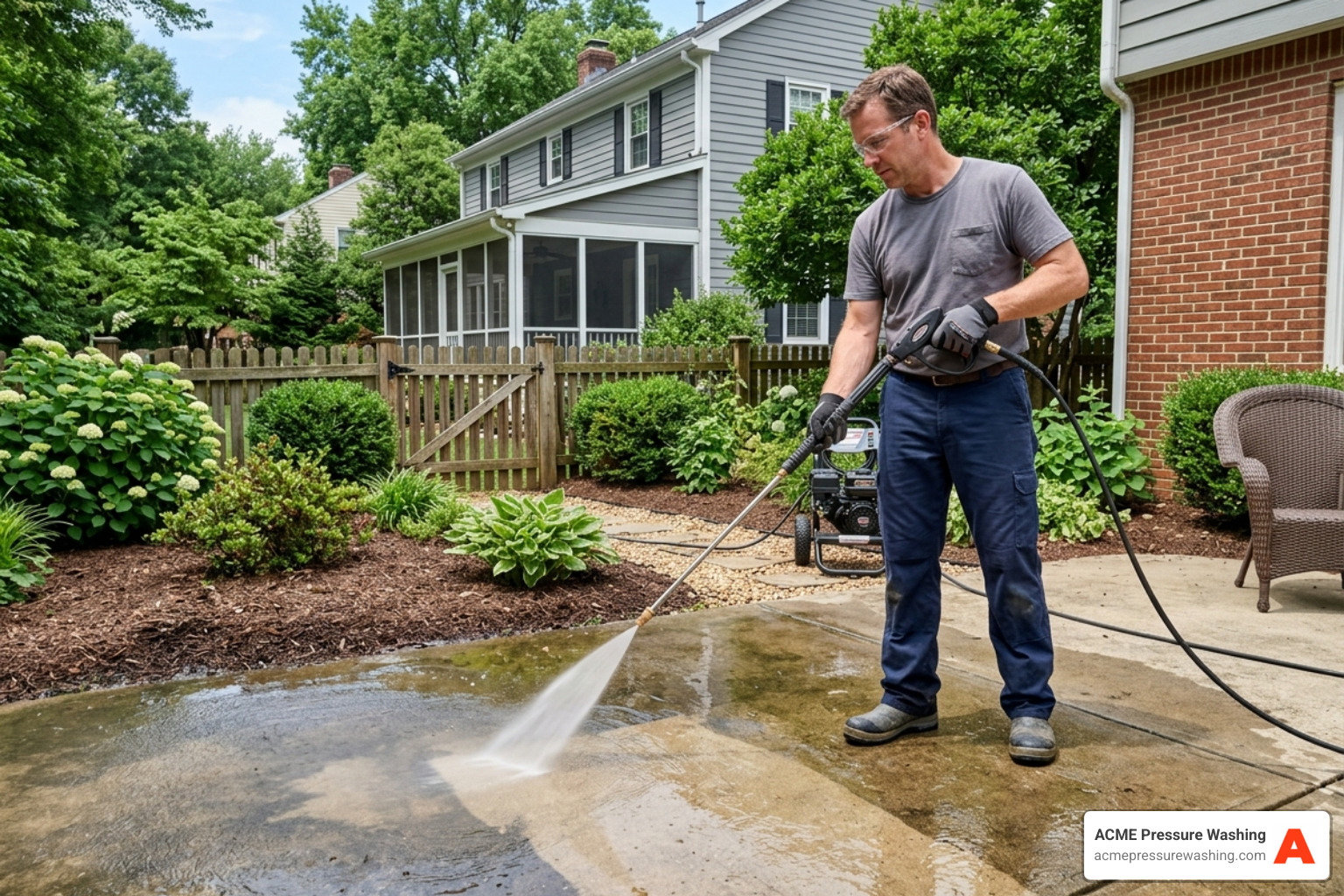
Success when you power wash concrete patio surfaces comes down to technique. If you move too fast, you’ll leave “zebra stripes” (streaks). If you stay in one spot too long, you’ll damage the slab.
The Golden Rules of Technique
- The 45-Degree Angle: Never point the wand straight down at the concrete. Hold it at a 45-degree angle. This allows the water to “peel” the dirt off the surface rather than driving it deeper into the pores.
- The 12-Inch Rule: Keep the nozzle about 12 inches away from the surface. If you need more “bite” for a stain, move slightly closer, but never closer than 6 inches.
- The 50% Overlap: Think of it like mowing the lawn. Each pass should overlap the previous one by about 50%. This ensures you don’t miss any spots and prevents those dreaded streaks.
Step-by-Step Guide to Power Washing a Concrete Patio
- Apply Detergent: Using your low-pressure (soap) nozzle, apply a concrete-safe detergent to the dry patio. Start from the bottom of any slope and work your way up.
- Dwell Time: Let the soap sit for 10–15 minutes. This is “dwell time.” It allows the chemicals to break the molecular bond between the dirt and the concrete. Do not let the soap dry! Mist it with a little water if it starts to evaporate.
- Scrub Tough Spots: For oil or grease, use a stiff-bristled brush to work the detergent into the stain during the dwell time.
- The High-Pressure Wash: Switch to your 25-degree nozzle. Start at the highest point of the patio and work your way down in 3×3 foot sections. Use a steady, sweeping motion.
- The Final Rinse: Once the whole patio is clean, do a final rinse of the entire area (and your siding/plants) to ensure no detergent residue remains.
Handling Tough Stains and Post-Wash Sealing
Sometimes, standard detergent isn’t enough. If your patio has seen 20 years of BBQ grease and oil drips, you might need a specialized approach.
Dealing with Stubborn Contaminants
- Oil and Grease: Use a dedicated alkaline degreaser. For very old stains, an enzyme cleaner can “eat” the oil over several days.
- Rust: Rust often comes from metal patio furniture. A citric-acid-based cleaner can help lift these orange stains without harming the concrete.
- Mold and Algae: A solution of sodium hypochlorite (essentially professional-grade bleach) is the gold standard for killing organic growth.
Common Mistakes When You Power Wash Concrete Patio Surfaces
The most common mistake is using too much pressure or the wrong nozzle. If you see a “powdery” residue or white dust coming off the concrete, you are etching the surface—stop immediately! This removes the “cream” coat of the concrete and exposes the aggregate underneath, which leads to faster deterioration.
Sealing the Concrete After Cleaning
Once your patio is clean, it’s wide open to new stains. We highly recommend sealing the concrete after it has dried for at least 24–48 hours. A high-quality silane/siloxane sealer will penetrate the pores and create a hydrophobic barrier. This makes future cleanings much easier and protects the slab from the harsh New Hampshire freeze-thaw cycles we see in towns like Bedford and Derry.
Professional vs. DIY: Costs and Considerations
While DIY power washing can be a fun Saturday project, it’s a 2–4 hour commitment (at minimum) for a standard patio. You also have to factor in the cost of a rental machine (usually $75–$150 per day) plus the cost of chemicals and fuel.
If you don’t have experience with high-pressure equipment, the risk of “scarring” your concrete is high. Professionals like ACME Pressure Washing have over 38 years of experience and use specialized equipment like surface cleaners. These are circular attachments that hover over the ground, providing a perfectly even clean without the risk of wand streaks.
Average Costs for Patio Cleaning Services
Based on average internet data, professional patio cleaning costs can vary significantly depending on the size and condition of the area.
- Average Range: $150 – $300
- Full Range: $100 – $900 (for very large or heavily stained commercial-grade areas)
Investing in a professional service ensures the job is done safely, eco-friendly detergents are used correctly, and your landscaping is fully protected.
Frequently Asked Questions about Power Washing Concrete
Can power washing damage my concrete patio?
Yes. If you use a 0-degree nozzle or hold a high-pressure wand too close to the surface, you can “etch” or “pit” the concrete. This damage is permanent and can only be fixed by resurfacing the slab. Always start with a wide fan pattern and keep your distance.
How often should I power wash my concrete patio?
In New Hampshire, we recommend a thorough cleaning at least once a year. Spring is the best time to remove the salt and sand from winter. However, if your patio is under heavy tree cover or in a shaded area, a second “refresh” in the fall can prevent mold and algae from taking hold during the damp autumn months.
Do I need a surface cleaner attachment for my patio?
If your patio is larger than a small “landing” pad, a surface cleaner is a lifesaver. It cleans a 15–20 inch path at once, ensuring that the pressure is always at a consistent distance from the ground. This eliminates the “tiger stripes” often caused by uneven wand movements.
Conclusion
A clean patio is the heart of your outdoor living space. Whether you’re hosting a graduation party in Merrimack or a summer BBQ in Amherst, a power wash concrete patio service can make your home feel refreshed and inviting.
At ACME Pressure Washing, we’ve spent the last 38 years perfecting our techniques. We understand the specific challenges that New Hampshire weather poses to concrete, from the humidity that breeds algae to the road salts that cause pitting. We use safe, customized, and eco-friendly techniques to ensure your property is protected while achieving that “like-new” shine.
Ready to reclaim your outdoor space without the DIY headache? We serve homeowners throughout Amherst, Auburn, Bedford, Brookline, Derry, Goffstown, Hollis, Londonderry, Manchester, Merrimack, Milford, Mont Vernon, Nashua, New Boston, Wilton, and Windham.
Schedule Your Professional Patio Cleaning Today and let us do the heavy lifting!
