Why Moss Invades Brick Walkways in New Hampshire
Moss is a simple, non-vascular plant that does not have traditional roots. Instead, it anchors itself to surfaces using tiny hair-like structures called rhizoids. Because brick is a highly porous material, it acts like a sponge, retaining moisture long after a rainstorm. This porous face provides the perfect structural grip and moisture reservoir for airborne moss spores to settle and multiply.
In New Hampshire communities like Bedford, Merrimack, Amherst, and Hollis, several environmental factors accelerate this invasion:
- Moisture Retention: Our humid summers and wet springs keep brick walkways damp for extended periods.
- Deep Shade: Walkways shaded by dense tree canopies or situated on the north side of a building rarely receive the direct sunlight needed to dry out the brick.
- Acidic Soil Conditions: Moss thrives in acidic environments, which are highly common throughout New Hampshire’s wooded landscapes.
- Organic Debris: Falling leaves, pine needles, and pollen collect in the joints between bricks, decomposing into a nutrient-rich soil layer that feeds growing moss.
While a light green dusting might offer an old-world aesthetic, leaving moss unchecked creates severe hazards. Moss forms a thick, slick carpet that becomes incredibly hazardous when wet. This creates a major liability for slip-and-fall injuries on residential paths and commercial walkways throughout Bedford, Merrimack, Amherst, and Hollis.
Furthermore, moss causes structural damage. Its rhizoids push deep into mortar joints and sand gaps. As the plant grows, it expands these spaces, allowing water to pool deeper within the walkway. During New Hampshire winters, this trapped water expands, causing the brick to crack, spall, or shift completely out of alignment.
How to Clean Moss Off Brick Walkway: High-Level DIY Methods
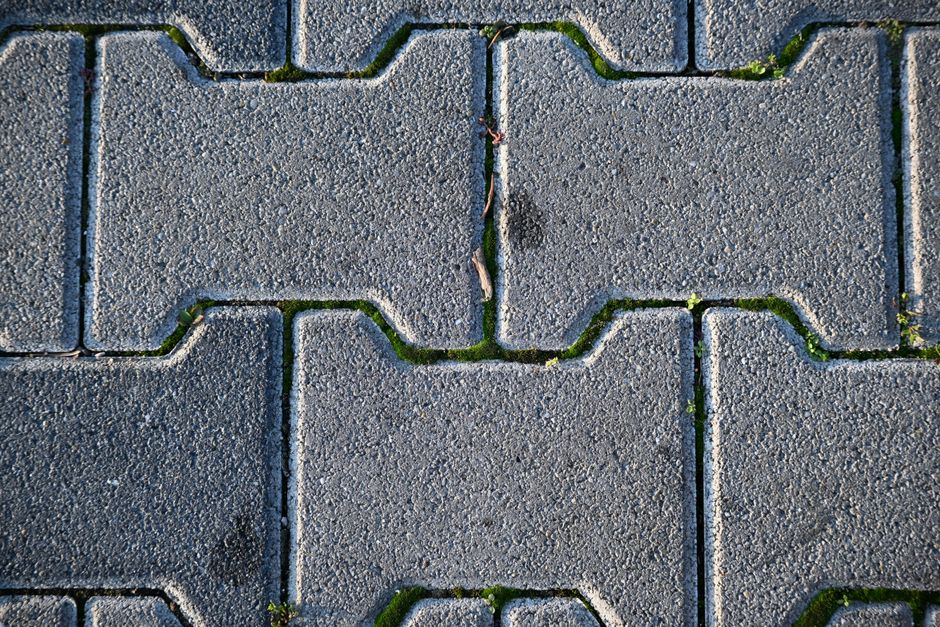
If you have a very small, localized patch of moss on a stable, modern brick walkway, limited DIY cleanup may be possible. However, DIY methods should be treated as short-term, high-level options only, especially in Bedford, Merrimack, Amherst, and Hollis, where recurring moisture and shade make regrowth likely. For most moss-covered brick walkways in New Hampshire, professional service is the safer recommendation.
Before applying any liquid solutions, always perform light manual preparation.
Use a specialized joint scraper or a stiff-bristle hand brush to physically scrape away the thickest cushions of moss. This mechanical removal helps any follow-up treatment reach the base of the plant rather than just wetting the surface. For more details on manual preparation, refer to How To Clean Moss Off Brick — Home Essentials Guide (HEG).
Boiling Water and Manual Scrubbing
One of the simplest chemical-free methods for a small spot treatment is boiling water. This method relies on thermal shock to collapse the plant’s cellular structure.
- Boil and Pour: Bring a large kettle of water to a rolling boil. Carefully carry it to your walkway and pour it slowly and directly over the mossy joints.
- Watch the Collapse: Boiling water can work quickly, causing the moss to shrivel, darken, and die within minutes.
- Scrub: While the area is still warm and wet, scrub with a stiff-bristle deck brush to dislodge the dead organic matter from the brick pores.
- Rinse: Flush the loosened debris away with a garden hose.
Vinegar and Baking Soda Solutions
If boiling water is not enough, some property owners try household pantry items to alter the conditions moss needs to survive. These methods can affect nearby landscaping and may stain or damage delicate brick, so they should be used cautiously and only on minor growth.
- The Vinegar Method (Acidic Treatment): White vinegar contains acetic acid, which acts as a natural herbicide. Mix equal parts white vinegar and warm water in a garden sprayer. Spray the solution generously over the moss and let it dwell for 15 to 30 minutes. Be highly cautious: vinegar is non-selective and will damage or kill any surrounding grass or garden plants it touches.
- The Baking Soda Method (Alkaline Treatment): Baking soda kills moss by raising the pH level of the surface, making it too alkaline for the plant to survive. Wet the walkway down first, sprinkle baking soda heavily over the mossy areas, and mist it lightly with water to activate it. Leave it to sit for 24 to 48 hours until the moss turns brown and dry, then scrub and sweep it away.
For anything beyond a very minor patch, especially on older brick or walkways with loose joints, hiring a professional soft washing company is strongly recommended to avoid damage and achieve longer-lasting results.
The Risks of DIY Moss Removal on Delicate Brick
While DIY approaches seem straightforward, they carry significant risks of permanent damage to your hardscaping investment. Brick walkways are delicate systems held together by friction, joint sand, or vintage mortar.
| Method | Potential Damage to Brick Walkway | Environmental & Landscape Impact |
|---|---|---|
| Boiling Water | Minimal risk to brick, but can wash out loose joint sand if poured too aggressively. | Can scald nearby plant roots if allowed to run off. |
| Vinegar (Acetic Acid) | Can etch soft, historic brick and degrade old lime-based mortar joints. | Highly toxic to surrounding lawns, annuals, and perennials. |
| Baking Soda | Can leave unsightly white efflorescence stains on porous brick surfaces. | Temporarily alters soil pH, which can stress acid-loving garden plants. |
| High-Pressure Washing | Blasts away joint sand, erodes old mortar, and causes brick spalling. | High-velocity debris and dislodged spores are scattered across the property. |
| Professional Soft Washing | None. Low pressure protects structural integrity while sanitizing the surface. | Safe. Nearby plants are thoroughly pre-wetted, shielded, and rinsed. |
Why High-Pressure Washing Can Backfire on Old Mortar
The single biggest mistake we see property owners in Bedford and Merrimack make is renting a high-PSI pressure washer to blast the moss away. Using high pressure on brick walkways often backfires.
Standard consumer pressure washers operating at 2,000 to 3,000 PSI will easily strip away the face of older, softer clay bricks, leading to a permanent condition called spalling. It also quickly degrades historic mortar joints, turning solid structural joints into loose powder.
Once the mortar or joint sand is blasted away, the bricks lose their lateral support, causing the walkway to shift, sag, and become a major tripping hazard. For a deeper look at proper pressure limits on delicate stone, check out our guide on Pressure Washing Paving Stones Like a Pro.
Protecting Joint Sand and Surrounding Landscaping
Another critical risk of aggressive DIY cleaning is the destruction of joint materials. Many modern brick walkways rely on polymeric sand—a specialized sand infused with binding additives that harden when misted with water to lock the pavers in place. High-pressure streams or harsh chemical washes break down these polymers, flushing the sand out completely.
Additionally, chemical runoff from DIY bleach or vinegar applications can quickly ruin landscaped gardens in Amherst or Hollis. Without professional-grade containment, pre-wetting protocols, and neutralizing agents, these acidic or basic runoffs will soak into the surrounding soil, killing turf and ornamental plants.
For commercial-grade results with less risk, professional soft washing remains the preferred solution for brick walkways, patios, sidewalks, and similar hardscape surfaces throughout New Hampshire.
Professional Soft Washing vs. DIY Walkway Cleaning

When dealing with extensive moss, deep-seated spores, or historical brick, professional soft washing is the safest and most effective solution. Unlike high-pressure washing, which relies on brute force to strip away surface growth, soft washing uses specialized low-pressure pumps (usually under 500 PSI) combined with customized, eco-friendly sanitizing solutions.
This method treats the brick gently, acting more like a deep sanitation treatment than a harsh scrub. For a closer look at how this process restores exterior surfaces, read our article on How to Deep Clean Patio Slabs Without Breaking a Sweat.
Our professional soft wash solutions penetrate deep into the porous face of the brick and the microscopic crevices of the joints. This process kills the moss, algae, and mold spores at their root level.
By sanitizing the surface rather than just shaving off the green tops, we help the walkway remain clean and clear for much longer. To learn more about our specialized sanitization methods, check out How to Kill and Prevent Patio Moss for Good.
How to Clean Moss Off Brick Walkway Safely and Permanently
At ACME Pressure Washing, we have refined our walkway restoration process over 38 years to deliver safe, beautiful, and lasting results for properties in Merrimack, Bedford, Amherst, and Hollis:
- Site Inspection & Preparation: We identify the brick type, age, and mortar condition. We then pre-wet all surrounding grass, shrubs, and garden areas with fresh water to protect them from any cleaning runoff.
- Gentle Application: We apply our custom, eco-friendly soft wash solution at low pressure. This solution breaks down the organic bond holding the moss to the brick while completely sanitizing the spores.
- Dwell Time: We allow the solution to sit for 10 to 15 minutes, giving it time to work deep into the brick’s pores without damaging the structural polymeric sand or mortar.
- Low-Pressure Rinse: We gently rinse away the dead moss, dirt, and organic matter, revealing the clean, bright brick underneath.
- Post-Treatment Protection: We apply a specialized, professional-grade algae and moss inhibitor. Based on industry averages and online data, professional chemical treatments may provide 6 to 9 months of moss suppression depending on shade, drainage, and seasonal conditions in New Hampshire.
Industry Pricing Realities for Walkway Restoration
When considering professional cleaning, it is helpful to understand typical industry pricing. All prices mentioned below are broad average costs sourced from publicly available internet data and industry averages. They are not the actual prices of ACME Pressure Washing and do not represent ACME quotes, rates, or guarantees.
Across the industry, a wide typical pricing range for walkway and patio cleaning can fall between $400 and $2,500+ depending on area size, severity of moss growth, drainage issues, accessibility, and the condition of the brick and joints. The lower end may apply to smaller, straightforward surfaces, while the higher end can reflect larger or more delicate restoration projects in Amherst, Bedford, Merrimack, or Hollis that require soft washing, specialized treatments, and follow-up protection.
If you need professional help with brick walkway cleaning, patio washing, sidewalk cleaning, or broader exterior maintenance, ACME Pressure Washing also provides house washing, commercial pressure washing, and fleet and equipment cleaning.
Frequently Asked Questions About Brick Walkway Maintenance
How often should I clean my brick walkway?
For most properties in New Hampshire, we recommend a professional soft wash deep clean once a year. However, if your walkway is heavily shaded by mature trees or sits on the north side of a building, you may need a maintenance rinse every 3 to 6 months to prevent slick moss sheets from reforming. Regular sweeping of leaves, dirt, and organic debris will also help extend the time between cleanings.
What is the best way to keep moss from returning?
The most effective way to prevent moss from returning is to alter its growing conditions:
- Increase Sunlight: Prune overhanging tree branches and trim back dense shrubs to allow more sunlight and airflow to reach the brick.
- Improve Drainage: Ensure your gutters are clean and downspouts direct water away from the walkway. Repair any low-lying areas where water pools.
- Keep Joints Filled: Ensure the joints between your bricks are fully packed with polymeric sand to eliminate the physical space where moss spores can settle.
- Apply Inhibitors: Regularly apply a professional-grade moss inhibitor to keep spores from germinating.
How to clean moss off brick walkway without damaging the joints?
The only way to clean moss without damaging delicate mortar or washing out joint sand is to avoid high pressure entirely. Utilizing low-pressure soft washing combined with targeted, eco-friendly sanitizing solutions dissolves the moss at its root level, allowing it to be gently rinsed away without disturbing the structural sand or mortar holding your walkway together. Learn more about our gentle techniques on our Walkway and Patio Cleaning page.
What other exterior surfaces can ACME Pressure Washing clean?
In addition to brick walkways and patios, ACME Pressure Washing provides exterior cleaning services for houses, fences, decks, pool areas, concrete, sidewalks, sheds, commercial buildings, commercial fleets, tractor trailers, and heavy equipment throughout New Hampshire.
Conclusion
A moss-covered brick walkway is more than just an aesthetic issue—it is a slick slip-and-fall hazard and a threat to the structural integrity of your hardscaping. While simple DIY methods like boiling water or vinegar may help with very minor, localized patches, heavy infestations and delicate historic brick require professional care to avoid costly damage.
At ACME Pressure Washing, we bring over 38 years of hands-on experience to every project. We use safe, customized, and eco-friendly low-pressure soft washing techniques to restore walkways without damaging brick, mortar, or surrounding landscaping.
Whether you need residential Walkway and Patio Cleaning, professional house washing, commercial pressure washing, or fleet and equipment cleaning, we are proud to serve properties throughout Merrimack, Bedford, Amherst, and Hollis.
Don’t let slippery green slime put your family, customers, tenants, or visitors at risk. To see examples of our work, visit our Gallery Walkway and Patio Cleaning page.
Ready to restore your brick walkway?
Use our quote form to Get a Free Quote Today and connect with Lionel Greenwood and the expert team at ACME Pressure Washing.
What Does Driveway Cleaning Actually Cost? Here’s the Short Answer
Understanding driveway cleaning cost is the first step to planning your exterior maintenance budget. Here is a quick budgeting snapshot based on industry averages from publicly available online data:
| Driveway Size | Typical Cost Range |
|---|---|
| Small (200-400 sq ft) | $400 – $2,000 |
| Medium (400-800 sq ft) | $600 – $3,000 |
| Large (800-1,200 sq ft) | $800 – $4,000 |
| Extra-Large (1,200+ sq ft) | $1,000 – $5,000+ |
Note: These are average costs sourced from publicly available online data and do not reflect ACME Pressure Washing’s actual pricing. Always request a quote specific to your property in New Hampshire.
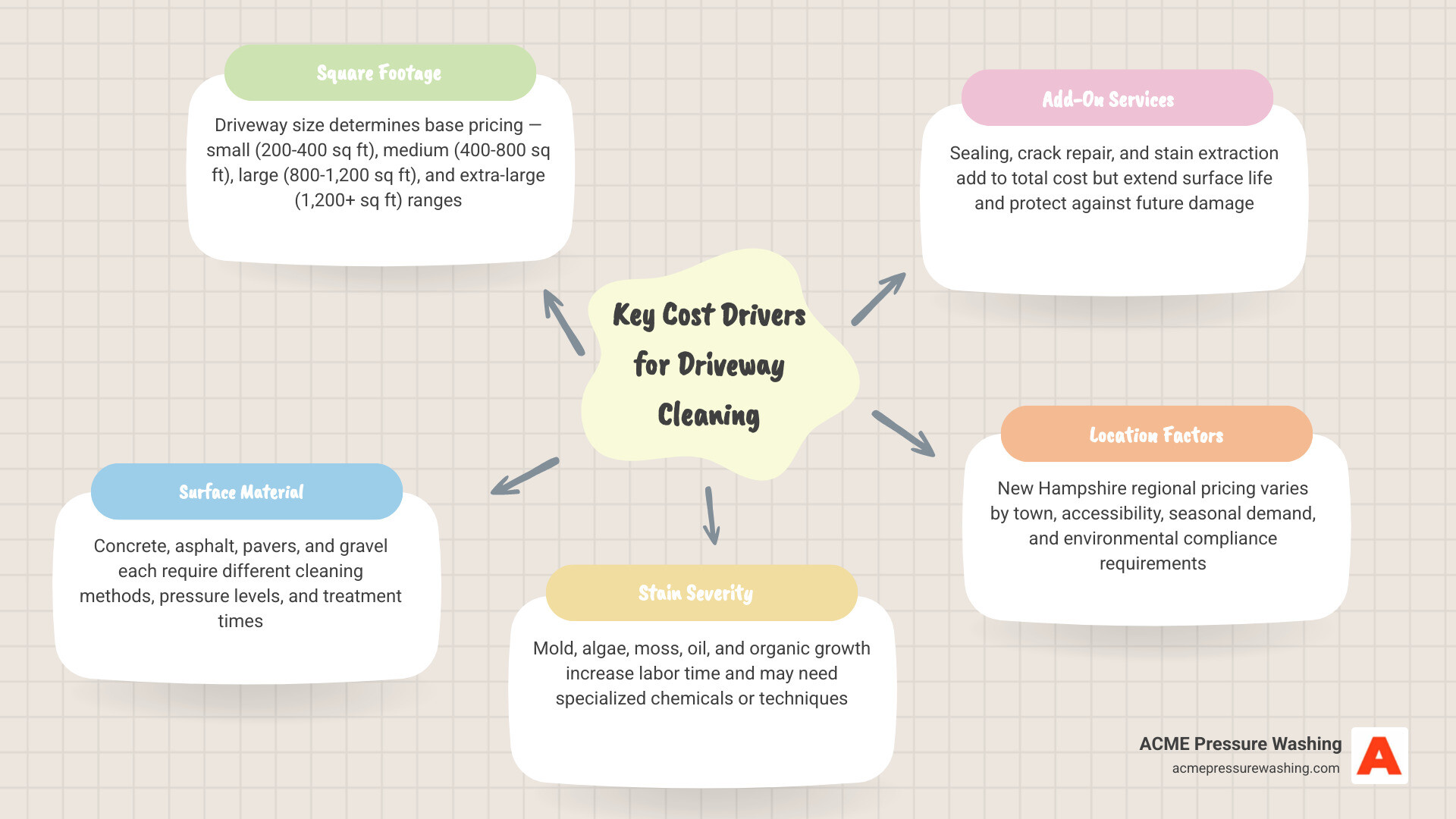
Key cost drivers at a glance:
- Square footage of the driveway
- Surface material such as concrete, asphalt, pavers, or gravel
- Level of staining, mold, algae, or organic buildup
- Add-on services like sealing or targeted stain treatment
- Property access, drainage, and service location within New Hampshire
A clean driveway supports more than appearance. In towns like Merrimack, Bedford, Nashua, and Windham, it also helps reduce slip hazards, protect the surface, and present a more professional overall property image. Dirt, algae, moss, and embedded residue can create slick conditions while also contributing to premature wear.
Professional driveway cleaning helps remove those issues at the source. It improves appearance, supports safety, and helps preserve one of the most visible hardscape surfaces on the property.
At ACME Pressure Washing, we bring more than 38 years of hands-on exterior cleaning experience in New Hampshire. In this guide, we will walk through the major cost factors, cleaning methods, and budgeting considerations so you can plan with confidence. Ready to get started? Call us at +1603-883-6900 or REQUEST YOUR FREE ESTIMATE.
Understanding the Average Driveway Cleaning Cost in 2026
When people ask about average driveway cleaning pricing in New Hampshire, the honest answer is simple: it depends.
Across publicly available online cost data in 2026, driveway cleaning can vary widely depending on size, material, staining, access, drainage, and treatment method. That is why it makes more sense to discuss broad budgeting ranges rather than pretend every surface has the same needs.
For general planning purposes, industry averages often place basic driveway cleaning around an average in the low hundreds, but realistic budgeting should use a much wider range. A practical planning range is often closer to $400 to $2,000+, with larger, heavily stained, or specialty-surface projects extending well beyond that. Per-square-foot online data can also vary significantly depending on scope and service conditions. For broader background on pressure washing methods and standards, the Pressure washing article offers a general overview.
For budgeting purposes, it helps to think in terms of scope:
- Light cleaning on a smaller concrete driveway is usually at the lower end
- Heavily stained or oversized surfaces move higher
- Pavers, natural stone, and grease-heavy commercial areas usually cost more
- Add-ons like chemical treatment or sealing push the total upward
In places like Bedford, Goffstown, Nashua, and Derry, local conditions also matter. Tree cover, winter salt, damp shaded areas, and freeze-thaw wear all influence how much labor and treatment a driveway needs.
If you want to understand why technique matters just as much as price, our guide on Stop Making These Noob Mistakes During Concrete Power Washing explains common errors that can lead to visible striping, etching, or surface damage.
Factors Influencing Your Driveway Cleaning Cost
No two driveways age the same way, so no two estimates are exactly alike. Here are the biggest pricing factors we look at.
Surface area
This is the obvious one. More square footage means more water, more labor, more setup time, and more rinse time. A compact driveway in Goffstown will naturally cost less to clean than a long, multi-vehicle entrance in Bedford or Windham.
Material type
Material changes the entire cleaning approach.
- Concrete is usually the most straightforward and often the most economical
- Asphalt requires gentler pressure and more care to avoid damage
- Pavers and brick often need detail work around joints
- Natural stone may require custom detergents and lower pressure settings
- Gravel is tricky because aggressive washing can displace material
Level of organic growth
Moss, algae, mildew, lichen, and black organic staining are not just cosmetic. They make surfaces slippery and often need pretreatment. Heavy growth usually means extra chemical dwell time and slower cleaning passes.
Accessibility in Nashua or Derry
A driveway with easy hose access and open working room is simpler than one with tight fencing, retaining walls, steep slopes, or limited drainage. Denser suburban layouts in places like Nashua or Derry can add time compared with a more open property.
Drainage considerations
Water runoff matters. In New Hampshire, responsible contractors must think about where wash water goes, especially if degreasers or specialty cleaners are being used. Poor drainage can slow down the job and require more controlled methods.
Regional Pricing Variations for Driveway Cleaning Cost
Even within New Hampshire, driveway cleaning costs can shift based on local operating conditions.
Labor and travel
Labor rates vary by area and season. Travel time, fuel, setup, and equipment hauling all affect smaller jobs in particular. That is one reason many companies apply minimum service charges on small projects.
Seasonal demand in Windham and Merrimack
Spring and early summer are peak cleaning seasons in Windham, Merrimack, Goffstown, and nearby towns. Higher demand can tighten scheduling and affect project timing.
Weather and winter residue
New Hampshire driveways take a beating from road salt, sand, plow scraping, packed grime, and freeze-thaw cycles. In Londonderry and Manchester especially, traffic and winter carryover can mean heavier staining than broad online averages assume.
Environmental practices
Eco-friendly cleaning methods are not just nice to have. They are part of doing the job responsibly. Safer detergent selection, careful application, and runoff awareness may add some labor, but they also help protect landscaping, pets, and nearby surfaces.
Comparing Cleaning Methods and Material Impacts
Not every driveway should be cleaned the same way. The cheapest method on paper can become the most expensive method if it damages the surface.
| Cleaning Method | Best For | Water Temperature | Typical Internet-Data Cost Trend | Notes |
|---|---|---|---|---|
| Pressure washing | Light to moderate dirt on concrete and some hard surfaces | Cold | Lower | Effective for general cleaning |
| Power washing | Oil, grease, heavy grime, commercial buildup | Hot | Higher | Better for stubborn stains |
| Soft chemical treatment plus rinse | Organic growth on delicate areas | Usually low pressure | Varies | Useful where pressure alone is not enough |
| Surface cleaner with pretreatment | Large flat driveways | Cold or hot | Efficient mid-range | Helps produce even results |
The basic difference is simple:
- Pressure washing uses unheated water
- Power washing uses heated water
That heat can make a big difference on grease, oil, tire marks, and ground-in grime. It can also raise the price because the equipment is more specialized and the process is more involved.
For paver-specific tips, see Pressure Washing Paving Stones Like a Pro.
Cost Considerations for Concrete and Asphalt
Concrete and asphalt are common across Manchester, Londonderry, Bedford, and Merrimack, but they do not behave the same way under pressure.
Concrete
Concrete is durable, but it is also porous. It absorbs oil, rust, fertilizer residue, and organic staining. That means a simple rinse often is not enough. Deep cleaning may require:
- Pretreatment with a driveway-safe cleaner
- Surface cleaner passes for uniform appearance
- Spot treatment for oil or tire marks
- Optional sealing afterward
Public online data often places straightforward concrete driveway cleaning toward the lower end of the material spectrum, but severe staining, large surface area, or post-treatment needs can move costs substantially higher. All prices referenced here are average costs sourced from publicly available internet data and are not the actual prices of ACME Pressure Washing.
Asphalt
Asphalt needs a lighter touch. Too much pressure can scar the surface, loosen aggregate, or shorten its life. It may also need specialty degreasers if vehicle fluids have soaked in. Because technique matters so much, asphalt is one of the clearest examples of why professional service helps protect long-term value.
If the driveway is older, softened by heat, or already showing wear, cleaning must be adjusted accordingly. We never treat asphalt like concrete.
Specialized Cleaning for Pavers and Natural Stone
Pavers and natural stone often cost more to clean because they require more precision.
Why pavers cost more
Paver driveways usually involve:
- Cleaning around joint lines
- Removing weeds and moss
- Protecting or replacing joint sand after washing
- Using pressure levels that clean without destabilizing the system
That added detail work is why pavers are often among the more expensive materials in online pricing data.
Why natural stone needs care
Natural stone can vary widely in density and finish. Some stone tolerates stronger cleaning. Some does not. Etching, flaking, or color change are real risks if the wrong method is used.
For related reading on protecting hardscapes after cleaning, see How to Clean and Seal Your Patio for Long-Lasting Beauty.
Essential Add-ons and Long-Term Maintenance
The base cleaning price is only part of the full picture. Depending on the driveway condition, additional services may be worth budgeting for from the start.
Common add-ons include:
- Oil and rust stain treatment
- Heavy degreasing
- Weed or moss removal
- Joint sand replacement for pavers
- Sealing
- Minor crack or edge repair coordination
- Cleaning nearby walkways or aprons at the same time
Online cost data suggests that chemical cleaning methods, specialty stain treatment, and protective sealing can increase total project cost significantly depending on surface condition and square footage. As with base pricing, all prices mentioned are average costs sourced from publicly available internet data and are not the actual prices of ACME Pressure Washing.
Bundling can help reduce the overall cost per area cleaned. If you are already scheduling driveway service, it may make sense to combine it with house pressure washing, commercial pressure washing, or fleet and equipment pressure washing if your property needs broader exterior cleaning.
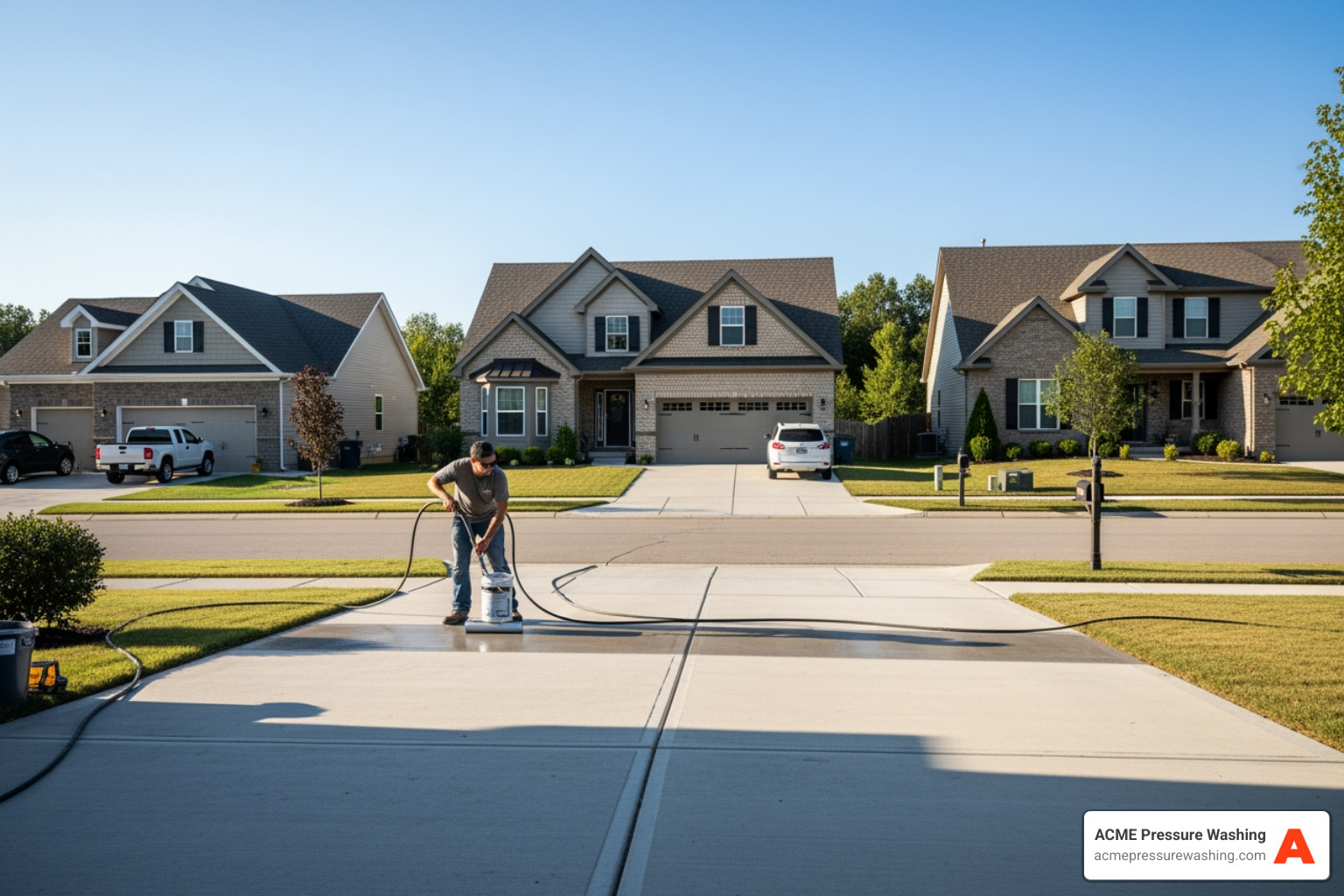
For lower-impact maintenance ideas between professional services, you may also like How to Deep Clean Your Patio Using Elbow Grease Instead of Electricity. That said, for thorough results and surface protection, we always recommend hiring a professional.
The Value of Professional Sealing Services
Sealing is optional, but often smart.
A good sealer can help:
- Reduce future staining
- Slow water penetration
- Improve resistance to salt and weather
- Make routine maintenance easier
- Extend the “just cleaned” look
This is especially helpful in New Hampshire, where winter moisture and road salt are repeat offenders. In Milford, Bedford, Merrimack, and Nashua, sealing can be a practical follow-up after a proper driveway wash, especially for concrete and pavers.
Sealing is not a magic force field. It will not make a driveway invincible or stop every spill from leaving a mark. But it can reduce how quickly the surface gets dirty again and help support a longer service life.
For more on cleaning hard surfaces well before protecting them, see How to Deep Clean Patio Slabs Without Breaking a Sweat.
Why Professional Service Outperforms DIY
While renting a pressure washer may sound less expensive at first, driveway cleaning is one of those jobs where the wrong approach can quickly create surface damage, uneven results, or safety issues. We strongly recommend relying on a professional for driveway cleaning rather than attempting it yourself.
DIY attempts usually run into four problems:
- Wrong pressure for the material
- Uneven cleaning lines and striping
- Incomplete stain removal
- Risk of injury or property damage
Commercial-grade machines clean faster, more evenly, and more effectively than most rental units. Professionals also know when to use hot water, when to pre-treat, when to reduce pressure, and when not to overclean a surface.
This is especially important for:
- Asphalt driveways in Bedford and Londonderry
- Paver driveways with joint sand in Hollis
- Large concrete entrances in Merrimack and Nashua
- Commercial access lanes where oil and tire residue are heavier
A botched DIY job can turn a cleaning project into a repair project. That is rarely a bargain. Save time and protect your investment by calling a professional.
Industry Pricing Standards and Estimates
To set realistic expectations, here is the best way to think about internet pricing in 2026:
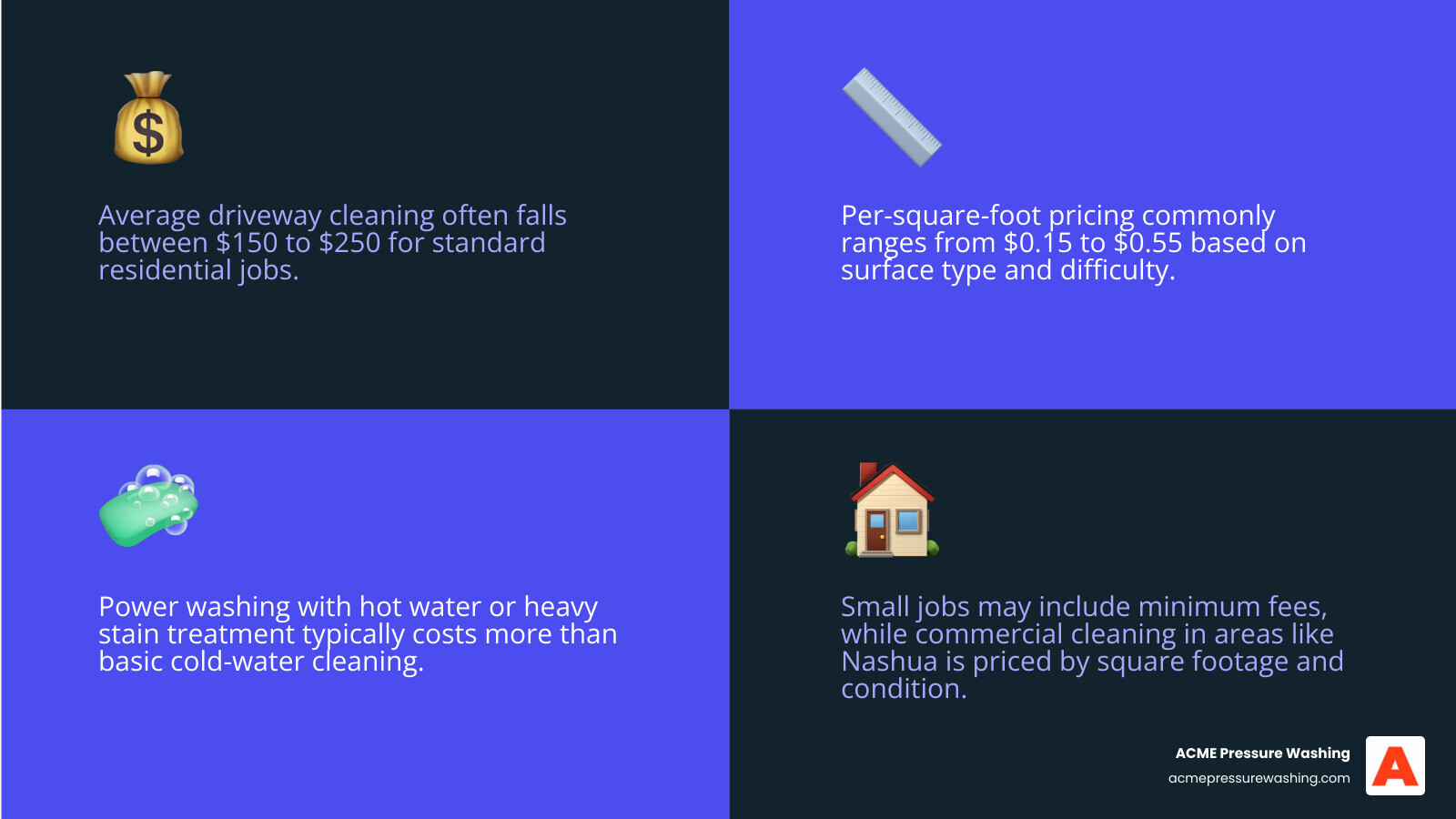
- Average standard driveway cleaning often appears in the low hundreds across public online data
- A broader planning range of about $400 to $2,000+ is more realistic for budgeting because condition, material, and access vary so widely
- Per-square-foot pricing can vary substantially depending on source, material, and difficulty
- Power washing or heavy stain treatment tends to cost more than basic cold-water pressure washing
- Small jobs may be affected by minimum service fees
- Large or commercial-scale cleaning in Nashua, Manchester, or Derry may be priced by square footage, labor hours, condition, and access
All prices mentioned in this article are average costs sourced from publicly available internet data and are not the actual prices of ACME Pressure Washing. Real project pricing can vary substantially depending on conditions. For an accurate quote tailored to your property, call us at +1603-883-6900 or REQUEST YOUR FREE ESTIMATE.
If you are comparing cleaning methods, timing, and service scope, our main power washing service page is a good next step.
Frequently Asked Questions about Driveway Cleaning
How often should a driveway be cleaned in New Hampshire?
For most New Hampshire properties, once a year is a solid baseline. Twice a year can make sense if the driveway sees heavy traffic, lots of shade, major tree debris, persistent algae, or repeated oil drips.
In towns like Merrimack, Bedford, and Windham, spring cleaning is common because winter leaves behind sand, salt, and grime. A second cleaning later in the year can help if the property stays damp or shaded.
Is power washing better than pressure washing for oil stains?
Usually, yes. Power washing uses heated water, which is generally more effective on oil, grease, and stubborn vehicle residue than cold-water pressure washing alone. That said, detergent choice and surface type still matter. Old, deeply set stains may improve significantly without disappearing 100 percent.
Can high pressure damage my asphalt driveway?
Yes. Asphalt can absolutely be damaged by excessive pressure or poor technique. That is why asphalt cleaning should be done with lower pressure, proper nozzles, and a method tailored to the surface condition. This is one of the clearest cases where professional service is the safer option.
How do I get a quote from ACME Pressure Washing?
You can call us directly at +1603-883-6900 or submit a request through our online quote form. We serve properties across New Hampshire and are happy to provide a free estimate tailored to your specific driveway and property needs.
Conclusion
A clean driveway does more than improve curb appeal. It helps reduce slip hazards, protects the surface, and creates a stronger first impression for visitors, tenants, customers, or employees arriving at your property.
At ACME Pressure Washing, we bring more than 38 years of experience to exterior cleaning across Merrimack, Bedford, Nashua, Derry, Goffstown, Hollis, Manchester, Londonderry, Milford, Windham, Brookline, and surrounding New Hampshire communities. We use safe, customized, eco-friendly techniques designed for the specific surface and condition in front of us, not a one-size-fits-all approach.
If you want expert help planning your driveway cleaning project, call us at +1603-883-6900 or REQUEST YOUR FREE ESTIMATE.
You can also explore related services including house pressure washing, commercial pressure washing, fleet and equipment pressure washing, or Explore Our Power Washing Services to see how we help maintain houses, fences, decks, patios, pool areas, walkways, concrete, sidewalks, sheds, commercial buildings, commercial fleets, tractor trailers, heavy equipment, and more across New Hampshire.