The Natural Guide to Kill Moss on Patio Pavers

Moss on Patio Pavers Is a Safety Hazard — Here’s What to Do
If you want to kill moss on patio pavers, here are the most effective methods:
- White vinegar solution — Mix equal parts white vinegar and water, spray onto moss, wait 10–30 minutes, scrub with a stiff brush, and rinse.
- Baking soda — Sprinkle dry baking soda directly on moss, leave for 2–3 days, then brush away.
- Boiling water — Pour directly onto moss for immediate results; repeat as needed.
- Bleach solution — Mix 1 part bleach with 3–10 parts water, apply, wait 15 minutes, scrub, and rinse thoroughly.
- Professional power washing — Best for heavy infestations or large areas; prevents joint damage and spore spread.
That slippery green film creeping across your patio isn’t just ugly — learning how to kill moss on patio pavers is a genuine safety issue. Moss becomes extremely slippery when wet, turning a backyard patio or walkway into a serious fall hazard, especially after a New England rain.
It starts small. A thin green line between stones. Then, before long, entire sections look carpeted. In damp, shaded conditions — which are very common across Merrimack, Nashua, and the surrounding New Hampshire region — moss spreads fast and digs in deep.
The good news? You don’t always need heavy equipment or harsh chemicals to deal with it. Several household remedies work well on moderate growth. The bad news? DIY methods have real limits, and the wrong approach (like aggressive pressure washing) can damage your paver joints and make the problem worse.
I’m Lionel Greenwood, owner of ACME Pressure Washing, and I’ve been removing moss, algae, and grime from patios and walkways across New Hampshire for over 38 years — I know exactly what it takes to kill moss on patio pavers safely without causing structural damage. In the sections below, I’ll walk you through what actually works, what to avoid, and when it makes sense to call in a professional.
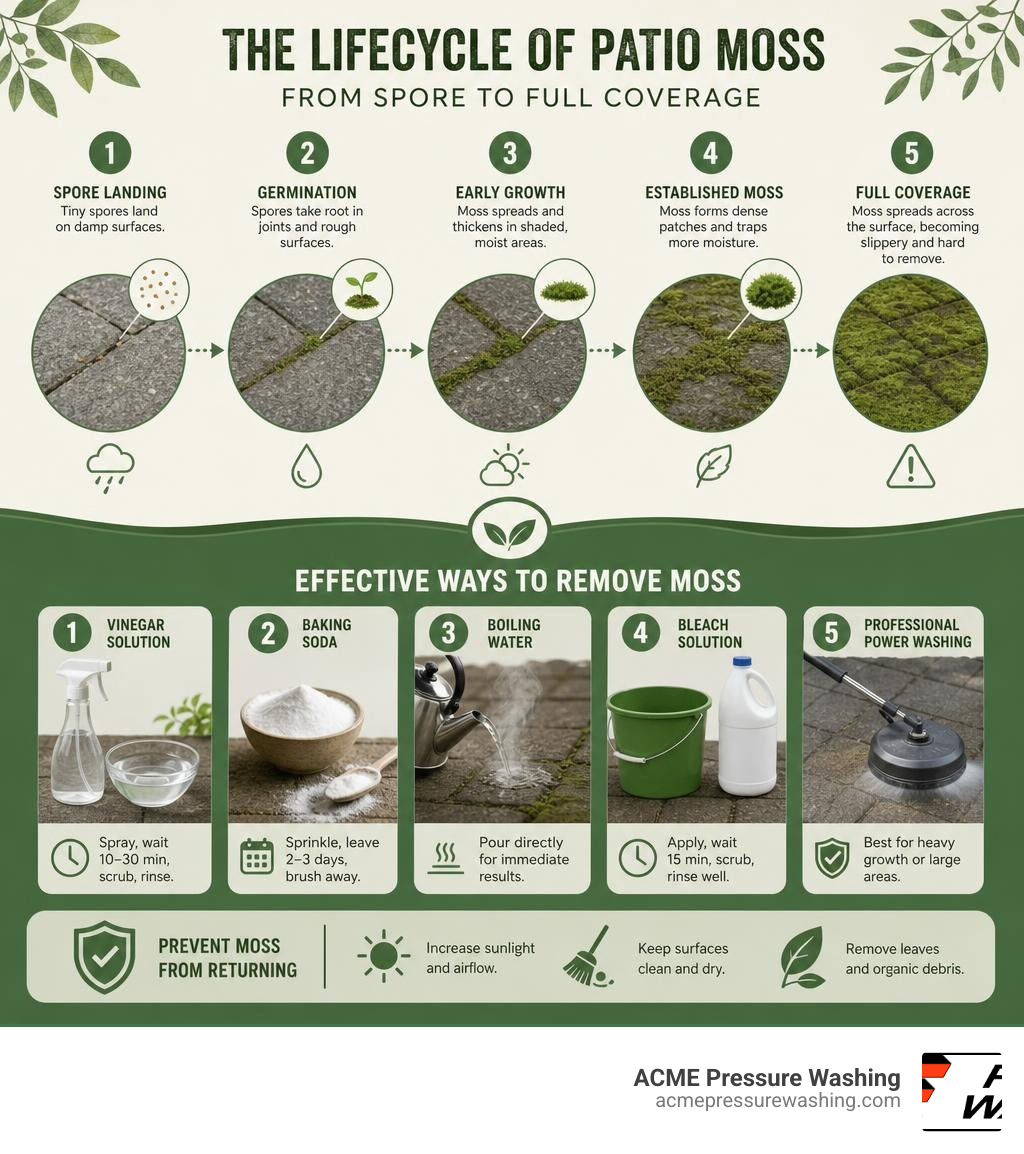
Simple guide to kill moss on patio pavers:
Why Moss Invades New Hampshire Patios and Walkways
To effectively kill moss on patio pavers, we first need to understand why it chooses your hardscape as its favorite home. Moss is a primitive, non-vascular plant. Unlike grass or garden flowers, it doesn’t have true roots. Instead, it anchors itself using tiny hair-like structures called rhizomes. Because it doesn’t need deep soil to thrive, the narrow, sand-filled joints between your patio pavers are prime real estate.
In southern New Hampshire communities like Merrimack, Bedford, Nashua, and Amherst, several local environmental factors come together to create the perfect storm for moss growth:
- Deep Shade: Moss lacks the vascular system to survive intense, direct sunlight. Patios built under mature tree canopies, behind two-story homes, or beneath second-story decks receive very little sun, keeping the surface cool and shaded.
- Persistent Dampness & Clay Soil: Many yards in Bedford and Amherst have dense, clay-heavy soils that naturally retain water. When rainwater cannot drain away quickly, it pools around the edges of the patio, keeping the pavers damp for days.
- Freeze-Thaw Cycles: Our harsh New Hampshire winters create micro-cracks in concrete pavers and brick. When spring arrives, these tiny, weathered crevices collect moisture and organic debris, giving microscopic moss spores a secure place to take root.
- Acidic Environments: Concrete pavers and clay bricks are naturally porous and can develop a slightly acidic surface pH over time. Moss thrives in acidic conditions, making untreated hardscapes highly vulnerable.
Left unchecked, moss does more than create a slippery safety hazard. It traps moisture against the surface of the stone, accelerating the breakdown of the paver material. During winter, this trapped water freezes and expands, causing the pavers to crack, spall, and shift out of alignment.
High-Level Natural Methods to Kill Moss on Patio Pavers
If you catch a moss infestation early, you don’t necessarily have to jump straight to industrial-strength chemicals. There are several highly effective, low-impact household remedies that can disrupt the plant’s cellular structure and make it easy to remove.

When we look at natural methods, we are essentially trying to shock the plant. Because moss draws moisture and nutrients directly through its leaves rather than deep roots, it is highly sensitive to sudden changes in temperature, acidity, and alkalinity.
To see how these household solutions stack up in real-world testing, you can read about a direct comparison in this article on how I Tried Three Ways to Remove Moss From My Pavers — One Worked Surprisingly Fast. For those interested in a deeper dive into kitchen-cupboard alternatives, you can also explore Baking Soda To Kill Moss On Pavers (11 Proven Methods).
Let’s break down the two most popular DIY natural remedies: white vinegar and baking soda.
Using White Vinegar to Kill Moss on Patio Pavers
Household white vinegar is highly effective against moss due to its acetic acid content. The acid breaks down the protective outer layer of the moss, causing it to dehydrate and die within hours.
To use this method safely and effectively, follow these steps:
- Prepare the Mixture: Mix a 1:1 solution of white vinegar and water in a garden sprayer. For severe patches, some homeowners use a stronger 65/35 vinegar-to-water ratio.
- Apply Strategically: Choose a dry, sunny day. Spray the mixture directly onto the green moss, ensuring it is thoroughly saturated.
- Dwell Time: Let the solution sit for 10 to 30 minutes. You will notice the vibrant green moss begin to turn a dull, brownish-yellow color.
- Scrub and Rinse: Use a stiff-bristled scrub brush to dislodge the dead moss from the paver surface and joints. Rinse the area thoroughly with a garden hose.
Crucial Safety Precaution: Acetic acid is non-selective. This means it will kill your prized garden beds, lawn, and surrounding ornamental plants just as easily as it kills the moss. Always use a targeted spray nozzle, protect nearby vegetation with plastic sheeting, and avoid spraying on windy days to prevent drift. For more guidance on using natural acids safely, check out our guide on How to Kill and Prevent Patio Moss for Good.
Applying Baking Soda to Kill Moss on Patio Pavers
If you prefer to avoid acidic treatments, baking soda (sodium bicarbonate) is an excellent alkaline alternative. While vinegar burns the moss with acid, baking soda dramatically raises the pH of the paver surface, creating an ultra-alkaline environment that moss simply cannot tolerate.
Here is how to apply it:
- The Dry Sprinkle Method: On a dry day when no rain is forecast for at least 48 hours, sprinkle dry baking soda generously over the damp moss.
- Mist Lightly: Use a spray bottle to lightly mist the powder with water. This activates the sodium bicarbonate without washing it away.
- Wait It Out: Let the baking soda sit for 2 to 3 days. The moss will gradually dry out, turn black, and die.
- Sweep and Clean: Once the moss is completely dead and dry, sweep it away with a stiff broom.
Because baking soda is non-acidic, it is exceptionally gentle on concrete and brick pavers, eliminating any risk of etching or surface discoloration. To learn more about preparing your patio for this type of seasonal cleaning, read our article on how to Clean Your Patio Pavers Like a Pro This Weekend.
The Risks of DIY Moss Removal and Joint Sand Damage
While the idea of tackling patio moss with a weekend DIY project is appealing, it comes with significant structural risks. The most common mistake homeowners make is renting a high-powered pressure washer from a local home improvement store and blasting the patio at maximum pressure.

This aggressive approach often leads to a major structural issue known as interlocking friction failure.
Paver patios do not rely on mortar to stay in place. Instead, they are held together by a tight network of joint sand (often polymeric sand) that creates friction between the stones. This sand locks the pavers into a solid, unified surface that can support heavy weight and resist shifting.
When you blast a pressure washer directly into the joints to remove moss, you inevitably wash away this vital joint sand. Without sand, the pavers lose their structural integrity. Over the next few months, water will seep underneath the stones, washing away the gravel bedding and causing the patio to sag, wobble, and shift out of alignment.
Furthermore, high-pressure washing without proper sanitization actually spreads microscopic moss spores across your entire yard, leading to an even larger infestation the following spring. To understand how to handle paving stones without ruining their foundation, read our professional insights on Pressure Washing Paving Stones Like a Pro.
If you do choose to manually scrape the joints, you must use specialized tools like a block paving knife or a wire-bristled joint brush. For a detailed look at manual, non-chemical weed and moss extraction, refer to Remove Moss from Patio Joints: Home Remedies That Work.
Long-Term Prevention: Keeping Your Pavers Moss-Free
Once you successfully kill moss on patio pavers, the real work begins: keeping it from coming back. Moss removal is only a temporary fix if you do not address the underlying environmental conditions that allowed it to grow in the first place.
To protect your investment and maintain a safe, slip-free patio, implement these long-term preventative measures:
- Improve Drainage: If water pools on your patio, consider digging shallow, gravel-filled French trenches along the edges of the hardscape to direct runoff away from the foundation. Ensure your gutters are clean and downspouts are directed away from the pavers.
- Increase Sunlight and Airflow: Prune back low-hanging tree branches and dense shrubs that cast continuous shade over your patio. Increasing sunlight and wind exposure will help the pavers dry out rapidly after a rainstorm.
- Apply a Professional Sealant: This is the single most effective way to prevent moss. A high-quality, breathable paver sealant fills the microscopic pores in the concrete or brick, preventing water from soaking into the stone and cutting off the moisture supply that moss needs to survive. Learn more about this process in our guide on How to Clean and Seal Your Patio for Long-Lasting Beauty.
Comparing DIY vs. Professional Care
To help you decide between tackling this project yourself or hiring a professional team, here is a direct comparison of the two approaches:
| Feature | DIY Manual Scrubbing & Household Remedies | Professional Hot-Water Power Washing & Sealing |
|---|---|---|
| Effort Required | High (hours of physical scrubbing, scraping, and rinsing) | None (fully completed by trained technicians) |
| Risk of Damage | High (risk of joint sand erosion, paver shifting, and stone etching) | Extremely Low (customized, low-pressure soft washing techniques) |
| Effectiveness | Temporary (kills surface moss, but leaves deep spores intact) | Long-lasting (hot water kills spores at the root; sealant blocks future growth) |
| Equipment Used | Standard garden hose, push broom, household spray bottle | Industrial hot-water pressure washers, surface cleaners, professional sealants |
| Average Cost | $20 – $50 (cost of vinegar, baking soda, and brushes) | See pricing details below* |
*Pricing Note: Based on publicly available internet data, the average cost for professional patio cleaning and sealing across the industry is approximately $450. However, due to variations in patio size, level of moss infestation, and site accessibility, national industry rates range widely from a low end of $900 to a high end of $2,500 for extensive restoration and sealing projects. Please note that these figures represent general online market data and do not reflect the actual pricing structures of ACME Pressure Washing.
Frequently Asked Questions about Patio Moss Removal
How long does it take for vinegar to kill moss on pavers?
When you apply a 1:1 white vinegar and water solution on a warm, dry day, the drying process begins almost immediately. You will typically see the moss start to turn yellow and brown within 24 hours. Within 2 to 3 days, the cellular structure of the moss will completely collapse, making it dry, brittle, and ready to be swept away with a stiff brush. If the infestation is particularly thick or if the weather is cool and damp, a second application may be required.
Will pressure washing damage my paver joints?
Yes, if done incorrectly. Using a standard high-PSI pressure washer with a narrow spray nozzle pointed directly down into the joints will quickly blast away the polymeric sand holding your pavers together. This leads to uneven settling and shifting.
To avoid this, professionals use specialized rotary surface cleaners that distribute water pressure evenly across the surface, combined with customized, low-pressure “soft washing” techniques and hot water to sanitize the stone without disturbing the joint sand.
What is the best time of year to treat patio moss in New Hampshire?
The absolute best times of year to treat patio moss in New Hampshire are early spring (April to May) and late autumn (September to October). During these transitional seasons, temperatures typically hover in the optimal 50–80°F range, which is ideal for cleaning solutions to work effectively without evaporating too quickly.
As of June 2026, we are in the prime summer maintenance season. If you are treating moss during the hot summer months, always apply your treatments in the cooler early morning hours (between 8:00 AM and 11:00 AM) to prevent the sun from drying out your vinegar or baking soda mixtures before they can fully penetrate the plant.
Conclusion
While natural household remedies like white vinegar and baking soda can help you manage small, localized patches of moss, keeping a large paver patio safe, beautiful, and structurally sound requires a professional touch.
At ACME Pressure Washing, we bring over 38 years of exterior cleaning experience directly to your doorstep. Operating out of Merrimack, NH, we proudly serve homeowners and businesses throughout Bedford, Nashua, Amherst, and the surrounding communities. Our USP is simple: we combine decades of local expertise with safe, customized, eco-friendly hot-water cleaning techniques that eliminate moss and spores without damaging your pavers, washing away your joint sand, or harming your surrounding landscape.
Don’t let slippery green slime ruin your outdoor living space or put your family at risk of a dangerous fall. Let our experienced team restore your patio to its original beauty and protect it for years to come.
- To restore your walkways and outdoor living spaces, check out our walkway and patio cleaning services.
- Ready to get started? Get a free quote today or call us directly at +1603-883-6900.
- We also specialize in a full suite of exterior cleaning services. Learn about our house pressure washing, explore commercial pressure washing for your business, or discover fleet and equipment pressure washing to keep your commercial assets in top condition.