How to Clean Your House Siding Like a Pro

Why the Best Way to Clean House Exterior Surfaces Matters More Than You Think
The best way to clean house exterior surfaces is soft washing — a low-pressure method that combines specialized cleaning solutions with gentle rinsing to safely remove mold, mildew, algae, and grime without damaging your siding, trim, or landscaping.
Here’s a quick overview of the most effective approach:
- Soft wash the siding using a diluted sodium hypochlorite solution and a surfactant
- Apply cleaning solution from bottom to top to prevent streaking
- Let it dwell for 10–15 minutes to break down organic growth at the source
- Rinse from top to bottom using low pressure (500–1,500 PSI depending on surface)
- Match the method to the material — vinyl, wood, brick, stucco, and fiber cement each need different care
This approach works for most New Hampshire homes, including properties in Merrimack, Nashua, Manchester, and Bedford. For anything above one story, heavily mildewed surfaces, or delicate siding materials, hiring a professional is strongly recommended.
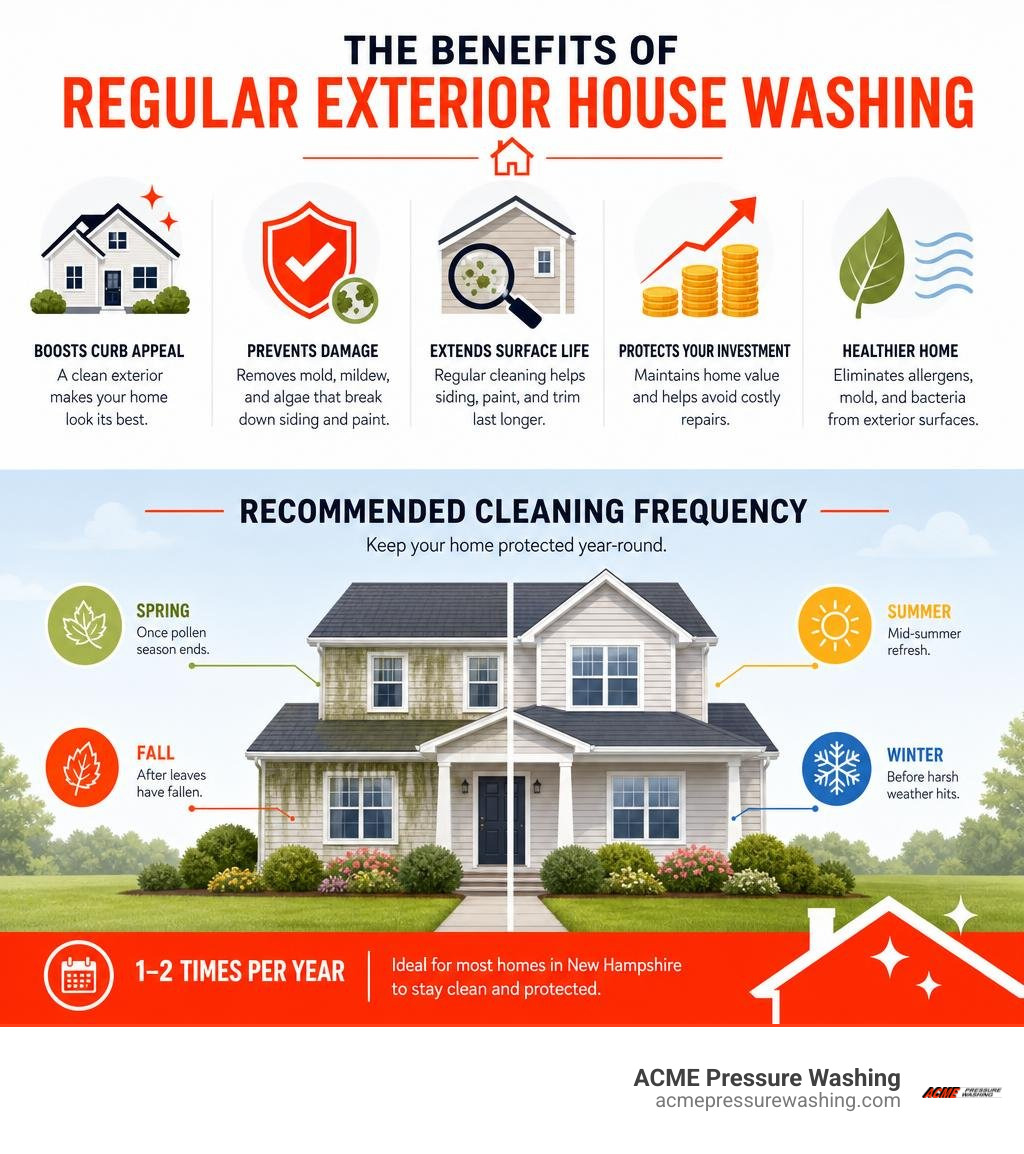
Your home’s exterior takes a beating year-round. In New Hampshire, that means pollen in spring, humidity through summer, falling leaves in fall, and road salt and freeze-thaw cycles all winter. The result? A slow buildup of algae, mold, mildew, and grime that doesn’t just look bad — it actively degrades your siding, eats into paint, and can cause moisture to work its way behind panels, leading to costly structural repairs.
Most homeowners don’t notice the damage until it’s already significant. By then, a simple cleaning job has turned into a much more expensive problem.
The good news: regular exterior cleaning is one of the most cost-effective ways to protect your property investment and maintain curb appeal — especially before selling or heading into another harsh New Hampshire winter.
I’m Lionel Greenwood, owner of ACME Pressure Washing, and with over 38 years of hands-on experience helping homeowners across New Hampshire find the best way to clean house exterior surfaces safely and effectively, I’ve seen every mistake in the book — and I’ll help you avoid them. Let’s walk through exactly what works, what doesn’t, and when to call in a pro.
Quick best way to clean house exterior definitions:
Why Soft Washing is the Best Way to Clean House Exterior Surfaces
When most people think about cleaning their home’s exterior, they picture a high-pressure blast of water stripping away years of dirt. While high pressure is excellent for hard, non-porous horizontal surfaces like concrete driveways or stone walkways, it is often the worst choice for your home’s vertical siding.

Using high pressure on delicate siding materials like vinyl, painted wood, or stucco can result in cracked panels, stripped paint, torn window screens, and ruined seals. Even worse, high-pressure streams can force water directly behind your siding panels. Once water gets trapped in the wall cavities, it creates a breeding ground for hidden mold, wood rot, and structural decay.
This is why we advocate for low-pressure house cleaning, commonly known as soft washing. If you want to discover the true Don’t Blast Your Siding Away and Other Soft Washing Benefits, you have to look at how the process actually works. Instead of relying on raw physical force to knock grime loose, soft washing relies on safe, targeted cleaning solutions to break down organic growth at the molecular level.
Once the cleaning agents have dissolved the dirt, mold, and algae, a gentle rinse — often using no more pressure than a high-end garden hose nozzle — washes everything away cleanly. When you Don’t Be a High Pressure Mess and Switch to Low Pressure House Cleaning, you preserve the structural integrity of your home while achieving a level of clean that lasts significantly longer than pressure washing alone.
Choosing the Best Way to Clean House Exterior Siding by Material
Every home is built differently, and a one-size-fits-all approach to exterior cleaning can quickly lead to property damage. To achieve a spotless finish safely, you must tailor your cleaning method and chemical solutions to the specific material on your home’s exterior.
- Vinyl Siding: Vinyl is highly popular throughout New Hampshire, but it is notorious for attracting green algae and dark mold, particularly on shaded, north-facing walls. To understand why this happens, you can read about The Science Behind Why Vinyl Siding Turns Green in New Hampshire. Vinyl should always be cleaned using soft washing. High pressure can easily crack cold vinyl or drive water upward through the weep holes designed for ventilation, soaking the sheathing underneath.
- Wood Siding: Whether you have cedar shakes or traditional clapboard, wood is incredibly delicate. High pressure will raise the wood grain, leaving a fuzzy, ruined texture that requires extensive sanding and refinishing to fix. Instead, wood siding requires a gentle soft wash with specialized wood cleaners to kill mold spores without stripping away natural oils or protective stains.
- Brick and Stucco: Brick is highly durable, but the mortar joints holding it together are porous and fragile. Blasting brick with high pressure can erode mortar, leading to water leaks and structural instability. Stucco is even more vulnerable; its textured surface can easily be gouged or stripped away by a pressure washer. A low-pressure chemical application is essential to lift dirt out of these porous textures safely.
- Fiber Cement (Hardie Board): Fiber cement is tough, but it is held together by specialized paint coatings. Using excessive pressure can strip this paint or chip the edges of the boards. Following a proper Siding Pressure Washing Guide 2026 ensures you use the correct low-pressure settings to preserve the manufacturer’s warranty and paint finish.
Why Professional Soft Washing is the Best Way to Clean House Exterior Walls
The secret to soft washing isn’t the machine; it’s the chemistry. Professional soft washing utilizes a highly effective mixture of sodium hypochlorite (the active sanitizing agent found in household bleach) and specialized, eco-friendly surfactants.
Sodium hypochlorite is the industry standard because it doesn’t just wash away organic growth like mold, mildew, moss, and algae — it kills it at the root. When you wash a house with water alone, you leave microscopic spores behind in the pores of the siding. Within a few months, those spores multiply, and the green or black stains return.
By applying a sanitizing solution, you ensure the organic growth is completely eradicated. This keeps your home cleaner for up to three times longer than traditional pressure washing. Furthermore, professional-grade surfactants act as “wetting agents.” They reduce the surface tension of the water, allowing the cleaning solution to cling to vertical walls instead of immediately running off. This maximizes the “dwell time” needed for the chemicals to work their magic.
If you are dealing with stubborn dark patches, learning How to Kill Black Mold at the Root Without Ruining Your Siding is key to preserving your home’s health and appearance. Additionally, understanding the mechanics of how professionals apply these chemicals allows you to see how to safely How To Pressure Wash The Exterior Of Your Home Without Causing Damage.
Preparing Your Property for a Professional House Wash
A successful house washing project is 80% preparation and 20% execution. Because soft washing relies on active chemical solutions to break down organic matter, proper steps must be taken to protect your surrounding property, plants, and utilities before any cleaning begins.

When we perform a professional house wash, we follow a strict checklist to guarantee a safe and efficient service. You can review these essential guidelines in our 10 Dos and Don’ts for House Soft Washing Service.
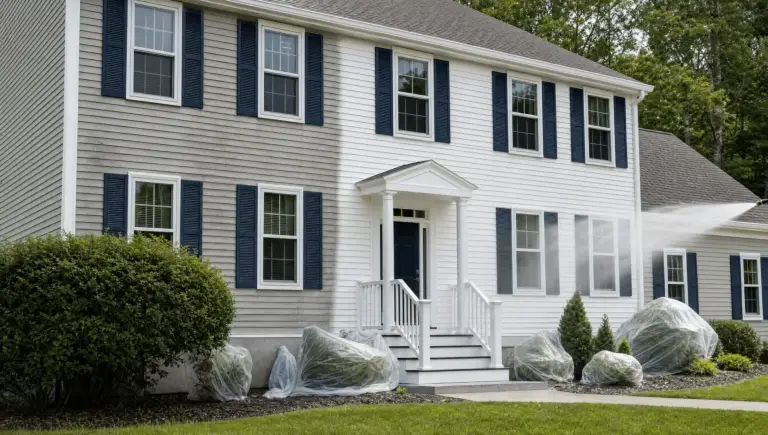
Before turning on any equipment, all outdoor furniture, cushions, grills, planters, and toys must be moved at least 10 to 15 feet away from the wash zone. Any items that cannot be moved should be covered with heavy-duty plastic sheeting.
Windows must be completely closed and latched to prevent water from entering the home. Additionally, all outdoor electrical outlets, light fixtures, security cameras, and AC units must be covered and sealed with plastic and painter’s tape. Water and electricity never mix well, and even low-pressure overspray can short out sensitive outdoor electronics. For a deeper look at proper pre-cleaning steps, Popular Mechanics offers an excellent guide on How to Pressure Wash a House.
Protecting New Hampshire Landscaping and Utilities
One of the biggest concerns homeowners have when hiring an exterior cleaning service is the health of their landscaping. Sodium hypochlorite is highly effective at killing organic matter on your siding, which means it can also harm your grass, shrubs, and flower beds if it is not handled with extreme care.
To protect your beautiful New Hampshire landscaping, we use a technique called “plant saturation.” Before any cleaning chemicals are applied to the house, we thoroughly drench all nearby trees, shrubs, grass, and flower beds with fresh, clean water. Because plants are porous, saturating them with fresh water ensures their root systems and leaves are fully hydrated. This prevents them from absorbing any chemical overspray that might land on them.
Throughout the washing process, we keep a dedicated technician on the ground to continuously rinse the landscaping, diluting any chemical runoff instantly. Once the house is clean, we perform a final, comprehensive rinse of all surrounding soil and plants.
Another crucial step is bagging downspouts. When cleaning a roof or upper gutters, we attach heavy-duty plastic bags to the bottom of your gutter downspouts. This catches any concentrated chemical runoff, preventing it from pouring directly into your lawn or flower beds.
Whether we are working on a historic home in Bedford, NH, a multi-family property in Manchester, NH, a commercial building in Nashua, NH, or a beautiful family estate in Merrimack, NH, we take environmental protection seriously. You can read more about our sustainable practices in our guide on How to Clean Your Home Exterior Without Harming the Planet.
The Risks of DIY Pressure Washing and Common Mistakes
It is incredibly tempting to head to the local home improvement store, rent a high-powered gas pressure washer for the weekend, and attempt to clean your home’s exterior yourself. However, DIY pressure washing is one of the leading causes of accidental property damage and personal injury for homeowners.
Operating a pressure washer is not as simple as pointing and spraying. Gas-powered units easily produce between 2,500 and 4,000 PSI (pounds per square inch) of pressure. To put that in perspective, a standard garden hose operates at about 40 to 60 PSI. At 3,000 PSI, water behaves like a solid knife, capable of carving deep gouges into wood, slicing through vinyl siding, and stripping away protective coatings in a fraction of a second.
Furthermore, ladder safety is a massive risk. Operating a high-pressure wand while standing on a ladder is incredibly dangerous. The physical recoil of the spray gun can easily knock you off balance, leading to catastrophic falls.
Additionally, improper spray angles can force water behind your siding or through window seals, leading to hidden water intrusion that ruins drywall and insulation inside your home. Before you pick up a wand, make sure you understand how to Pressure Wash Exterior Surfaces Without Damaging Your Home and check out AOL’s guide to Transform Your Home’s Exterior in an Afternoon with a Proper Pressure Washing: We’ll Show You How.
Siding and Structural Damage from High PSI
When homeowners use excessive PSI on their siding, the damage is often immediate and irreversible.
- Blown Window Seals: High pressure directed around windows can easily destroy the delicate rubber seals and caulking. Once these seals are broken, moisture gets trapped between double-paned glass, causing permanent fogging and destroying the window’s insulating properties.
- Stripped Paint and Wood Gouging: On wood siding, high pressure strips away protective paint and stains, gouging deep lines into the soft wood fibers. This ruins the look of the siding and leaves the wood vulnerable to rot and pest infestation.
- Vinyl Siding Problems: Vinyl siding panels are designed to hang loosely to allow for natural expansion and contraction. Blasting them with high pressure can easily knock panels out of alignment, break the locking channels, or blow them completely off the house.
To avoid these costly headaches, read our expert advice on 4 Practical Ways to Solve Your Vinyl Siding Power Washing Problems for Good.
Understanding the Cost of Professional Exterior Cleaning in 2026
When considering the best way to clean house exterior surfaces, it is helpful to look at the financial investment of hiring a professional versus attempting a DIY job.
While DIY seems cheaper upfront, when you factor in equipment rentals, chemical purchases, safety gear, and the high risk of accidental damage, professional cleaning often proves to be the most cost-effective choice in the long run.
Below is a comparison of typical costs based on average public internet data. Please note: these rates represent industry-wide averages compiled from online sources and do not reflect the specific pricing of ACME Pressure Washing.
| Factor | DIY Pressure Washing | Professional Soft Washing Service |
|---|---|---|
| Equipment Cost | $100–$150 (Daily rental or cheap electric unit purchase) | Included in service |
| Chemicals & Supplies | $50–$100 (Surfactants, cleaners, safety gear) | Included in service |
| Time Investment | 8–12 hours of intense manual labor | 2–4 hours (Zero homeowner labor) |
| Risk of Damage | High (Potential for cracked siding, water intrusion, falls) | Zero (Backed by professional insurance and experience) |
| Results Longevity | 3–6 months (Water-only wash leaves mold spores behind) | 12–24 months (Sanitizing solution kills spores at the root) |
| Average Price Range | N/A | $600 to $1,500 (Sourced from public internet data)* |
*Note on Pricing: Sourced from general online industry data, residential exterior cleaning rates typically range from $600 on the lower end for small, single-story homes up to $1,500 or more for larger, multi-story estates with complex architectural features. This wide range reflects industry variability across different home sizes and siding conditions.
To get a realistic sense of what goes into professional pricing in New Hampshire — whether you live in Bedford, Manchester, Nashua, or Merrimack — check out our detailed breakdown on The Real Cost to Power Wash Your House in 2026.
Frequently Asked Questions About Exterior House Cleaning
How often should you clean the exterior of your house?
For most homes in New Hampshire, we recommend a thorough exterior cleaning once a year, ideally in the spring or late fall.
However, several environmental factors can influence this frequency. If your home is surrounded by missing trees, shaded by heavy canopy, or located in a high-humidity area, mold and algae will grow much faster, requiring biannual cleanings. Additionally, north-facing walls receive very little direct sunlight, making them prime real estate for green algae buildup.
Regular maintenance prevents these organic growths from permanently staining your siding or eating into painted surfaces. For more tips on maintaining your home’s exterior year-round, check out How To Clean Your House Exterior Like A Pro: The Complete 2026 Guide.
Can you clean a house exterior without a pressure washer?
Yes, it is possible to clean a house exterior using a standard garden hose equipped with a specialized foam sprayer attachment and a soft-bristled scrubbing brush.
While this DIY method is safer than using a high-pressure washer, it has major limitations. Manual scrubbing is incredibly labor-intensive and physically exhausting. Furthermore, standard garden hoses lack the reach to safely clean second-story siding, soffits, and gutters without requiring you to climb high ladders.
For spot-treating small areas near your patio, a manual wash can work, but for a whole-house deep clean, professional methods are required to achieve a uniform, streak-free finish safely. If you want to explore safe DIY cleaning mixtures and application techniques, you can read more in the guide on the Best Exterior House Cleaning Spray.
What is the difference between power washing and soft washing?
While these terms are often used interchangeably, they represent two completely different cleaning methodologies:
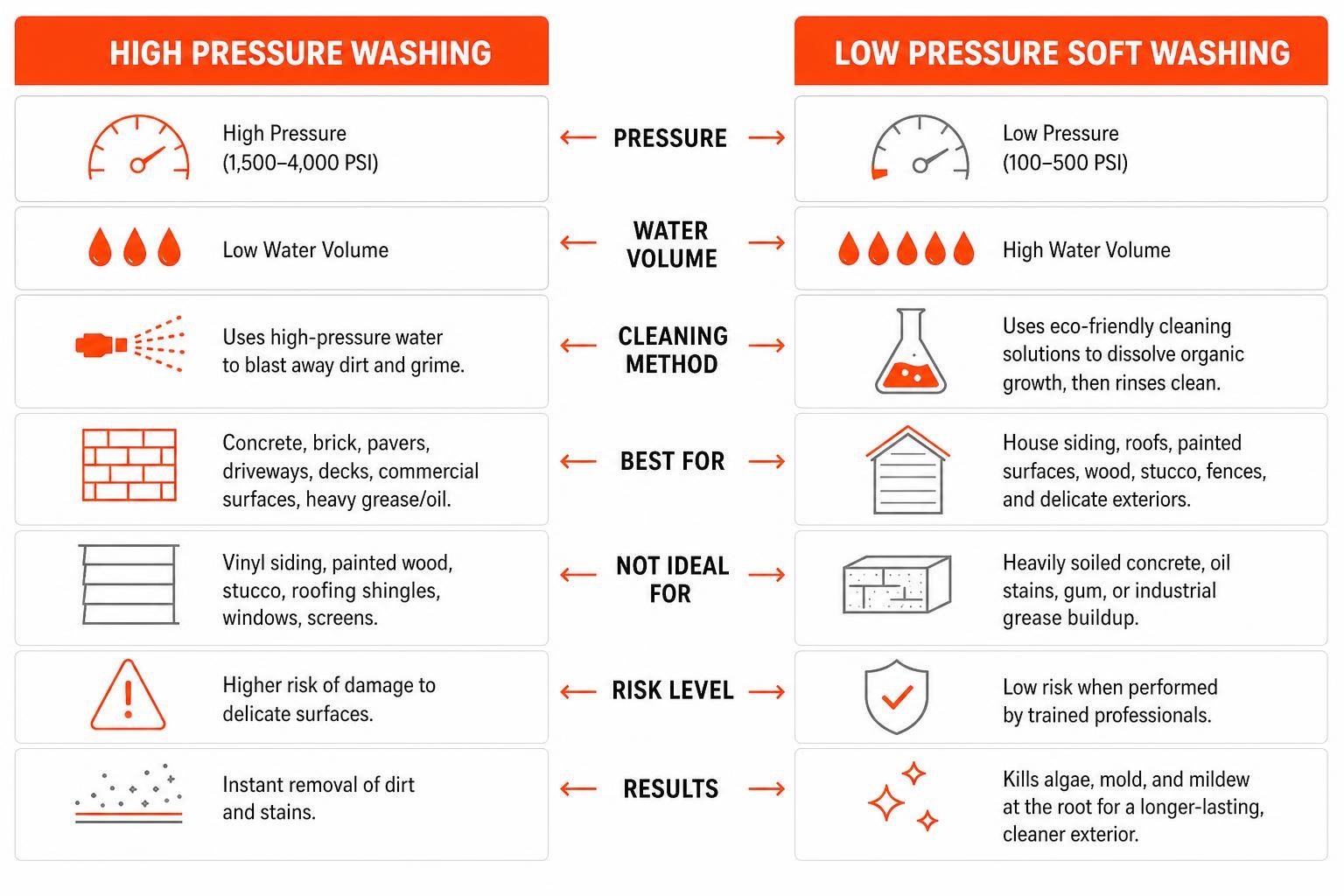
- Power Washing: Uses high-pressure water (often heated) to physically blast away heavy dirt, grease, oil, and baked-on grime. It is ideal for highly durable, non-porous horizontal surfaces like concrete driveways, commercial parking lots, and heavy machinery.
- Soft Washing: Uses very low pressure (similar to a strong garden hose) combined with specialized, biodegradable chemical solutions to gently dissolve organic growth like algae, mold, and mildew. It is the gold standard for delicate vertical surfaces like house siding, roofs, painted wood, and stucco.
To dive deeper into the technical differences, read our guide on The Ins and Outs of House Power Washing.
Conclusion
Finding the best way to clean house exterior surfaces doesn’t have to be a stressful, high-risk DIY chore. By choosing professional soft washing, you protect your siding from high-pressure damage, eliminate harmful mold and algae at the root, and instantly restore your home’s beautiful curb appeal.
At ACME Pressure Washing, we bring over 38 years of dedicated experience to every job. Our highly trained, fully insured team uses safe, customized, eco-friendly soft washing techniques specifically designed to handle the unique climate challenges of New Hampshire. We proudly serve homeowners and businesses throughout Bedford, Manchester, Nashua, Merrimack, and the surrounding communities.
Ready to make your home shine like new? Let the professionals handle the hard work safely.
Contact ACME Pressure Washing today at +1603-883-6900 to speak with our friendly team, or click here to fill out our quick Online Quote Form to get your free, no-obligation estimate. For more information about our specialized residential services, visit our House Pressure Washing page.