Safe Algae Roof Cleaning Methods That Actually Work

What Those Black Streaks Are Telling You About Your Roof
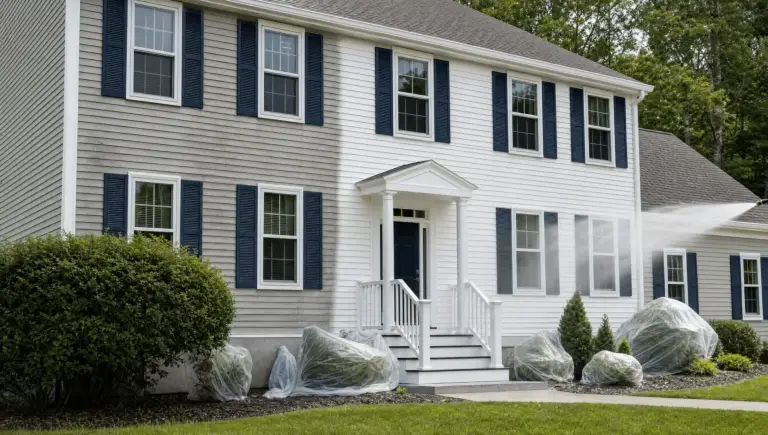
Algae stained roof cleaning is the process of safely removing dark biological growth from your shingles using low-pressure chemical washing — without damaging the roof or voiding your warranty.
Here is a quick summary of what you need to know:
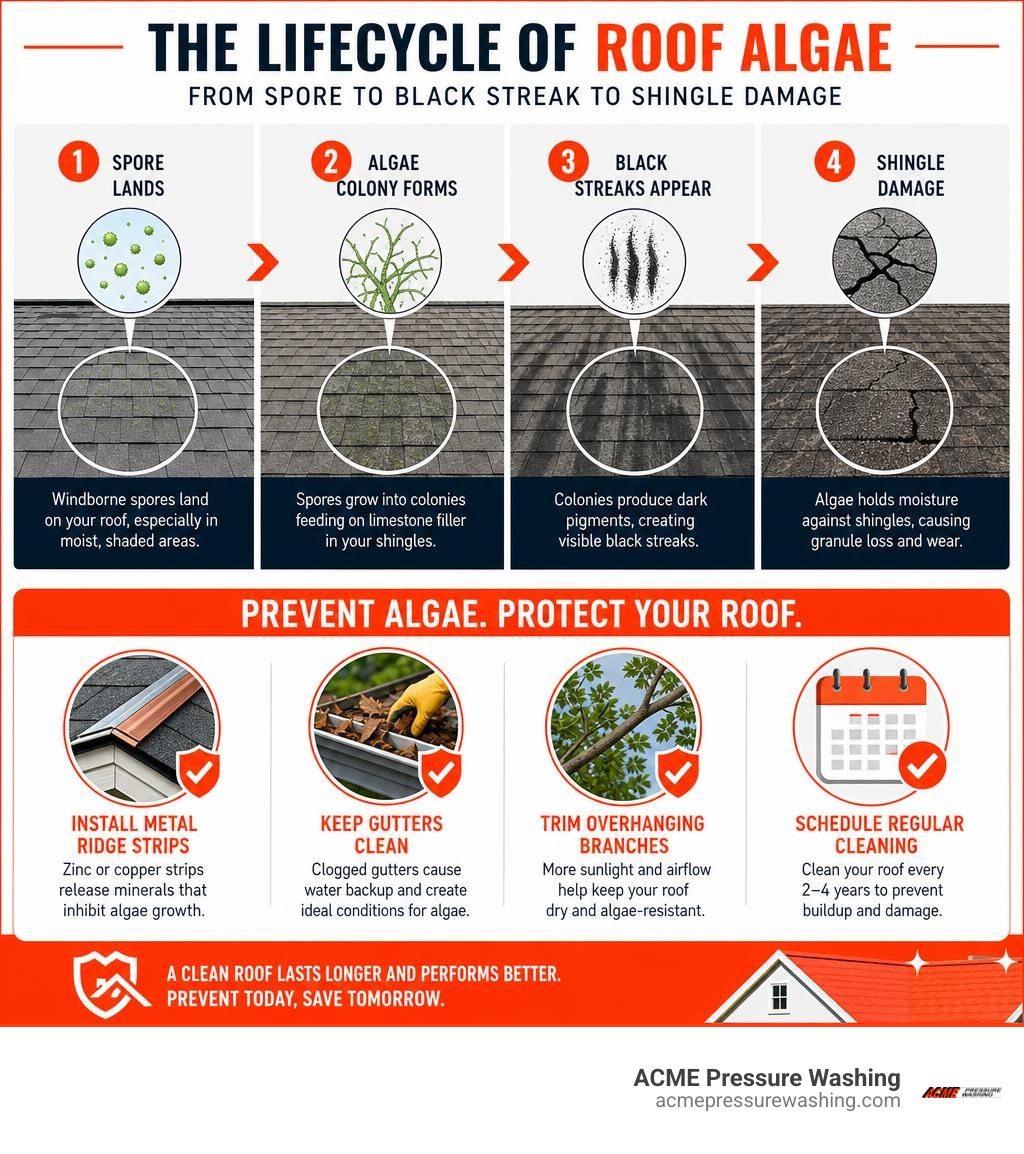
- What causes it: A cyanobacterium called Gloeocapsa magma feeds on the limestone filler in asphalt shingles and leaves dark black or brown streaks
- Is it harmful: Yes — beyond looking bad, it shortens shingle lifespan by 5 to 10 years and raises attic temperatures
- How to remove it: Soft washing with a diluted sodium hypochlorite solution, applied at under 150 PSI, left to dwell 15–20 minutes, then rinsed gently
- What NOT to do: Never pressure wash asphalt shingles — it strips granules, voids warranties, and can cut roof life by 30 to 50%
- How to prevent regrowth: Install zinc or copper ridge strips, keep gutters clean, trim overhanging branches, and schedule cleaning every 2 to 4 years
Those dark streaks spreading down your roof are not dirt, not pollution, and not a sign your roof is failing. They are a living organism — and in New Hampshire’s humid summers, they spread fast.
Gloeocapsa magma thrives anywhere moisture lingers and sunlight is limited. That makes north-facing slopes in towns like Merrimack and Bedford especially vulnerable. Once a colony takes hold, it does not just sit there looking ugly. It actively feeds on your shingles and holds moisture against the roof surface, accelerating wear with every freeze-thaw cycle our New Hampshire winters deliver.
Left untreated, what starts as a cosmetic issue becomes a structural one — and a roof replacement in 2026 runs anywhere from $10,000 to $25,000.
I’m Lionel Greenwood, owner of ACME Pressure Washing, and I’ve been handling algae stained roof cleaning across New Hampshire since 1988 — over 38 years of learning exactly what works and what causes expensive damage. In this guide, I’ll walk you through the science, the safe removal methods, and the prevention steps that actually protect your investment long-term.
Relevant articles related to algae stained roof cleaning:
The Science Behind Algae Stained Roof Cleaning
To solve the problem of dark roof stains, we first need to understand what is actually growing on your home. For decades, homeowners assumed these dark, tapering streaks were soot, dirt, or tree droppings. Today, we know the real culprit is a highly resilient, photosynthetic organism.
The primary organism responsible for these unsightly marks is Gloeocapsa magma. While commonly referred to as “blue-green algae,” it is actually a species of cyanobacteria. This ancient class of bacteria is capable of photosynthesis, allowing it to generate its own energy from sunlight.
To survive the harsh, direct ultraviolet (UV) rays of the sun on an exposed roof, Gloeocapsa magma secretes a dark, pigmented outer sheath. This sheath acts as a natural “sunscreen” for the colony. The black streaks you see running down your roof are actually millions of these microscopic sheaths, aligned along the paths where rainwater and morning dew naturally travel down the slope.
As airborne spores travel on the wind, they land on roofs across New Hampshire, establishing new colonies. This is why you will often see an entire street in a neighborhood like Londonderry or Nashua develop identical dark streaking patterns around the same time.
For a deeper dive into the biological mechanics of these stains, check out this detailed guide on Algae Streaks on a Roof: Cause, Clean, Prevent | TRB.
Gloeocapsa Magma: The Shingle-Eating Cyanobacteria
Why did this become such a widespread epidemic over the last few decades? The answer lies in the evolution of modern roofing materials.
Before the 1980s, asphalt shingles were manufactured using an organic paper felt base. However, as the industry transitioned to fiberglass-based shingles, manufacturers needed a way to add weight, stability, and fire resistance to the shingles. Their solution was to pack the asphalt with a heavy, inexpensive mineral filler: calcium carbonate, commonly known as limestone. Modern asphalt shingles typically contain 20% to 40% limestone filler by weight.
Unfortunately, limestone is the favorite food source of Gloeocapsa magma.

As the cyanobacteria feast on the limestone filler, they slowly degrade the structural integrity of your shingles. This feeding process results in:
- Granule Loss: The protective ceramic granules on the surface of your shingles lose their grip on the asphalt and wash away into your gutters.
- Cupping and Curling: As the shingle loses its structural filler, it begins to warp, cup, and curl at the edges.
- Accelerated UV Damage: Without the protective granules, the underlying asphalt is exposed directly to the sun, leading to cracking and premature failure.
Left untreated, Gloeocapsa magma can easily shorten a shingle’s lifespan by 5 to 10 years, turning a standard 25-year roof into a failing system in as little as 15 to 20 years. To learn more about identifying these marks and protecting your home, read our article on Black Streaks on Roof: What Causes Them and How to Clean Them Safely.
Why North-Facing Roofs in Bedford and Nashua Suffer Most
If you walk around your property in Bedford or Nashua, you will likely notice that the black streaks are not distributed evenly. The heaviest staining almost always occurs on the north-facing and heavily shaded slopes of the roof.
There is a simple meteorological reason for this. Gloeocapsa magma requires two main ingredients to thrive: limestone and moisture. While rain provides plenty of water, it is actually morning dew that sustains these colonies. North-facing roof slopes receive the least amount of direct sunlight throughout the day. This lack of sun exposure means that dew and moisture remain on north-facing shingles hours longer than on south-facing slopes, creating the perfect, humid microclimate for cyanobacteria to multiply.
Overhanging tree branches compound this issue by casting dense shade and dropping organic debris, which traps even more moisture on the roof surface.
Soft Washing vs. Pressure Washing: Which is Safe for Your Roof?
When homeowners realize their roof is covered in living bacteria, their first instinct is often to blast it away. However, using the wrong cleaning method can instantly ruin your shingles and cost you thousands of dollars in premature replacement costs.
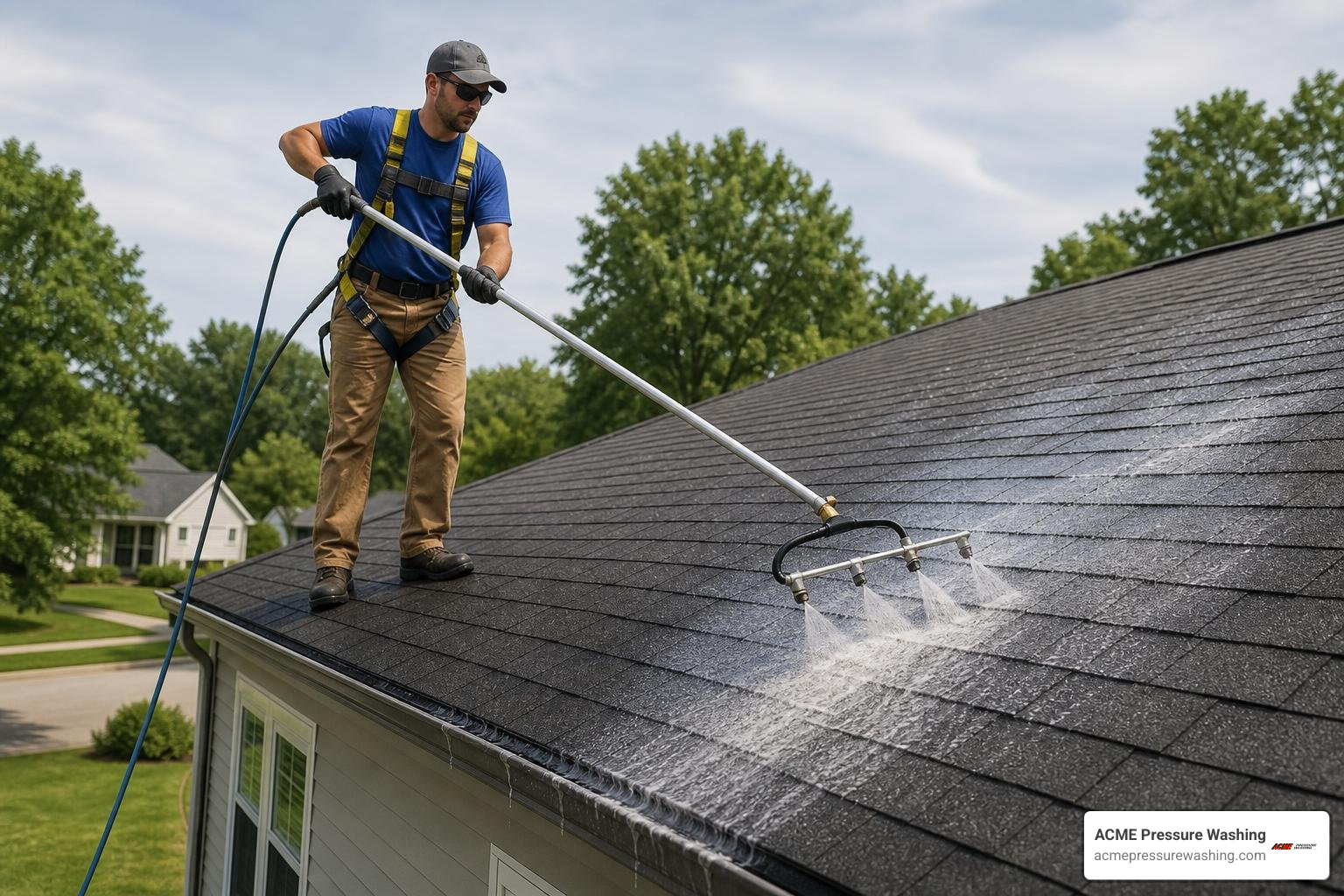
The professional exterior cleaning industry is divided into two main methodologies: high-pressure power washing and low-pressure soft washing. When it comes to asphalt shingles, concrete tiles, or clay tiles, there is only one acceptable method.
To understand the risks of improper cleaning, you can read our detailed breakdown on Can You Power Wash Shingles? Risks and Safer Alternatives.
The Dangers of High-Pressure Power Washing on Asphalt Shingles
A standard residential pressure washer operates anywhere from 1,500 to 4,000 PSI (pounds per square inch). While this force is excellent for cleaning concrete walkways, it is absolutely destructive to asphalt shingles.
Using high pressure on a shingled roof can cause severe, irreversible damage:
- Granule Stripping: High-pressure water will instantly blast away the protective ceramic granules. A single pressure washing session can strip 30% to 50% of your roof’s remaining lifespan by exposing the raw asphalt beneath.
- Water Intrusion: Pressure washers can force water upward under the laps of your shingles, soaking the wooden roof deck, ruining the underlayment, and creating hidden mold issues in your attic.
- Voided Warranties: Every major shingle manufacturer — including GAF, Owens Corning, and CertainTeed — explicitly states that pressure washing asphalt shingles voids their product warranty.
If a contractor pulls up to your home in Merrimack or Bedford and prepares to climb your roof with a high-pressure wand, send them home immediately. To see visual examples of the damage pressure washing can cause, visit our Gallery Roof Pressure Washing page, or read about the structural risks in Pressure Washing Roofs.
Why Soft Washing is the Only Safe Algae Stained Roof Cleaning Method
Soft washing is the only method approved by the Asphalt Roofing Manufacturers Association (ARMA). Instead of relying on physical force to blast away organic growth, soft washing uses specialized, low-pressure agricultural pumps to apply a customized biocidal solution at under 100 PSI — about the same pressure as a heavy garden hose.
The benefits of soft washing include:
- Root-Depth Kill: Pressure washing only removes the surface pigment of the cyanobacteria, leaving the microscopic root-like structures (known as the holdfast) alive. Within 6 to 12 months, the streaks will return. Soft washing kills the organism at cellular depth, ensuring it does not immediately regrow.
- Gentle Application: Because the pressure is so low, there is absolutely zero risk of granule loss or water intrusion.
- Long-Lasting Results: A proper soft wash treatment typically keeps a roof clean and streak-free for 2 to 4 years, depending on the local climate.
At ACME Pressure Washing, we have spent decades refining our soft-wash techniques to deliver safe, effective results for our neighbors. You can learn more about why this method is the gold standard by reading Merrimack Roof Cleaning: Why Soft Washing Wins.
Manufacturer-Approved Chemical Solutions and Prevention
To clean a roof safely, we must rely on chemistry rather than mechanical force. The goal is to apply a solution that completely sanitizes the roof, breaking down the cyanobacteria, mold, and lichen without damaging the underlying materials.
| Cleaning Agent | Active Ingredient | Recommended Use | Pros | Cons |
|---|---|---|---|---|
| Sodium Hypochlorite | Chlorine-based sanitizer | Asphalt shingles, concrete tiles | Fast-acting, kills at root, ARMA-approved | Requires strict landscaping protection |
| Oxygen Bleach | Sodium Percarbonate | Cedar shakes, delicate tiles | Eco-friendly, gentle on wood | Slower acting, requires light scrubbing |
| Biocides (DDAC) | Plant-derived ammonium | Clay tiles, slate, concrete | Long-term residual protection | Takes weeks to show full results |
When working with these solutions, protecting the surrounding environment is crucial. At ACME Pressure Washing, our 38+ years of experience has taught us that proper preparation is key. Before any chemical touches your roof, we thoroughly pre-wet all surrounding grass, shrubs, and flowers with clean water. This saturates the plants’ root systems, preventing them from absorbing any chemical runoff. We also continuously rinse the landscaping throughout the process and perform a final post-treatment wash to ensure your gardens remain perfectly healthy.
ARMA-Approved Sodium Hypochlorite and Biocide Treatments
For asphalt shingles, ARMA and major manufacturers recommend a solution based on sodium hypochlorite (household bleach or pool-grade sanitizer) diluted with water, often mixed with a small amount of Trisodium Phosphate (TSP) or a biodegradable surfactant. The surfactant helps the solution cling to the steep slopes of your roof rather than running off immediately.
The standard professional application process follows these strict steps:
- Pre-wetting: The dry shingles are pre-sprayed with a light mist of water to prevent them from absorbing the chemicals too quickly.
- Application: The chemical mixture is gently applied from the top down using a low-pressure soft wash system.
- Dwell Time: The solution is allowed to sit (dwell) on the shingles for 15 to 20 minutes. During this time, you will actually watch the black streaks fade away as the cyanobacteria are neutralized.
- Gentle Rinse: The roof is thoroughly rinsed with low-pressure water, flowing from the ridge down to the eaves.
For tile roofs, alternative biocides like Didecyldimethylammonium chloride (DDAC) are highly effective. These plant-derived active ingredients remain stable in hard water and provide a long-lasting residual barrier that prevents new spores from taking root. You can read more about tile cleaning options on How to Remove Green Algae from Roof Tiles | ProGreen and explore the differences in chemical performance in Naples Roof Algae & Black Streaks — The Cyanobacterium Behind the Stains and Why Standard Cleaning Fails It.
Preventing Regrowth with Zinc Strips and Algae-Resistant Shingles
Once your roof is clean, you want to keep it that way. There are several highly effective strategies to prevent Gloeocapsa magma from returning:
- Zinc and Copper Strips: Have you ever noticed that the shingles directly below metal chimney flashings or galvanized vents are always perfectly clean? That is because rainwater washes trace metal ions down the roof, creating an environment where algae and bacteria cannot survive. By installing a 2- to 3-inch strip of zinc or copper along the ridge of your roof, you can replicate this natural defense. Every time it rains, protective ions will wash down your shingles, preventing regrowth for 6 to 20 feet downslope.
- Algae-Resistant (AR) Shingles: If you are planning a roof replacement in Londonderry or Nashua, ask your contractor for algae-resistant shingles. These modern shingles feature copper-infused granules mixed into the surface layer, which slowly release copper ions over a 10- to 30-year period to inhibit biological growth.
- Shade and Moisture Management: Keep overhanging tree branches trimmed back at least 3 to 5 feet from your roofline. This allows more sunlight to reach the shingles, helping morning dew evaporate quickly and reducing the damp conditions that Gloeocapsa magma loves.
To explore more prevention options, read our guides on Stop the Slime: Best Ways to Prevent Roof Moss and Algae on Roofs: How to Remove It and Stop It Coming Back | RoofScour.
The Financial Reality: Professional Roof Washing Costs
Many homeowners view roof cleaning as a purely cosmetic luxury. In reality, regular maintenance is a highly practical investment that protects your home’s structural integrity, preserves its market value, and even lowers your monthly utility bills.
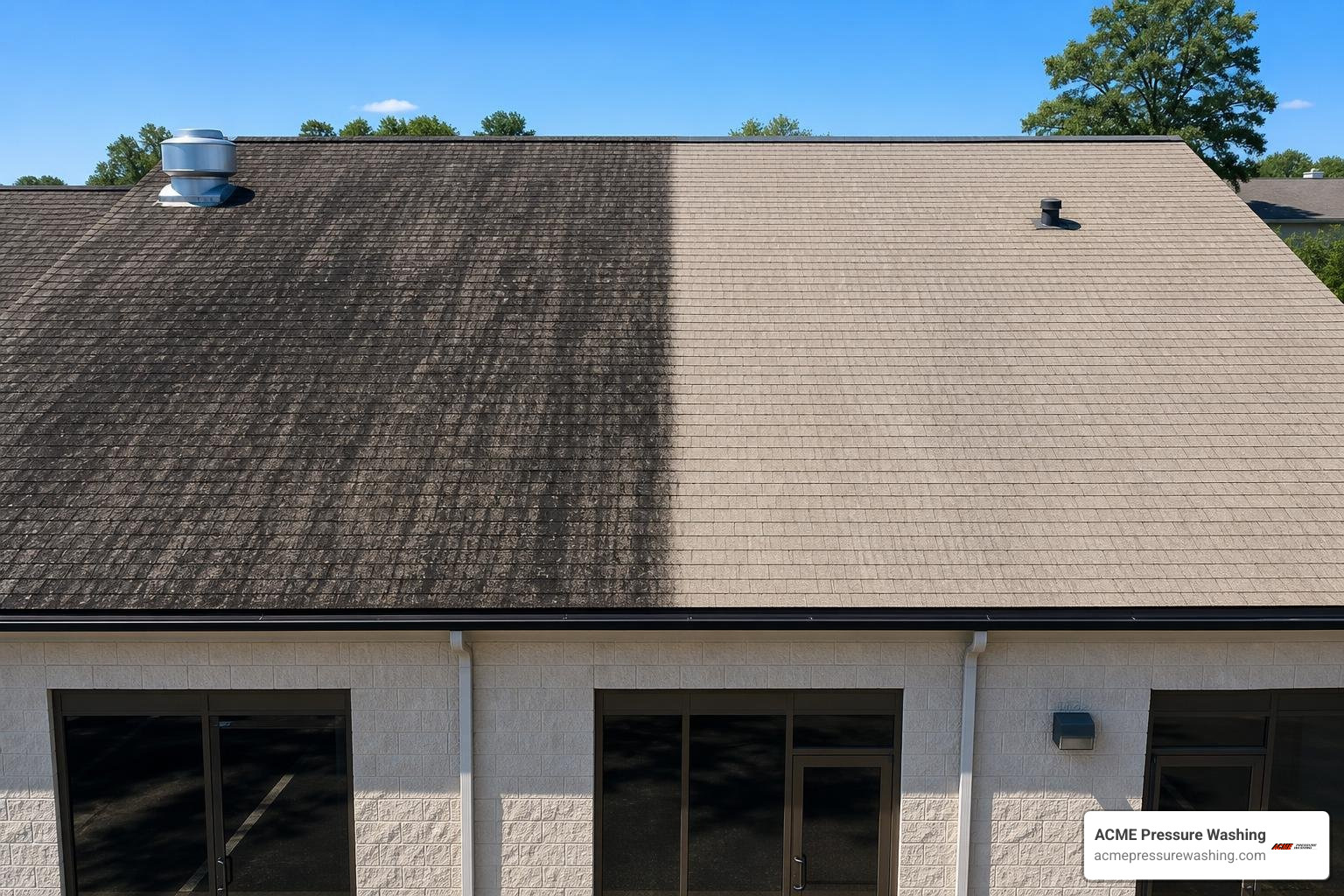
When a roof is covered in black streaks, its solar reflectivity drops dramatically. The dark pigment absorbs heat from the sun, raising attic temperatures by 10 to 20 degrees Fahrenheit. This additional thermal load forces your air conditioning system to work much harder, driving up your energy bills during the hot summer months in New Hampshire.
Furthermore, a stained roof severely hurts your home’s curb appeal. Real estate industry assessments estimate that a roof covered in dark streaks can lower a property’s perceived value by 5% to 10% during a home inspection or appraisal.
Professional vs. DIY Algae Stained Roof Cleaning Costs
While some homeowners consider tackling algae stained roof cleaning as a DIY project, working on a steep, wet roof coated in slippery cleaning chemicals is incredibly hazardous. One misstep can lead to severe injury or permanent roof damage.
When looking at the cost of hiring a professional, it helps to understand the market landscape.
- Pricing Disclaimer: All prices mentioned below are average costs sourced from publicly available internet data and are not the actual prices of ACME Pressure Washing.
Based on industry averages and online data, professional soft-wash roof cleaning generally ranges from $600 to $3,000. The low end of this range typically covers smaller, single-story ranch homes with a gentle pitch, while the high end represents larger, multi-story historical homes or commercial properties with steep, complex rooflines that require specialized safety rigging and equipment.
By comparison, attempting to DIY might save a few dollars upfront, but the risk of a fall or ruining your shingles makes professional cleaning the far more logical choice. To learn how to select a reputable contractor, read How to Hire a Local Roof Algae Cleaning Service Without Getting Ripped Off and explore options in How to Find the Best Moss Removal from Roof Companies Without Getting Scalped.
How Regular Maintenance Protects Your Roof Warranty and Home Value
Failing to clean your roof does more than hurt your home’s appearance — it can actually void your manufacturer’s warranty. Shingle manufacturers require homeowners to perform basic maintenance to keep their warranties active. If a manufacturer determines that roof failure was caused by neglected biological growth (like algae feeding on the limestone or moss roots lifting shingles), they may deny your warranty claim entirely.
By investing in a professional soft wash every 2 to 4 years, you ensure full warranty compliance and keep your home ready for any future real estate transactions. For a detailed breakdown of how black streaks affect home sales, read Roof Algae & Black Streaks: Causes & Cleaning Guide (2026).
Frequently Asked Questions About Roof Algae
Is roof algae harmful or just cosmetic?
While it starts as a cosmetic nuisance, roof algae is definitely harmful over time. Gloeocapsa magma feeds on the limestone filler in your shingles, causing them to lose their protective granules. This leads to premature aging, warping, and curling. Furthermore, the cyanobacteria create a damp biofilm on your roof surface, which acts as a precursor, making it much easier for highly destructive moss and lichen to take hold. For more details on the progression from algae to moss, see our guide on How to Clean Roof Moss the Right Way.
Will professional roof cleaning void my shingle warranty?
No, as long as it is done correctly. High-pressure power washing will void your warranty because it strips the protective granules from the shingles. However, professional soft washing using ARMA-approved chemical solutions and low pressure (under 150 PSI) is the exact cleaning method recommended by shingle manufacturers. It preserves your shingles and maintains your warranty coverage. To learn more about safe cleaning practices, read our article on 10 Common Questions About Roof Cleaning Service Answered.
Does algae grow on tile roofs or just asphalt shingles?
Algae grows on almost all roofing materials, including concrete tiles, clay tiles, slate, metal, and cedar shakes. While the cyanobacteria do not “eat” tile or metal like they eat the limestone filler in asphalt shingles, they still create an unsightly dark biofilm that traps moisture. On clay and concrete tiles, this trapped moisture can lead to micro-fracturing during winter freeze-thaw cycles. On cedar shakes, it can accelerate wood rot. To learn how we safely treat different roofing materials, explore our guide on Metal Roof Cleaning: The Ultimate Guide to Solutions and Soft Washing.
Keep Your Roof Safe and Clean with the Professionals
Your roof is one of the most expensive and important components of your home. When Gloeocapsa magma begins to take over, don’t risk your safety on a ladder or ruin your shingles with a high-pressure power washer.
At ACME Pressure Washing, we bring over 38 years of local experience to every job. Based in Merrimack, NH, we use customized, safe, and eco-friendly soft-wash techniques designed specifically for New Hampshire’s unique climate. We proudly serve homeowners and businesses across the region, including Amherst, Auburn, Bedford, Brookline, Derry, Goffstown, Hollis, Londonderry, Manchester, Merrimack, Milford, Mont Vernon, Nashua, New Boston, Wilton, and Windham.
Beyond roofs, we specialize in high-quality exterior cleaning services to keep your entire property looking pristine. Whether you need professional house washing, commercial pressure washing to protect your business assets, or specialized fleet pressure washing to keep your commercial vehicles in top shape, our experienced teams are ready to help.
Ready to restore your home’s curb appeal and extend the lifespan of your shingles? Contact the experts at ACME Pressure Washing today.
- Call Us Today: +1603-883-6900
- Get a Free Estimate: Request a Quote Online
- Learn More: Our Professional Roof Cleaning Services